The DfE’s decision to refine the manual stems from a rigorous evaluation of how internal and external teams interact with accessibility guidelines. While initial feedback following the 2024 launch was largely positive, internal metrics and user behavior data suggested that certain sections of the resource were underutilized or difficult to navigate. By engaging directly with professionals in design and product roles, the DfE identified key friction points, leading to a total reorganization of the manual’s content, a simplification of its user interface, and a more human-centric approach to its technical guidance.
The Evolution of UK Digital Accessibility Standards
To understand the significance of the DfE’s manual update, it is essential to consider the broader legal and regulatory landscape of the United Kingdom. Since the introduction of the Public Sector Bodies (Websites and Mobile Applications) (No. 2) Accessibility Regulations 2018, all public sector digital services have been legally required to meet the Web Content Accessibility Guidelines (WCAG) 2.1 AA standards. More recently, the transition toward WCAG 2.2 has placed additional pressure on government departments to ensure their digital estates are not only compliant but also intuitive for users with cognitive, motor, or sensory impairments.
The Department for Education manages a vast and complex digital ecosystem, ranging from teacher recruitment platforms to student finance interfaces and internal administrative tools. Given the diversity of the DfE’s audience—which includes students, parents, educators, and civil servants—the department’s approach to inclusive design must be exceptionally robust. The 2025 manual update reflects a shift from "compliance-driven" design to "user-driven" inclusivity, ensuring that accessibility is integrated into the earliest stages of the product development lifecycle rather than being treated as a final audit requirement.
Strategic Reorganization and the Removal of the Knowledge Hub
One of the most substantial changes in the updated manual is the complete removal of the ‘Knowledge Hub’ section. During the research phase, users reported that while the content within the hub was informative, the section itself felt like a "dumping ground" for miscellaneous information. This lack of clear categorization created a high cognitive load, making it difficult for busy delivery teams to find specific answers to urgent design queries.
In response, the DfE digital team disassembled the Knowledge Hub and redistributed its contents into sections that mirror the actual user journey of a project team. Instead of grouping information by "type" (such as articles or case studies), the information is now organized by "task" or "need." For example, guidance on specific components is now located where a designer would naturally look while building a prototype, rather than being sequestered in a separate academic folder. This move toward a task-based information architecture is intended to reduce the time spent searching for information and increase the likelihood of accessibility standards being applied correctly in real-time.
From Technical Specs to People-Centric Tools
The updated manual also features a complete reimagining of the ‘Tools’ guidance. In previous iterations, this section functioned primarily as a technical directory—a list of software and browser extensions with instructions on how to install them. However, user research indicated that knowing how to install a tool was less important than knowing when and why to use it.
The new guidance shifts the focus toward the human impact of these tools. Rather than simply listing a screen reader or a contrast checker, the manual now explains the specific user needs these tools help to validate. It provides context on which tools are best suited for different stages of the development process—such as automated testing during the build phase versus manual testing during the design phase. By framing tools in the context of people’s needs, the DfE aims to foster a deeper understanding of the barriers that users face, rather than treating accessibility as a checklist of software outputs.
Streamlining the User Interface: The Homepage Redesign
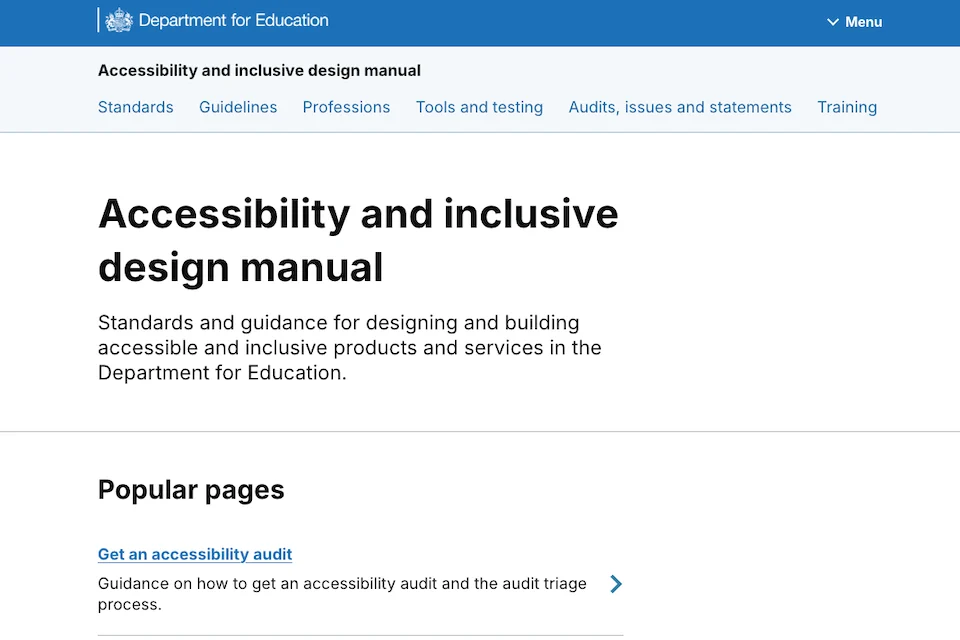
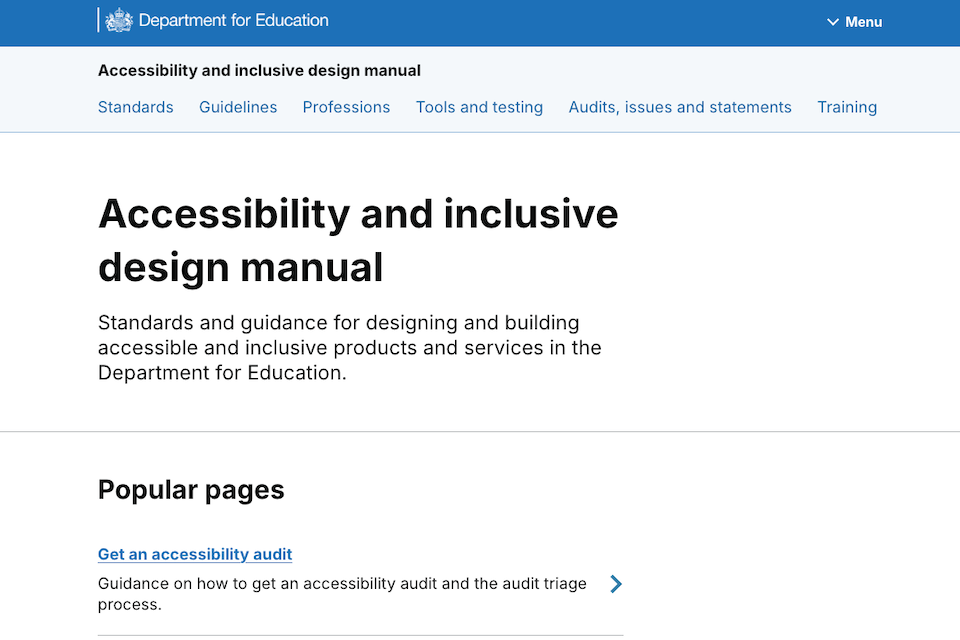
The visual and structural interface of the manual itself underwent a significant transformation. The original homepage was characterized by a high volume of icons, images, and a long-scroll format that many users found overwhelming. In the fast-paced environment of digital delivery, "busy" interfaces can hinder productivity and lead to information fatigue.
The DfE simplified the homepage by:
- Reducing visual clutter and removing non-essential imagery.
- Implementing a clearer, more intuitive top navigation bar.
- Prioritizing high-traffic sections to ensure that the most sought-after information is accessible with minimal clicks.
- Optimizing the layout for better readability and faster load times, adhering to the very principles of inclusive design that the manual advocates.
Chronology of the Manual’s Development
The journey toward the 2025 update followed a structured timeline of research, development, and deployment:
- September 2024: The initial DfE Accessibility and Inclusive Design Manual is launched to provide a unified standard for the department’s digital output.
- Late 2024 – Early 2025: The DfE Digital team initiates a "Deep Dive" research phase. This involves qualitative interviews with designers, product managers, and delivery leads, as well as quantitative analysis of site usage data.
- Spring 2025: Development begins on the new structure. Content designers work to break down the ‘Knowledge Hub’ and rewrite technical guidance to be more user-centric.
- June 2025: Beta testing of the new interface is conducted with internal DfE teams to ensure the new navigation logic holds up under real-world conditions.
- July 21, 2025: The updated manual is officially moved to the live environment, replacing the 2024 version.
- September 2025: The DfE publishes a formal retrospective on the improvements, signaling a commitment to continuous iteration.
Data-Driven Improvements and User Feedback
The DfE’s decision-making process was heavily influenced by user feedback. In the research sessions, three main themes emerged that dictated the direction of the 2025 update:
- Navigation Efficiency: Users expressed a preference for "shallow" navigation structures where information is no more than two or three clicks away. The previous "Knowledge Hub" added unnecessary layers of depth.
- Contextual Application: Delivery roles, such as Product Managers, requested more information on the "business value" and "user impact" of accessibility, rather than just technical implementation.
- Visual Clarity: Data showed that users frequently skipped over icon-heavy sections, preferring clear text-based headings that allowed for quick scanning.
By addressing these specific pain points, the DfE has reported an increase in engagement with the manual’s core guidance. Preliminary data following the July relaunch suggests a reduction in "bounce rates" on the homepage and an increase in the time spent on specific "how-to" pages, indicating that users are finding the content they need more effectively.
Broader Implications for Government and the Tech Industry
While the manual was created specifically for DfE teams, its influence extends far beyond the department. The DfE has maintained the manual as an open-source resource, accessible to anyone designing or building digital services. This transparency is a hallmark of the UK Government Digital Service (GDS) philosophy: "Make things open; it makes them better."
For the wider tech industry, the DfE’s manual serves as a blueprint for how large organizations can manage "content debt" and evolve their internal standards. In many corporate environments, accessibility documentation becomes stagnant and out-of-date. The DfE’s proactive approach to researching its own documentation and being willing to dismantle sections that weren’t working (like the Knowledge Hub) sets a high bar for organizational agility.
Furthermore, the emphasis on "Inclusive Design" over mere "Accessibility" marks a sophisticated evolution in digital thinking. While accessibility often focuses on the technical ability of a user to access content, inclusive design considers the full range of human diversity—including ability, language, culture, gender, age, and other forms of human difference. By integrating these concepts into a single manual, the DfE is helping to shape a generation of civil servants and contractors who view inclusivity as a fundamental aspect of quality, rather than a secondary feature.
As the Department for Education continues to iterate on its digital services, the Accessibility and Inclusive Design Manual will remain a living document. The July 2025 update is not the end of the project, but rather a new baseline for a department that recognizes that in the digital age, education and information must be accessible to everyone, without exception.