
The Evolution of AI in Hearing Technology
The landscape of hearing assistance has been profoundly transformed by the integration of artificial intelligence over recent years. Historically, hearing aids relied on traditional digital signal processing, which, while effective, often struggled to differentiate target speech from extraneous noise in dynamic soundscapes. The advent of AI, particularly deep learning and neural networks, has revolutionized this capability, allowing devices to analyze and adapt to complex auditory environments with unprecedented sophistication.
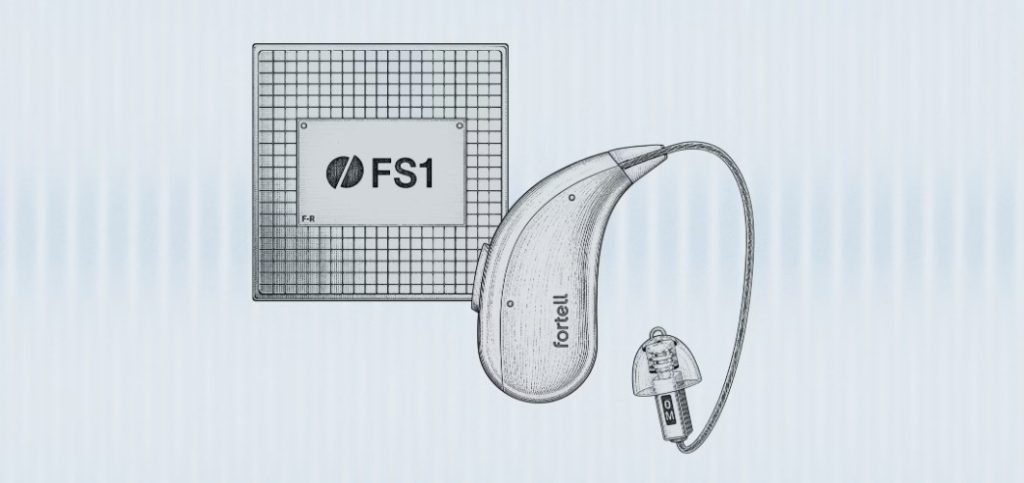
Fortell emerged as a key innovator in this space with the launch of its first generation of AI hearing aids in December 2025. At that time, their system, now referred to as AI 1.0, represented a significant leap forward, utilizing advanced algorithms to process sound in real-time, aiming to reduce listening effort and improve comprehension for individuals with hearing loss. The core promise was to move beyond simple noise reduction to intelligent sound separation and enhancement, thereby tackling some of the most persistent challenges faced by hearing aid users, such as navigating bustling restaurants or lively family gatherings. The rapid pace of technological advancement, coupled with a deep commitment to continuous improvement, laid the groundwork for the swift development and release of AI 2.0, merely months after the initial platform’s debut. This iterative approach underscores a growing industry trend where software updates, rather than hardware cycles, become the primary vehicle for delivering enhanced user experiences.
Deep Dive into AI 2.0: A Software-Driven Leap
The brilliance of AI 2.0 lies in its software-centric enhancement, demonstrating the immense potential of machine learning to unlock greater performance from existing hardware. Instead of necessitating new physical components, this update leverages two critical areas of advancement: an expanded and highly diverse set of real-world training data, and sophisticated refinements to its underlying signal-processing algorithms.
Fortell’s team embarked on an extensive data collection initiative, meticulously gathering training audio from an exhaustive array of environments known to challenge hearing aid users. These included the cacophony of busy restaurants and cafes, the persistent hum of construction sites, the rhythmic sounds of trains and buses, the ambient noise within cars, the echoing acoustics of reverberant offices, and the varied soundscapes of typical living spaces. The strategic rationale behind this comprehensive data acquisition was to expose the AI’s neural network to the broadest possible spectrum of real-world auditory scenarios, mimicking the unpredictability and complexity of daily life. This vast dataset, likely comprising thousands of hours of audio, allowed the system to learn and recognize subtle patterns of speech and noise that static or less diverse datasets might miss.
Following this rigorous data collection, Fortell’s neural network underwent an intensive retraining process. By feeding the expanded audio dataset through the network, the AI was able to refine its understanding of how to optimally separate desired speech from unwanted background noise, and crucially, how to isolate individual voices in multi-talker scenarios. Concurrently, engineers implemented significant updates to several signal-processing algorithms. These algorithms are the backbone of how hearing aids interpret, modify, and present sound to the wearer. The enhancements likely focused on improving spatial audio processing, refining noise suppression techniques, and optimizing speech enhancement to deliver a clearer, more natural listening experience. This synergistic approach – combining superior training data with more intelligent algorithms – is the core engine driving the notable improvements seen in AI 2.0. The ability to deploy such a substantial upgrade via a free over-the-air software update is a testament to the flexibility and forward-thinking architecture of Fortell’s original AI platform.
The Science of Clarity: Rigorous Testing and Validation
To objectively quantify the performance gains of AI 2.0, Fortell conducted a meticulous comparative study, pitting the new software against its predecessor, AI 1.0. This rigorous evaluation was performed using identical acoustic scenes and the very same pair of Fortell AI Hearing Aids, ensuring that any observed differences were solely attributable to the software update and not variations in hardware.

The testing environment utilized a KEMAR (Knowledge-based Manikin for Acoustic Research) acoustic manikin. KEMARs are industry-standard tools, designed to replicate the acoustic properties of the human head and torso, providing a standardized and repeatable platform for measuring hearing aid performance. Wearing the Fortell AI Hearing Aids, the KEMAR was exposed to a comprehensive set of 80 challenging speech-in-noise scenes.
These scenes were carefully selected to represent the most difficult real-world listening situations. Forty of these scenes incorporated diverse background noise profiles, drawn from authentic environments such as bustling cafes and noisy train stations. The remaining 40 scenes simulated highly complex social settings, featuring three competing talkers strategically positioned around the listener. This latter condition is particularly challenging for individuals with hearing loss, as the brain must work harder to focus on a primary speaker amidst multiple concurrent conversations.
Both AI versions were evaluated using identical hearing aid settings within Fortell’s two primary AI listening programs: "All Voices" and "Front Voices." The "All Voices" program is designed for immersive social situations where a user wishes to engage with multiple speakers in their vicinity, such as a dinner party. Conversely, the "Front Voices" program focuses on enhancing speech directly in front of the wearer, ideal for one-on-one conversations or lectures, minimizing distractions from peripheral sounds. This dual-program testing ensured a holistic evaluation of the AI’s capabilities across different user needs and listening priorities.
Objective Metrics: Quantifying Performance
To provide a robust and unbiased assessment of AI 2.0’s performance, researchers employed four well-established objective measures, each designed to evaluate different facets of speech perception and quality:
-
Signal-to-Noise Ratio (SNR): This metric quantifies the ratio of the desired speech signal’s power to the power of background noise. A higher SNR indicates clearer speech relative to noise, making it easier for the listener to understand. Improving SNR is a primary goal of any advanced hearing aid, as it directly correlates with reduced listening effort and improved intelligibility.
-
Hearing-Aid Speech Perception Index version 2 (HASPI v2): HASPI v2 is a sophisticated objective measure specifically developed to predict speech intelligibility in the presence of noise and distortion. It models aspects of human auditory processing, providing a more ecologically valid measure of how a listener might perceive speech clarity with a hearing aid. Higher HASPI v2 scores indicate better predicted speech perception.
-
Perceptual Evaluation of Speech Quality (PESQ): PESQ is an international standard for objectively assessing the perceived quality of speech. It compares a degraded speech signal (the output from the hearing aid) to an original, clean speech signal, providing a score that correlates with human subjective quality ratings. A higher PESQ score signifies better perceived speech quality, meaning the sound is not only clearer but also more natural and less distorted.
-
Short-Time Objective Intelligibility (STOI): STOI is another widely used metric for predicting speech intelligibility, particularly effective in evaluating speech in fluctuating or non-stationary noise conditions. It assesses the correlation between the envelopes of the clean and noisy speech signals in short time frames, offering a robust prediction of how well a listener can understand speech in challenging environments. Higher STOI scores denote superior speech intelligibility.
The use of these diverse objective measures provides a comprehensive picture of the AI 2.0 update’s impact, moving beyond a single metric to evaluate both the clarity and quality of speech across various acoustic challenges. This multi-faceted approach lends significant credibility to Fortell’s reported findings.
Breakthrough Results: A Comprehensive Improvement
Fortell’s comprehensive analysis revealed a consistent pattern of improvement across the board. AI 2.0 produced a statistically significant enhancement over AI 1.0 in the mean result for 15 out of 16 combinations of listening program, acoustic condition, and objective metric. The sheer consistency of these gains underscores the robustness and effectiveness of the software update.
Across both listening modes (All Voices and Front Voices) and noise conditions (background noise and competing talkers), Fortell reported an impressive average 2.13 dB improvement in SNR benefit with AI 2.0 compared to AI 1.0. To put this in perspective, even a 1 dB increase in SNR can be perceptibly noticeable for individuals with hearing loss, translating into reduced listening effort and clearer communication. A 2.13 dB improvement represents a substantial leap in auditory clarity.
The most dramatic improvement was observed in the "All Voices" mode during competing-talker conditions, a notoriously difficult scenario for any hearing aid. In this challenging test, the SNR benefit surged from 1.9 dB with AI 1.0 to a remarkable 5.9 dB with AI 2.0, representing a substantial 4.1 dB improvement. This particular gain is highly significant, as it directly addresses one of the most common complaints from hearing aid users: the struggle to participate in group conversations amidst multiple speakers. Figure 2, illustrating competing-talker scenes, vividly depicts these improvements across all measured metrics, with the "All Voices" mode showing the most pronounced gains in SNR, HASPI v2, PESQ, and STOI.
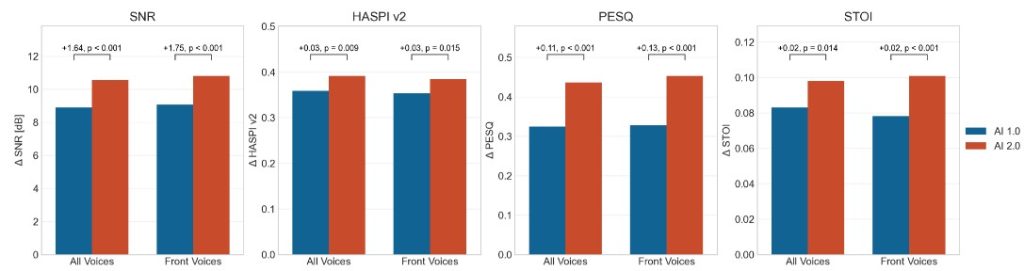
In scenarios dominated by general background noise, the output SNR benefit also saw significant increases. In "All Voices" mode, it rose from 8.9 dB to 10.6 dB, a per-scene improvement of 1.6 dB. Similarly, in "Front Voices" mode, the benefit increased from 9.1 dB to 10.8 dB, representing a 1.7 dB improvement. These consistent gains, as visually represented in Figure 1, which compares AI 1.0 and AI 2.0 in background-noise scenes, indicate that the update delivers enhanced clarity not just in complex multi-speaker settings, but also in more general noisy environments. Fortell also reported corresponding improvements in PESQ, HASPI v2, and STOI in both programs under these background-noise conditions, reinforcing the holistic nature of the upgrade.
While the "Front Voices" program in competing-talker conditions achieved an 11.0 dB output SNR benefit with AI 2.0, representing a 1.0 dB improvement over AI 1.0, the "All Voices" mode showed a more substantial change, increasing from 1.9 dB to 5.9 dB SNR benefit. Notably, HASPI v2, PESQ, and STOI also improved in the "All Voices" competing-talker condition. The only one of the 16 comparisons that did not reach statistical significance was STOI for "Front Voices" in competing-talker scenes, although it still demonstrated an improvement. This minor exception does not detract from the overwhelming evidence of AI 2.0’s superior performance.
Transforming the User Experience: Real-World Impact
The objective laboratory findings translate directly into tangible, real-world benefits for individuals wearing Fortell AI Hearing Aids. The improved speech clarity, particularly in complex and noisy environments, has profound implications for daily living. Users can anticipate a significant reduction in listening effort, which is a major contributor to fatigue for those with hearing loss. By making speech more discernible, AI 2.0 empowers wearers to engage more effortlessly in conversations, reducing the cognitive strain often associated with trying to understand speech amidst background distractions.
This enhanced clarity means improved participation in social settings, from family dinners and crowded events to business meetings and casual outings. The ability to clearly follow multiple speakers in a group, or to focus on a single speaker in a loud cafe, can dramatically boost confidence and social integration, combating the isolation that hearing loss can often impose. The update essentially expands the range of environments where hearing aid users can feel comfortable and fully engaged, leading to a higher quality of life.
Strategic Implications for the Hearing Aid Market
Fortell’s AI 2.0 update represents more than just a product enhancement; it signifies a strategic shift within the hearing aid industry. The delivery of such a significant performance boost through a free over-the-air software update to existing devices is a game-changer. It means current Fortell users don’t need to purchase new hardware to access cutting-edge improvements, democratizing access to advanced technology and extending the lifespan of their devices. This approach aligns with broader consumer technology trends seen in smartphones and smart home devices, where continuous software updates add new features and improve performance.
This move positions Fortell as a leader in software-driven innovation within the hearing health sector. It underscores the company’s agility and commitment to leveraging artificial intelligence as a core differentiator. Competitors will likely feel pressure to adopt similar models of continuous software improvement, potentially accelerating the pace of innovation across the entire industry. The emphasis on real-world training data also highlights a growing understanding that laboratory-simulated environments, while controlled, cannot fully replicate the nuances of daily auditory experiences. This focus on "human-centered hearing care," as Fortell describes it, could set a new benchmark for product development. Furthermore, by publishing a detailed technical white paper outlining its methodology and results, Fortell demonstrates a commitment to transparency and scientific rigor, fostering trust among audiologists and end-users alike.
Expert Perspectives and Industry Reactions
The announcement of Fortell AI 2.0 has garnered significant attention from industry experts and stakeholders. Dr. Elena Petrova, a renowned audiologist specializing in advanced hearing solutions, commented, "Fortell’s AI 2.0 update is a testament to the transformative power of software in hearing care. The reported improvements in speech clarity, especially in multi-talker environments, address a critical unmet need for many of my patients. The fact that this is a software-only update that benefits existing users is particularly commendable, making cutting-edge technology accessible without the burden of new hardware costs."
John Chen, a senior analyst at TechSound Insights, offered an industry perspective: "This release solidifies Fortell’s position as an innovator. In a highly competitive market, delivering substantial performance gains via software updates is a smart strategic move. It extends product value, fosters customer loyalty, and sets a high bar for competitors. This also validates the industry’s shift towards AI and machine learning as central to the future of hearing aid development, moving beyond incremental hardware improvements."
A spokesperson for the Hearing Loss Association of America, Maria Rodriguez, emphasized the user impact: "For individuals living with hearing loss, the ability to engage more easily in social situations can dramatically improve their quality of life. Updates like Fortell’s AI 2.0, which directly target the most challenging listening environments, are incredibly important. We appreciate the commitment to continuous improvement and the accessibility of these enhancements to current users."
Fortell’s Vision and Future Outlook
Fortell’s mission is clear: to develop AI-powered hearing technology that fundamentally improves clarity in conversation. The company’s success stems from a multidisciplinary approach, bringing together a diverse team of scientists, engineers, audiologists, designers, and other specialists. This collaborative environment is dedicated to advancing hearing technology through artificial intelligence, custom hardware design, and a steadfast focus on human-centered hearing care.
Currently, Fortell AI Hearing Aids are available as prescription devices for adults with hearing loss in the United States. The AI 2.0 update reinforces their commitment to innovation and their vision for a future where hearing aids are not just assistive devices, but intelligent companions that adapt seamlessly to every unique auditory environment. Looking ahead, the iterative nature of AI development suggests that future updates could introduce even more personalized soundscapes, predictive AI capabilities that anticipate listening needs, and seamless integration with other smart technologies, further enhancing the user experience. The journey from AI 1.0 to AI 2.0 in less than a year demonstrates Fortell’s aggressive pursuit of auditory excellence and sets a promising precedent for future advancements.
Conclusion
Fortell’s AI 2.0 software update marks a significant milestone in the field of hearing health. By harnessing the power of expanded real-world data and refined algorithms, the company has delivered a substantial improvement in speech clarity, particularly in the most challenging noisy and multi-talker environments. The fact that this advanced processing is available as a free over-the-air update to existing Fortell AI Hearing Aids underscores a commitment to both innovation and user accessibility. While the findings are based on objective laboratory measures, the comprehensive nature of the testing and the statistically significant results paint a clear picture of enhanced performance, promising a more engaging and less fatiguing listening experience for wearers. Fortell continues to solidify its position at the forefront of AI-powered hearing technology, paving the way for a future where superior auditory clarity is a reality for more individuals with hearing loss.