The Evolving Paradigm of Hearing Healthcare
For decades, hearing healthcare largely operated on a model where clinicians diagnosed conditions and prescribed solutions, with patient adherence often seen as a secondary, rather than integrated, concern. However, with an aging global population and the increasing recognition of hearing loss as a significant public health challenge impacting communication, cognitive function, and social well-being, the imperative for more effective, sustainable solutions has grown. The World Health Organization (WHO) estimates that over 1.5 billion people globally experience some degree of hearing loss, with 430 million requiring rehabilitation. This vast demographic underscores the urgency for approaches that not only address the physiological aspects of hearing loss but also empower individuals to actively manage their condition within the context of their daily lives.
The shift towards patient-centered care began gaining traction in the late 20th century, emphasizing respect for patient preferences, coordination of care, and emotional support. However, applying this broad principle effectively in specialized fields like audiology required more concrete frameworks. The early 2020s saw a surge in research dedicated to defining and measuring specific patient-related factors influencing treatment success, including motivation, self-efficacy, and, critically, empowerment. This intellectual movement culminated in recent studies that not only define patient empowerment within audiology but also provide tangible tools for its assessment and cultivation. Dr. Brian Taylor, a respected voice in the field and editor of Audiology Practices, regularly explores these timely reflections on research, technology, and clinical practice in his monthly "Ear to the Ground" column, highlighting emergent trends like this focus on patient empowerment.
Empowerment: More Than Just "Liking" Hearing Aids
Patient empowerment in hearing care goes far beyond simply a patient’s satisfaction with their devices or their ability to overcome every listening challenge. Instead, it encapsulates the acquisition of knowledge, confidence, and sustained support necessary to effectively manage hearing difficulties. This holistic view recognizes that successful outcomes are not solely dependent on technological advancements but profoundly shaped by the individual’s active engagement and sense of agency in their own care journey.
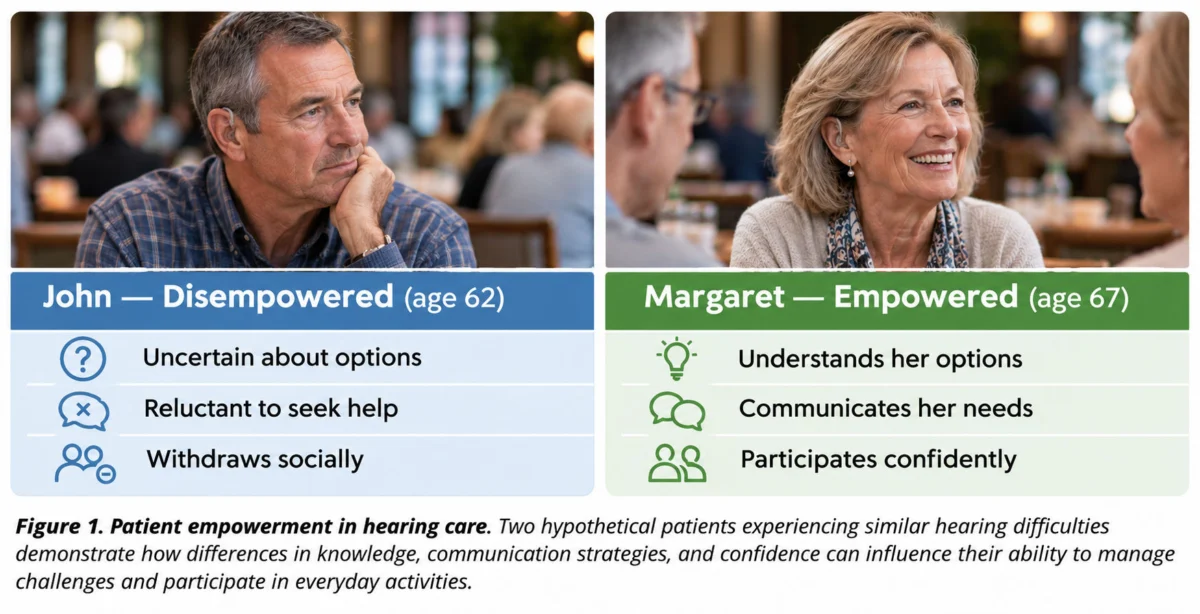
Consider two hypothetical patients, John and Margaret, facing similar struggles with hearing loss in noisy environments like restaurants. John, at 62, expects his hearing aids to be a complete fix. When they don’t eliminate all difficulties, he experiences frustration and embarrassment, internalizing these challenges and rarely communicating them to his audiologist. His devices eventually end up in a drawer, leading to social withdrawal – a classic example of a disempowered patient. In contrast, 67-year-old Margaret, while experiencing similar challenges, approaches her situation with a different mindset. She understands that hearing aids enhance, but don’t perfectly restore, hearing. She actively engages with her audiologist, exploring settings and communication strategies, and proactively learns to ask friends to face her when speaking. Her confidence in managing her condition allows her to participate more fully in social activities, demonstrating the hallmarks of an empowered patient.
The stark difference lies in their sense of agency. Margaret feels informed, involved, and capable of taking action, while John struggles with a perceived lack of control. Traditionally, clinicians might have viewed empowerment as an inherent trait a patient either possesses or lacks, limiting perceived opportunities for intervention. However, emerging research emphatically refutes this passive stance, demonstrating that clinicians can, and indeed should, play an active role in fostering a patient’s level of empowerment. Intentional efforts in this area are increasingly recognized as crucial for improving treatment acceptance, adherence, and ultimately, long-term outcomes.
The Five Intertwined Components of Empowerment
A groundbreaking framework developed by Gotowiec, et al. (2022) identifies five core components that constitute empowerment for adults experiencing hearing loss. For clinicians, understanding these elements is crucial for designing targeted interventions that go beyond generic advice. These dimensions are not discrete stages but rather operate dynamically throughout the entire hearing health journey, from initial recognition of difficulties to long-term management.
-
Knowledge: This involves a comprehensive understanding of one’s specific hearing loss, the results of diagnostic assessments, the benefits and limitations of various hearing solutions, and available management options. An empowered patient, for example, can articulate why speech understanding is particularly challenging in a noisy restaurant, even if they can hear quiet sounds, demonstrating an grasp of the auditory processing complexities involved.
-
Skills and Strategies: This component encompasses the practical abilities needed to manage hearing aids (e.g., insertion, removal, maintenance), troubleshoot common issues, utilize assistive listening technologies, and employ effective communication strategies. An example includes knowing how to politely ask a conversation partner to rephrase a sentence rather than simply requesting them to speak louder, indicating an active problem-solving approach.
-
Participation: Empowered patients actively engage in discussions and decisions regarding their treatment, rehabilitation goals, and communication needs. They have a meaningful voice in shaping their care plan. This could involve clearly communicating to their clinician that understanding colleagues in professional meetings is a higher priority than hearing every environmental sound equally well, thereby guiding the customization of their devices and strategies.

-
Self-efficacy: Often described simply as confidence, self-efficacy is the belief in one’s ability to successfully perform actions to address hearing difficulties, even when faced with challenging situations. A patient exhibiting high self-efficacy might feel confident enough to request communication accommodations at work or during family gatherings, rather than avoiding these situations.
-
Control: This refers to an overarching sense of agency—the feeling of being able to influence one’s hearing healthcare journey, effectively use hearing solutions, and make autonomous choices about participation in daily life. An example would be a patient independently deciding when and where to use their hearing aids or additional listening devices, and knowing precisely when and how to seek further help as their needs evolve.
Empowerment: A Noun and a Verb
A profound insight from recent research underscores that empowerment is both a state (a noun) and an active process (a verb). When viewed as a noun, empowerment describes a person’s condition or experience at a specific moment in time—their current level of confidence, knowledge, and ability to manage their hearing loss. For instance, an empowered person might walk into a clinic already possessing the confidence to ask direct questions about their treatment options.
However, understanding empowerment as a verb emphasizes its dynamic, ongoing nature. It is not a fixed trait but something that develops as individuals gain knowledge, practice skills, make decisions, participate in their care, and learn to navigate challenges. Supportive interactions with audiologists are crucial in this developmental process. For example, a patient becomes empowered by learning how to adjust their hearing aid settings for different environments, practicing effective communication strategies in real-life scenarios, or actively contributing to the formulation of their personalized care plan. This distinction is vital for clinicians, shifting the focus from merely assessing a patient’s current "power" to actively providing opportunities and support that enable them to become more empowered over time.
Operationalizing Empowerment: Insights from NICE Guidelines
International clinical guidelines are increasingly integrating the principles of patient empowerment into best practices. The UK’s National Institute for Health and Care Excellence (NICE) Guideline for "Hearing loss in Adults: Assessment and Management" (2023) provides an excellent framework for how empowerment fits into holistic care. This guideline recommends a five-stage approach, each inherently designed to foster patient agency:
- Explore the person’s experience: By asking about challenging situations, coping mechanisms, and motivations, the clinician ensures the patient feels heard and their individual needs are recognized, fostering initial participation and trust.
- Build understanding: Explaining assessment results, the impact of hearing loss, and the benefits/limitations of solutions (often with written materials) directly builds the patient’s knowledge base for informed decision-making.
- Make decisions together: Discussing suitable options, inviting questions, and agreeing on meaningful goals directly supports patient participation, choice, and a sense of control over their treatment path.
- Develop practical skills: Hands-on practice with devices, troubleshooting, and communication strategies cultivates competence and bolsters self-efficacy, ensuring the patient can manage their care independently.
- Review and adapt: Regular follow-ups that address patient goals, feedback, and evolving needs ensure sustained agency and support ongoing self-management, making empowerment a continuous process.
Leading audiology professional bodies, such as the American Academy of Audiology and the British Academy of Audiology, have increasingly endorsed these patient-centered approaches, recognizing their potential to elevate the standard of care. Statements from these organizations often highlight the ethical imperative and clinical effectiveness of empowering patients, positioning it as a cornerstone of modern audiological practice.
Measuring the Immeasurable: The EmpAQ Tools
Until recently, quantifying patient empowerment in audiology was challenging. However, innovative research has led to the development and validation of specific tools designed for this purpose. The Empowerment in Audiology Questionnaire (EmpAQ-15) and its shorter, clinically practical version, the EmpAQ-5, represent a significant leap forward.
A cross-sectional study by Ferguson et al. (2026), involving 693 adults with hearing loss, explored the correlates of empowerment using the EmpAQ-15. The findings revealed strong associations between empowerment scores and hearing aid use, social satisfaction, and various emotional and cognitive measures. Notably, hearing aid wearers demonstrated higher empowerment scores than non-wearers. While this cross-sectional design could not establish causality (i.e., whether empowerment leads to hearing aid use or vice-versa), it strongly indicated a symbiotic relationship between the two.
Further validation came from Bennett et al. (2026), who assessed the EmpAQ-15 and EmpAQ-5 in a cohort of 51 first-time hearing aid wearers. This longitudinal study showed that average empowerment scores significantly increased three months post-fitting and were maintained at six months. Although individual changes exceeding measurement error were observed in only about 22% of participants, this study provided crucial evidence that audiological interventions can indeed influence and improve patient empowerment over time.
These studies collectively underscore several key insights:
- Patient empowerment is a measurable outcome, not merely an abstract concept.
- It is dynamic, evolving throughout the patient’s journey.
- Empowerment is demonstrably linked to positive clinical outcomes, including hearing aid adoption and social engagement.
The EmpAQ-5: A Practical Tool for Clinical Integration

The EmpAQ-5, a five-item short form derived from the more extensive EmpAQ-15, offers audiologists a quick yet powerful instrument to assess and track patient empowerment in routine clinical settings. Each question directly corresponds to one of the five core dimensions of empowerment, allowing for a targeted understanding of a patient’s self-perception:
- Q1. (Knowledge) I know how to get help if I have any problems with my hearing:
- Strongly Disagree / Disagree / Neither Agree Nor Disagree / Agree / Strongly Agree
- Q2. (Skills & Strategies) I use tactics to help me communicate in challenging situations (e.g., move to a quieter location):
- Strongly Disagree / Disagree / Neither Agree Nor Disagree / Agree / Strongly Agree
- Q3. (Participation) My hearing loss doesn’t stop me from participating in social activities:
- Strongly Disagree / Disagree / Neither Agree Nor Disagree / Agree / Strongly Agree
- Q4. (Control) I can control how I respond to the challenges I experience resulting from my hearing loss:
- Strongly Disagree / Disagree / Neither Agree Nor Disagree / Agree / Strongly Agree
- Q5. (Confident) I am confident about my ability to manage problems caused by my hearing loss:
- Strongly Disagree / Disagree / Neither Agree Nor Disagree / Agree / Strongly Agree
Each response is assigned a point value (e.g., Strongly Disagree = 1, Strongly Agree = 5), and the total sum provides a rapid empowerment score. This score can then be converted into a percentile rank using a standardized chart, offering immediate insight into an individual’s empowerment profile.
Empowerment Profiles and Clinical Recommendations
The EmpAQ-5 percentile rank allows clinicians to categorize patients into three distinct empowerment profiles, each warranting tailored clinical approaches:
-
Highly Empowered Patient (High Rank: 75% – 100%): These patients possess strong self-efficacy, effective coping strategies, and high confidence in their participation. For them, the clinical focus should shift towards shared decision-making, exploring advanced wearer-controlled hearing aid technologies, and engaging in proactive self-management and other forms of rehabilitation. These individuals are often excellent candidates for complex solutions and independent management.
-
Developing Self-Management (Moderate Rank: 40% – 74%): Patients in this category understand their condition but may have specific gaps in execution strategies or struggle in particular challenging environments. Clinicians should use individual item responses to pinpoint areas needing support. For example, if a patient scores low on "Skills & Strategies" but high on "Knowledge," the intervention might focus on practical communication tactics or device troubleshooting rather than re-explaining basic audiology concepts.
-
Vulnerable / Low Self-Efficacy (Low Rank: 0% – 39%): These patients often report feelings of helplessness, poor participation, or significant perceived hearing handicap. They require high-support care, prioritizing intensive counseling, involving communication partners or family members, and scheduling structured, gradual follow-up appointments to build foundational operational skills and confidence. Remote care options (e.g., apps for basic troubleshooting) can also be highly beneficial in providing accessible support.
Tracking progress with the EmpAQ-5 is equally valuable. Clinical validation data (Bennett et al., 2026) indicates that a mean change score of approximately 10-11% at follow-up appointments signifies a true, meaningful shift in patient empowerment. This often corresponds to a patient improving their rating on two distinct items by one step each (e.g., moving from "Disagree" to "Agree" on two questions).
Beyond quantitative scores, the qualitative feedback from clinicians integrating the EmpAQ-5 into their practice has been overwhelmingly positive. A multi-site study (Ferguson et al., 2025) found that the EmpAQ-5 was feasible, appropriate, and acceptable in real-world audiology settings, acting as a catalyst for "empowerment-focused care." Clinicians reported that the tool facilitated deeper, more meaningful dialogues with patients, moving beyond superficial inquiries about satisfaction to truly understand and address underlying challenges.
Broader Implications and the Future of Hearing Healthcare
The integration of patient empowerment as a core tenet of audiological care carries far-reaching implications:
- For Patients: Empowerment translates to enhanced quality of life, greater adherence to treatment plans, reduced social isolation, and a stronger sense of personal control over their health. It transforms them from passive recipients of care into active partners.
- For Clinicians: This approach fosters more profound patient-clinician relationships, increases job satisfaction by enabling more impactful interventions, and potentially leads to more efficient use of clinical time as patients become more self-sufficient. It shifts the audiologist’s role from a sole provider to a facilitator and coach.
- For the Healthcare System: Empowered patients are more likely to achieve optimal outcomes, potentially reducing the need for repeated interventions or managing complications arising from non-adherence. This contributes to a more efficient allocation of resources and ultimately, better public health outcomes related to hearing loss.
- Future Directions: The success of tools like the EmpAQ-5 calls for further longitudinal research to solidify causal links, greater integration of empowerment-focused training into audiology curricula, and policy changes that support patient-centered funding models. Addressing potential barriers to implementation, such as time constraints in busy clinics and the need for ongoing professional development, will be crucial.
In conclusion, patient empowerment is not merely a fashionable buzzword but a measurable, actionable strategy essential for the future of hearing healthcare. By understanding its components, adopting validated assessment tools like the EmpAQ-5, and intentionally fostering agency in their patients, audiologists can move beyond simply treating hearing loss to truly empowering individuals to live full, connected lives. This paradigm shift promises not only better clinical outcomes but also a more fulfilling and sustainable model of care for all involved.