The research, spearheaded by OHSU, involved critical contributions from Linköping University in Sweden, the University of Michigan, and the University of Washington. Their collective work not only deepens the scientific community’s grasp of hearing but also opens new avenues for innovation in how sound information is delivered to the auditory system, potentially improving outcomes for millions globally.
Rethinking the Cochlea’s Established Frequency Map: A Historical Context
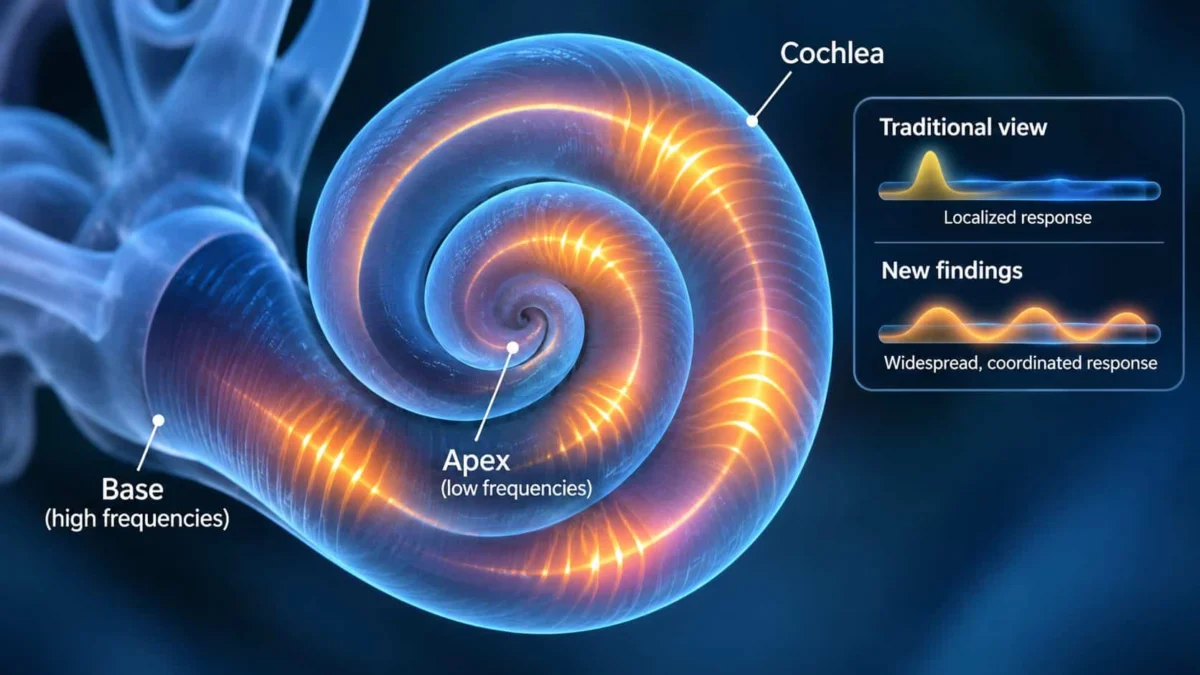
For well over half a century, the understanding of hearing has been anchored to the principle of tonotopic organization, often described as the cochlea’s frequency-to-place map. This foundational concept posits that different regions along the basilar membrane within the cochlea are selectively tuned to respond most strongly to specific sound frequencies. High-frequency sounds are understood to primarily stimulate regions near the base of the cochlea, the part closest to the middle ear, while lower frequencies elicit their greatest response closer to the apex, the innermost tip of the coiled structure.
This elegantly simple yet powerful model was meticulously established through the groundbreaking research of Nobel Prize-winning scientist Georg von Békésy. His pioneering work, for which he received the Nobel Prize in Physiology or Medicine in 1961, involved direct observations of the basilar membrane’s mechanics in cadaveric human and animal cochleae. Von Békésy introduced the concept of the "traveling wave," a mechanical vibration that propagates along the basilar membrane, peaking at a specific location determined by the frequency of the incoming sound. This peak amplitude at a particular "place" along the membrane was thought to be the primary mechanism by which the cochlea spatially encodes frequency information. His meticulous experiments and subsequent mathematical models provided the bedrock for modern hearing science, influencing everything from diagnostic audiology to the development of hearing aids and, crucially, cochlear implants.
The tonotopic map remains a central tenet in numerous fields, particularly in the design of cochlear implant technology. These sophisticated devices work by bypassing damaged hair cells in the cochlea and directly stimulating the auditory nerve. They achieve this by utilizing an array of electrodes strategically positioned along the cochlea, each intended to stimulate a specific region associated with a particular frequency range, thereby replicating the natural tonotopic organization. The success of cochlear implants in restoring significant speech understanding for individuals with severe to profound hearing loss is a testament to the validity and utility of von Békésy’s original insights.
However, the new research from OHSU and its collaborators suggests that while this place-based explanation undeniably holds true for many aspects of hearing, it may not fully encompass the intricate mechanisms by which the cochlea processes low-frequency sounds. This nuanced re-evaluation does not invalidate von Békésy’s monumental contributions but rather seeks to enrich and expand upon them, particularly in the complex domain of low-frequency sound encoding.
The Discovery: Unveiling Non-Canonical Processing in the Cochlea
Using highly sensitive and advanced imaging techniques, the research team conducted experiments on guinea pigs, a common and well-established animal model in auditory research due to the anatomical similarities of their cochlea to that of humans. What they observed during low-frequency acoustic stimulation was truly unexpected: vibrations were not confined to a single, predicted apical region but instead produced coordinated mechanical activity across widely separated regions of the cochlea. In some instances, these responses occurred almost simultaneously across these disparate locations, a finding that profoundly challenges the traditional spatially localized model for low-frequency processing.
This observation indicates that the mechanical activity involved in processing low-frequency sound may be far more spatially distributed and complex than traditional models, rooted in a strict place-based map, have suggested. It implies that the cochlea might employ additional, as-yet-unfully-understood mechanisms to represent and interpret low-frequency information, rather than relying solely on the peak vibration at a single point.
It is crucial to emphasize that these findings do not overturn the established frequency organization of the cochlea. The tonotopic map, with its gradient of high to low frequencies from base to apex, remains a fundamental characteristic of cochlear function. Instead, this new evidence indicates that, particularly at the lower end of the frequency spectrum, additional mechanisms may contribute significantly to how low-frequency information is encoded, represented, and ultimately interpreted by the auditory system. This represents a refinement and expansion of our understanding, adding layers of complexity to the existing framework.
Advanced Imaging Techniques: A Window into Cochlear Micro-Mechanics
To achieve these groundbreaking observations, the research team employed optical coherence tomography (OCT), a sophisticated imaging technology that has revolutionized various medical fields, most notably ophthalmology. OCT uses light waves to create high-resolution, cross-sectional images of biological tissues, allowing researchers to visualize structures and movements at a microscopic level.
The power of OCT in hearing research lies in its ability to examine extremely small, minute movements within biological tissues without any physical contact with the delicate structures being measured. The cochlea, being encased within the densest bone in the human body and containing structures that move on the scale of nanometers, presents immense challenges for direct observation. OCT overcomes these limitations, making it possible to study the intricate, sub-nanometer vibrations occurring deep inside the cochlea in a non-invasive manner.
However, distinguishing the subtle movements associated with low-frequency cochlear activity from inherent biological noise and background vibrations is inherently difficult. To surmount this challenge, the researchers ingeniously combined OCT measurements with advanced signal-processing methods. These computational techniques were vital in filtering out noise and enhancing the fidelity of their data, significantly improving their ability to detect and analyze these elusive low-frequency responses. Their meticulous measurements revealed remarkably similar low-frequency vibration patterns at multiple locations along the cochlea, with movement sometimes synchronized across substantial distances, underscoring the distributed nature of these responses.
This current study also builds upon earlier research published in 2022, which similarly identified unexpected low-frequency responses within the inner ear. This chronological progression highlights a growing body of evidence suggesting that the traditional view of low-frequency processing may need to be expanded. The continuous development of advanced imaging and signal processing techniques is proving instrumental in unraveling these previously hidden complexities of the inner ear.
Statements and Reactions from Key Researchers
George Burwood, Ph.D., the lead author of the study and a research instructor at OHSU’s Oregon Hearing Research Center, articulated the profound implications of these findings for future hearing technologies. "Our observations suggest that cochlear implant stimulation strategies may need to account for more than just electrode position and stimulation intensity alone," Dr. Burwood explained. His statement points towards a paradigm shift, where the temporal dynamics and the distributed mechanical information within the cochlea might play a crucial, yet overlooked, role in how the auditory system distinguishes sounds, particularly at lower frequencies. This implies that future implant designs might need to incorporate more sophisticated temporal coding strategies rather than relying predominantly on a spatial "place code."
Adding to this perspective, Laurence Trussell, Ph.D., the distinguished director of the Oregon Hearing Research Center at OHSU, suggested a broader conceptual shift in our understanding of brain function related to hearing. "The brain may have mechanisms for distinguishing frequencies that do not depend exclusively on a fixed location-based representation," Dr. Trussell commented. This possibility is particularly salient for low-frequency sounds, which are vital components of speech perception, contributing to crucial elements like speech pitch, voicing information, and the overall richness and emotional content of everyday listening experiences. If the brain utilizes more complex, possibly distributed, and time-dependent cues for these frequencies, then current technologies might be missing critical pieces of the puzzle.
The research also carries a poignant note, including contributions from the late Alfred Nuttall, Ph.D., a long-time OHSU hearing researcher and former director of the Oregon Hearing Research Center, who passed away earlier this year. His legacy of profound contributions to the field of hearing science undoubtedly informed and inspired this latest endeavor, emphasizing the continuity of scientific inquiry across generations.
Potential Implications for Cochlear Implants: A Path to Enhanced Hearing Outcomes
The findings from this study are particularly relevant to the ongoing evolution of cochlear implant research and development. Current cochlear implants, while highly effective, rely heavily on the established tonotopic organization. They employ an array of up to 22 electrodes, each designed to stimulate a specific segment of the auditory nerve corresponding to a particular frequency band along the cochlea. This place-based approach has enabled remarkable restoration of speech understanding for many users, fundamentally transforming their lives.
However, despite these significant benefits, cochlear implant users frequently report persistent difficulties with certain aspects of auditory perception. These challenges often include impaired music perception, difficulties with pitch discrimination, and significant struggles in understanding speech in complex and noisy listening environments. These limitations suggest that the current place-based stimulation strategy might not fully capture the richness and complexity of natural sound encoding, especially for low frequencies.
A more complete and refined understanding of how the cochlea processes low-frequency information, as illuminated by this new research, could provide critical insights for developing alternative and more sophisticated electrical stimulation strategies for cochlear implants. If low frequencies are indeed processed in a distributed and coordinated manner, then simply stimulating a single "place" might be insufficient to convey the full spectrum of information required for nuanced perception. Future implant designs might explore strategies that involve stimulating multiple electrodes simultaneously, varying stimulation patterns over time, or incorporating novel coding algorithms that mimic the observed distributed cochlear mechanics.
It is important to note that this study does not directly demonstrate that a specific cochlear implant programming approach would immediately improve hearing outcomes. Rather, its significance lies in identifying previously unrecognized aspects of normal cochlear mechanics that may be crucial for natural sound encoding. This newfound knowledge provides a robust scientific foundation for researchers and engineers to consider as implant technology continues to develop, guiding the next generation of innovations towards more natural and effective sound reproduction. The ultimate goal is to move beyond simply conveying speech information to restoring a richer, more complete auditory experience that includes music appreciation, nuanced pitch perception, and robust performance in challenging listening situations.
What the Findings Mean for Hearing Science: A More Complex Picture
This research offers a profound new insight into the inherent complexity of sound processing within the inner ear, reinforcing that our understanding of this intricate biological system is continually evolving. However, as with all groundbreaking scientific discoveries, several important questions remain to be addressed in future investigations.
Crucially, the experiments reported in this study were conducted using guinea pigs, not human subjects. While guinea pigs are excellent models for cochlear mechanics, additional research will be essential to determine how closely these observations reflect human cochlear mechanics. Translating these findings into improved human hearing technology will require rigorous validation in human physiological studies or advanced computational models based on human anatomy.
Furthermore, the study primarily examined the mechanical response of the cochlea, observing the physical vibrations of its structures. It did not directly test how the brain interprets these newly discovered distributed vibrations. Understanding how the auditory nerve, which transmits signals from the cochlea to the brain, and the central auditory pathways process and integrate this complex, distributed information will require further extensive investigation. This will likely involve neurophysiological studies to observe neuronal activity in response to such stimulation patterns.
For audiologists and hearing scientists, these findings reinforce a vital distinction: the cochlea’s frequency map, as established by von Békésy, remains a fundamental and undeniable feature of hearing. However, location alone may not fully explain how sound frequencies, particularly low ones, are represented and processed. This suggests that a more holistic model incorporating temporal cues and distributed spatial activity might be necessary for a complete understanding.
The study also powerfully demonstrates the growing and indispensable role of advanced imaging technologies in modern hearing research. Techniques such as OCT, which provide unprecedented levels of detail, are allowing investigators to observe and analyze cochlear mechanics at a resolution that was previously unimaginable. This technological advancement is proving to be a game-changer, pushing the boundaries of what is observable within the inner ear and paving the way for further discoveries that will refine our understanding of this most intricate of sensory organs. The continued development and application of such imaging tools promise to unlock many more secrets of auditory function.
While immediate clinical applications remain speculative, these groundbreaking findings provide a crucial new avenue for investigating how the inner ear encodes sound. By revealing a more complex, distributed mechanism for low-frequency processing, the research opens doors for developing future hearing technologies that might better reproduce this natural process, leading to more effective and nuanced solutions for individuals with hearing impairment. This represents a significant step forward in the quest to not just restore hearing, but to restore natural hearing.
Study citation: Burwood, G., et al. (2026). Denoised vibrometry reveals non-canonical filtering at the apex of the cochlea. Science Advances. https://doi.org/10.1126/sciadv.aei4634
Source: OHSU