The Evolution of Wearable Health Monitoring: From Wristbands to Hearables
The landscape of personal health technology has been undergoing a rapid transformation, driven by advancements in sensor miniaturization, wireless communication, and data processing. For years, the market has been dominated by wrist-worn devices like smartwatches and fitness trackers, which offer convenient ways to monitor heart rate, step counts, and sleep patterns. However, the quest for more accurate, diverse, and seamlessly integrated health data continues. This pursuit has naturally led innovators to explore other parts of the body that can host sensors without impinging on daily activities. The ear, a relatively stable and unobtrusive location, has emerged as a particularly promising frontier, giving rise to the category of "hearables" – intelligent ear-worn devices that go far beyond mere audio playback.
The STMicroelectronics patent, titled "Sensorized earphone device for out-of-ear measurements," represents a pivotal moment in this evolution. It signals a strategic move towards extending the sensing capabilities of ear-worn devices beyond the immediate vicinity of the ear canal. By leveraging the earbud not only for direct ear-based measurements but also as a control and processing hub for data collected from other body parts, STMicroelectronics is pioneering a more comprehensive and interconnected approach to personal health monitoring. This innovation addresses a growing consumer demand for less intrusive yet highly effective health tracking solutions that can integrate effortlessly into their lifestyles.
Unpacking Forcecardiography (FCG): A Deeper Look into Cardiac Mechanics
Central to STMicroelectronics’ patent is the application of forcecardiography (FCG) for monitoring heart mechanical vibration. FCG is a non-invasive technique that measures the mechanical forces exerted by the heart’s contractions and the subsequent blood flow through the cardiovascular system. Unlike electrocardiography (ECG), which records the electrical activity of the heart, or photoplethysmography (PPG), which measures volumetric changes in blood flow, FCG focuses on the subtle vibrations and displacements caused by the heart’s pumping action.
The principle behind FCG involves placing a highly sensitive accelerometer or force sensor on the body surface, typically near the chest or, in this innovative application, potentially linked to a distant measurement point like the radial artery. These sensors detect the micro-vibrations generated by the heart’s contraction and relaxation cycles, as well as the pulsation of blood through arteries. The data collected can then be processed to extract various physiological parameters, including heart rate, heart rhythm, and potentially more intricate insights into cardiac contractility and vascular stiffness.
The advantages of FCG in a wearable context are compelling. It offers a potentially continuous and passive monitoring solution, as it can be integrated into devices worn throughout the day. Compared to traditional ECG, which often requires multiple electrodes and specific placement, FCG can be less cumbersome. While PPG is widely used in smartwatches for heart rate monitoring, FCG provides a different dimension of cardiac information, focusing on mechanical forces rather than blood volume changes, which could offer complementary or even superior data for certain diagnostic purposes. For instance, changes in the mechanical vibration patterns could indicate early signs of cardiac dysfunction or monitor the effectiveness of certain treatments. The challenge, however, lies in achieving high signal-to-noise ratio and accurate data interpretation, especially when measurements are taken from an "out-of-ear" location and transmitted wirelessly.
The Ingenuity of Out-of-Ear Measurement via an Earbud
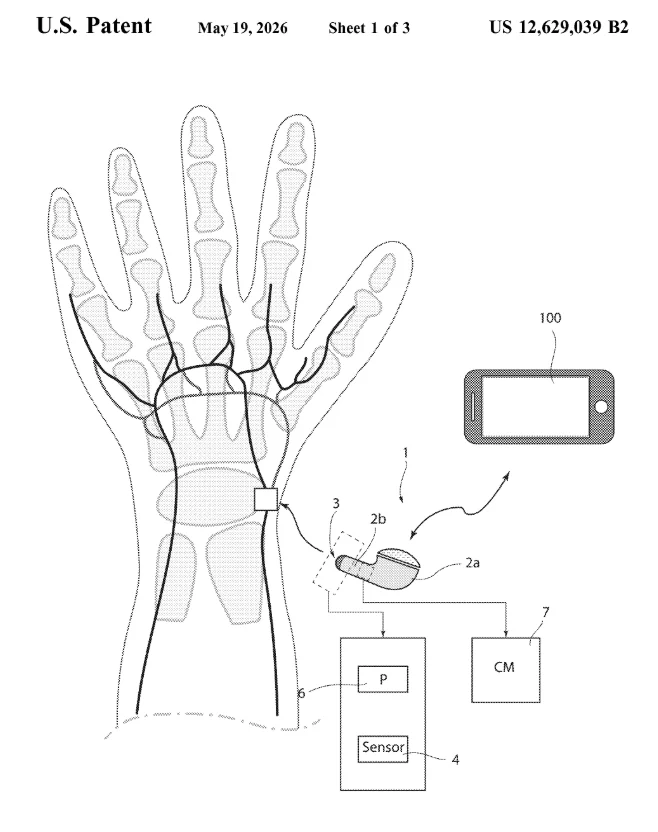
The most striking aspect of STMicroelectronics’ patent is the concept of using an earbud to facilitate "out-of-ear" measurements, specifically from the wrist’s radial artery. This innovative approach addresses several practical considerations for continuous health monitoring. The wrist is a universally accessible site for pulse measurement, making it ideal for user-initiated or passive data collection. However, traditional wrist-worn devices can sometimes be bulky or require precise positioning. By integrating the sensing mechanism at the wrist and having the earbud act as the processing and communication hub, STMicroelectronics proposes a distributed yet connected system.
Imagine a scenario where a user places a small, unobtrusive sensor on their wrist, perhaps as part of a subtle wristband or even integrated into clothing. This sensor, which would be equipped to detect the mechanical vibrations of the radial artery using FCG principles, would then wirelessly transmit its raw data to the earbud. The earbud, already an intelligent device with its own processing capabilities, would then perform the necessary computations to interpret the FCG data. This could involve filtering noise, extracting heart rate, analyzing rhythm patterns, and even sending summarized data to a connected smartphone or cloud service for long-term tracking and analysis.
The benefits of such a system are multi-faceted:
- Enhanced Comfort and Discretion: Separating the primary sensor from the processing unit allows for smaller, more specialized sensors that can be placed optimally without adding bulk to the ear or wrist.
- Optimized Power Management: The earbud, often equipped with a larger battery than a tiny wrist sensor, can handle the more power-intensive data processing and wireless communication, extending the operational life of the wrist sensor.
- Centralized Data Hub: The earbud becomes a personal health gateway, capable of collecting data from various body points and potentially integrating it with other biometric inputs (e.g., sound analysis from the ear itself).
- Improved Signal Quality: By having a dedicated sensor at the radial artery, the FCG measurements can be more precise and less prone to motion artifacts compared to, for example, a chest-worn device that might shift during activity.
This architectural approach highlights STMicroelectronics’ foresight in designing interconnected wearable ecosystems rather than isolated devices, promising a future where health monitoring is pervasive yet imperceptible.
STMicroelectronics: A Powerhouse in Sensor and Semiconductor Innovation
STMicroelectronics, the assignee of this groundbreaking patent, is a global leader in the semiconductor industry, renowned for designing, developing, manufacturing, and marketing a broad range of products, including microcontrollers, analog and mixed-signal integrated circuits, and advanced sensors. Headquartered in Geneva, Switzerland, with operational headquarters in Agrate Brianza, Italy, and financial headquarters in Geneva, the company has a long history of innovation across diverse markets, including automotive, industrial, communications equipment, computers, and consumer products.
Their expertise in developing highly sensitive and reliable micro-electromechanical systems (MEMS) sensors makes them a natural fit for pioneering advanced health monitoring solutions. STMicroelectronics’ accelerometers, gyroscopes, and pressure sensors are widely used in everything from smartphones to industrial equipment. This patent for a "Sensorized earphone device" aligns perfectly with their strategic focus on expanding into new growth markets, particularly the Internet of Things (IoT) and personal electronics, where the convergence of sensing, processing, and connectivity is paramount. By integrating complex physiological measurements into everyday consumer devices, STMicroelectronics is not just providing components but enabling entirely new product categories and user experiences. Their involvement underscores the serious technological backing and potential for mass-market adoption of such advanced hearable health devices.
A Glimpse into the Future: The Broader Patent Landscape of Ear-Worn Devices
The STMicroelectronics patent is not an isolated innovation but part of a vibrant and rapidly evolving intellectual property landscape surrounding ear-worn devices. A review of recently published patents, many slated for issuance around May 2026, reveals intense activity from a diverse array of companies, all vying to define the next generation of hearables. This competitive environment underscores the significant market potential and strategic importance of these devices.
-
Hearing Augmentation and Medical Devices: A substantial portion of recent patent activity focuses on enhancing hearing and medical applications. Companies like MED-EL Elektromedizinische Geraete GmbH (Innsbruck, AT) with "Patient specific frequency mapping procedure for hearing implant electrode arrays" (12616838), Oticon Medical A/S (Smorum, DK) with innovations like "Drill bit, drill kit and method for drilling a cavity or a recess into a skull" (12616485) and "Method of detecting a sudden change in a feedback/echo path of a hearing aid" (12621613), and Cochlear Limited (Macquarie University, AU) with multiple patents including "Self-locking fixation system for medical implant" (12616842) and "Musical perception of a recipient of an auditory device" (12621617), demonstrate a strong commitment to improving cochlear implants, hearing aids, and auditory prostheses. These patents address critical aspects such as surgical precision, personalized sound processing, feedback management, and the overall user experience for individuals with hearing impairments. Further contributions from GN Hearing A/S (Ballerup, DK) with "Hearing device with acceleration-based beamforming" (12620402), Widex A/S (Lynge, DK) for "Method of operating a hearing aid system and a hearing aid system using speech forecasting" (12621616), and Starkey Laboratories Inc (Eden Prairie, MN) on "Reducing comb filtering for hearing devices" (12634641) highlight advancements in sound quality, adaptive processing, and user comfort for hearing aids. The emergence of AI in this sector is also evident with patents like "Open ear system using artificial intelligence (AI) driven audio signal processing" (12627937) by Legato Audio Inc (Falmouth, MA) and "Method, apparatus and system for neural network hearing aid" (12634642) by Fortell Research Inc (New York, NY), indicating a shift towards intelligent, context-aware hearing solutions.
-
Advanced Audio and User Experience: Beyond medical applications, general ear-worn device functionality is a major focus. Bose Corporation (Framingham, MA) is a prolific innovator, securing patents such as "Wearable control system and method to control an an ear-worn device" (12619306), "Ear worn device" (12621596), "Dynamic voice nullformer" (12626713), and "Recovery of voice audio quality using a deep learning model" (12626714). These patents reflect Bose’s dedication to sophisticated audio processing, active noise cancellation (ANC), intuitive user controls, and enhanced voice communication quality – all critical for premium audio experiences. Knowles Electronics LLC (Itasca, IL) also contributes with "Low latency audio processing system having active noise cancellation for ear-worn hearing device" (12620385), emphasizing performance for ANC. Sony Group Corporation (Tokyo, JP) with "Sound processing device, sound processing method, and hearing aid device" (12621615), and Panasonic Intellectual Property Management Co Ltd (Osaka, JP) for "Ear-worn device and reproduction method" (12626684) further illustrate the continued drive by consumer electronics giants to refine audio quality and device functionality. Even design patents, such as LG Electronics Inc (Seoul, KR) for a "Wireless earbud" (D1125126) and Amazon Technologies Inc (Seattle, WA) for "Wingtip portion of an earbud" (D1127774), show the importance of form factor and ergonomics in this highly competitive market.
-
Integrated Health and Sensor Technology: While STMicroelectronics’ patent stands out for its specific FCG application, other patents hint at a broader integration of health and sensing capabilities. Chang Gung Memorial Hospital, Linkou; Chang Gung University (Taoyuan City, TW) filed for an "Array measuring method and interpretation device for ultrasonic detection of middle ear effusion" (12629129), showcasing medical diagnostic applications beyond hearing. The numerous patents from medical device companies also often incorporate sophisticated sensors for device performance and patient feedback. The STMicroelectronics patent uniquely bridges the gap between traditional audio devices and advanced physiological monitoring from a remote body site, underscoring a trend towards multi-functional, intelligent hearables that serve as personal health companions.
The collective intellectual property landscape demonstrates a clear trajectory: ear-worn devices are evolving into sophisticated platforms for communication, entertainment, hearing assistance, and increasingly, comprehensive health monitoring. Companies are investing heavily in AI, advanced sensor integration, and user-centric design to create devices that are not only comfortable and powerful but also intelligent and responsive to individual needs.
Implications and Future Outlook: A New Paradigm for Personal Health
The STMicroelectronics patent, alongside the broader trend in ear-worn device innovation, carries significant implications for consumers, healthcare providers, and the technology industry.
For consumers, these advancements promise unprecedented convenience and insight into their health. Imagine an earbud that not only plays music but also continuously monitors your heart’s mechanical activity from a discreet wrist sensor, providing real-time alerts or daily summaries of your cardiac health. This shift towards passive, continuous monitoring could empower individuals to take a more proactive role in managing their well-being, potentially leading to earlier detection of health issues and personalized interventions. The seamless integration of health monitoring into everyday accessories like earbuds means less friction and greater adherence to health tracking routines.
For healthcare, this technology opens new avenues for remote patient monitoring and preventative care. Clinicians could gain access to long-term, real-world physiological data, enabling more accurate diagnoses and tailored treatment plans. For patients with chronic conditions, continuous FCG monitoring could provide invaluable data for managing their health remotely, reducing the need for frequent clinic visits and improving quality of life. The challenge will be in validating the clinical accuracy of these consumer-grade devices and integrating their data securely and effectively into existing healthcare systems. Regulatory bodies will also need to adapt to certify these novel medical-grade wearable technologies.
For the technology industry, the STMicroelectronics patent signals a deepening convergence of consumer electronics, medical devices, and artificial intelligence. Companies across these sectors will increasingly compete and collaborate to develop integrated solutions. This will drive innovation in sensor design, ultra-low-power processing, advanced algorithms for data interpretation, and secure wireless communication. The market for hearables is poised for substantial growth, moving beyond simple audio playback to become intelligent health gateways. However, challenges such as data privacy, cybersecurity, battery life optimization, and ensuring user comfort across diverse populations will remain critical hurdles to overcome.
In conclusion, STMicroelectronics’ "Sensorized earphone device for out-of-ear measurements" is more than just another patent; it represents a conceptual breakthrough in wearable health technology. By ingeniously leveraging the earbud as a processing hub for forcecardiography data collected from the wrist, the company is charting a course towards a future where health monitoring is omnipresent, non-invasive, and deeply integrated into our daily lives. This innovation, set within a vibrant ecosystem of ear-worn device patents, underscores a profound shift in how we perceive and interact with our personal health, promising a new paradigm of proactive, personalized well-being.
Holly Hosford-Dunn, PhD, owned and operated a dispensing audiology practice in Tucson and was active in management of HearingHealthMatters.org through 2017. She holds BA degrees in Communication Sciences, Psychology and Economics; MA in Communication Disorders; PhD in Hearing Sciences. Following post-doctoral work at Max Planck Institute (Munich, DE) and Eaton-Peabody Auditory Physiology Lab (Boston), she joined the Stanford medical school faculty as director of audiology. She has authored/edited numerous text books, chapters, journals, and articles and taught Marketing and Practice Management in a variety of academic settings. She continues to consult and write on topics related to hearing health care vis-à-vis consumer demands, professional training, technological advancement, capital investment, industry consolidation, regulatory control, product and service distribution, and strategic pricing.