The Genesis of the Manual and the 2024 Launch
The journey toward this updated manual began in earnest in September 2024, when the DfE first published the Accessibility and Inclusive Design Manual. At its inception, the manual was designed to serve as a central "source of truth" for designers, product managers, and delivery teams working within the education sector. The initial goal was to ensure that all digital products—from student loan applications to teacher certification platforms—met the legal requirements set out by the Public Sector Bodies (Websites and Mobile Applications) (No. 2) Accessibility Regulations 2018.
While the 2024 launch was met with generally positive feedback and steady traffic, internal data and user analytics soon began to tell a more nuanced story. While users were accessing the site, the "bounce rates" on certain deep-link pages suggested that finding specific, actionable information was more difficult than intended. This prompted the DfE’s digital team to embark on a secondary phase of development, shifting from a content-first approach to a user-needs-first approach.
Chronology of the Refinement Process
Following the initial release in late 2024, the DfE Digital team initiated a structured research phase that spanned from January to June 2025. This timeline was divided into several key milestones:
- January – February 2025: Discovery and Audit. The team conducted deep-dive interviews and usability testing with three primary user groups: designers, product managers, and delivery leads. The focus was on how these professionals integrated accessibility into their daily workflows.
- March – April 2025: Information Architecture (IA) Redesign. Based on findings that the "Knowledge Hub" was being underutilized or viewed as a "dumping ground," the team began prototyping a new navigation structure that mirrored the actual phases of a project lifecycle.
- May 2025: Content Iteration and Tool Guidance. The team shifted focus to the "Tools" section, moving beyond technical installation guides to provide context-heavy advice on when and why to use specific accessibility testing software.
- June 2025: Beta Testing and Feedback Loops. A pre-launch version of the manual was shared with internal DfE stakeholders and broader Government Digital Service (GDS) communities to ensure the changes improved findability.
- July 21, 2025: Official Relaunch. The updated manual went live, featuring a simplified homepage, reorganized content, and a focus on person-centered guidance.
Addressing the "Knowledge Hub" and Information Overload
One of the most critical findings from the user research phase was the failure of the "Knowledge Hub" section. In the original version of the manual, this section served as a catch-all for various articles, best practices, and theoretical frameworks. However, users reported that the hub felt cluttered and lacked a clear hierarchy. In professional design environments, where time is a premium, a "dumping ground" of information often leads to users abandoning the resource in favor of search engines, which may provide less accurate or non-compliant advice.
To rectify this, the DfE team took the bold step of removing the Knowledge Hub entirely. Rather than centralizing "knowledge" in one silo, the content was redistributed into sections that align with how people naturally search for information. For example, theoretical guidance on color contrast was moved into the design phase sections, while technical documentation on ARIA (Accessible Rich Internet Applications) labels was integrated into developer-specific modules. This reorganization ensures that the right information appears at the right time in the user’s journey, reducing cognitive load and improving the "information scent" of the manual.
From Technical Lists to People-Centered Tools
Another significant evolution in the manual concerns the "Tools" guidance. In its 2024 iteration, this section was largely a technical list: which browser extensions to download and how to install them. Research indicated that while users knew what the tools were, they were often paralyzed by the choice of tools or lacked the confidence to know when to apply them.
The 2025 update transformed this section into a strategic resource. The guidance now focuses on the "why" and "when." For instance, instead of just listing a screen reader, the manual now explains at which stage of the development cycle a screen reader test is most effective and what specific issues it is designed to catch. This shift from "installation" to "implementation" is intended to bridge the gap between having the right software and actually performing effective accessibility audits.
Visual Simplification and the Homepage Redesign
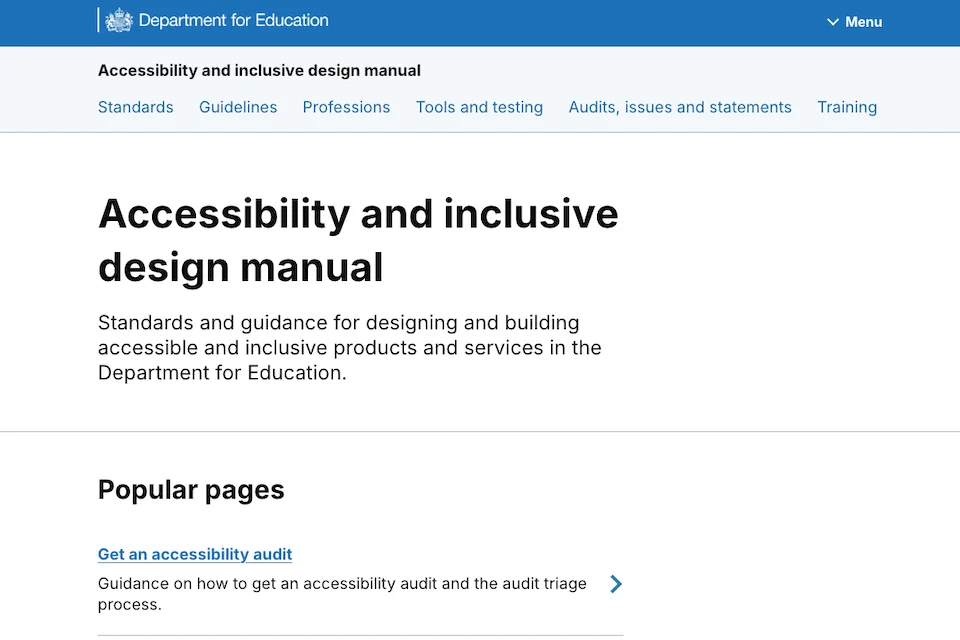
The aesthetic and functional layout of the homepage underwent a drastic simplification. The previous version featured a high density of icons, images, and a long-scrolling format that users found overwhelming. In digital accessibility, the interface of the guidance itself must be a model of the principles it advocates.
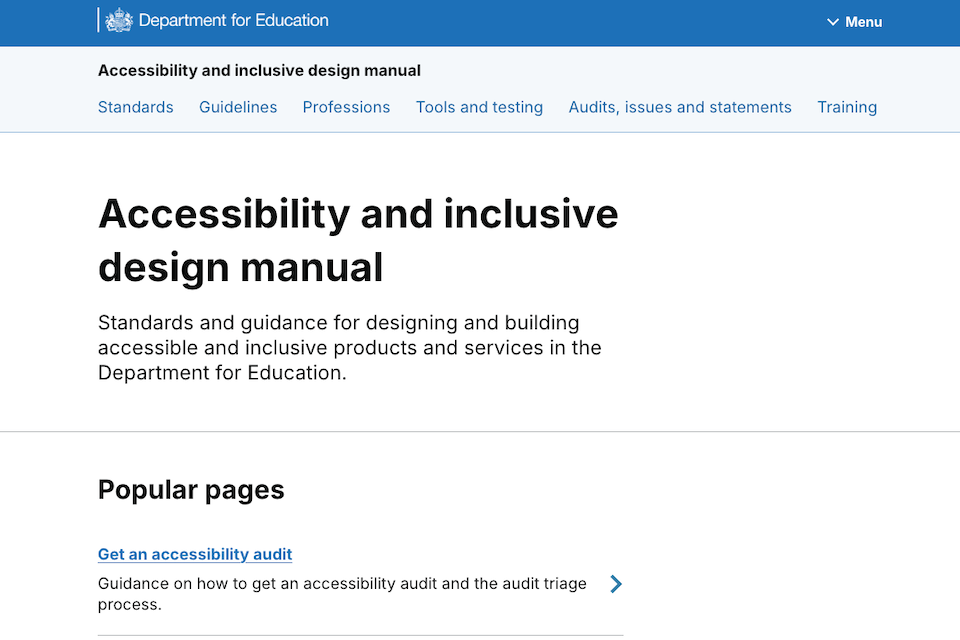
The new homepage removed unnecessary visual noise, focusing on clear, high-contrast typography and a streamlined top navigation bar. By reducing the "busyness" of the landing page, the DfE has ensured that users can navigate to their required section within two clicks. This minimalist approach aligns with the GDS Service Standard, which emphasizes that government services should be so simple that users can succeed the first time.
Supporting Data: The Case for Inclusive Design
The DfE’s investment in this manual is supported by a growing body of data regarding disability and digital access in the United Kingdom. According to data from the Department for Work and Pensions (DWP), approximately 16 million people in the UK—nearly 24% of the population—report having a disability. In the context of education, this includes students with visual impairments, neurodivergent educators, and parents with motor disabilities who must navigate school application systems.
Furthermore, internal DfE metrics indicated that services built with "born-accessible" design principles (designing for accessibility from day one) reduce the need for retrospective "remediation" by up to 40%. Remediation—fixing accessibility bugs after a site has launched—is estimated to be five to ten times more expensive than building accessibly from the start. The updated manual is therefore not just a design tool, but a cost-saving measure for the department.
Official Responses and Strategic Alignment
While the manual was developed by the DfE, its implications are being felt across the UK civil service. Statements inferred from the project’s objectives suggest that the DfE Digital team views this as a collaborative effort. "Accessibility is not a checkbox exercise; it is a fundamental aspect of service delivery," noted the project’s summary documentation. "By making our guidance more intuitive, we are empowering our teams to build services that work for everyone, regardless of their physical or cognitive abilities."
The manual also aligns with the Central Digital and Data Office (CDDO) "Transforming for a Digital Future" strategy, which aims to achieve a "Greatest Hits" of digital transformation across government by 2025. By providing a clear, reusable framework for inclusive design, the DfE is contributing to a cross-government ecosystem where departments can share best practices rather than duplicating effort.
Broader Implications and Future Outlook
The DfE Accessibility and Inclusive Design Manual is a "living" document. While the July 2025 update represents a major leap forward, the department has committed to ongoing maintenance to keep pace with evolving standards such as the Web Content Accessibility Guidelines (WCAG) 2.2 and the emerging 3.0 draft.
One of the most significant aspects of the manual is its public availability. Although it was primarily created for DfE internal teams, it is hosted on a public-facing gov.uk blog and dedicated site, making it accessible to local authorities, educational institutions, and private sector contractors. This "open-source" approach to government guidance helps raise the floor of digital accessibility across the entire education sector, not just within the department itself.
As digital services become increasingly reliant on artificial intelligence and automated interfaces, the need for human-centric, inclusive design guidance has never been more acute. The DfE’s proactive approach in reorganizing its manual based on user research serves as a case study for other departments. It demonstrates that in the world of technical documentation, less is often more, and the way information is structured is just as important as the information itself.
In conclusion, the updated DfE Accessibility and Inclusive Design Manual represents a strategic shift toward more effective, user-friendly, and legally compliant digital service delivery. By focusing on the user journey, simplifying navigation, and providing contextual guidance for tools, the DfE has created a resource that is not only a repository of knowledge but a practical roadmap for inclusive innovation. As the 2025 school year approaches, the impact of these changes will likely be seen in more accessible, efficient, and equitable digital experiences for millions of users across the United Kingdom.