The Magnitude of the Crisis: Defining the Challenge
The statistics underpinning this initiative are both stark and alarming. According to data provided by the Center for Construction Research and Training (CPWR), suicide claims nearly five times as many construction workers as on-the-job physical accidents. This metric challenges the historical focus of the industry, which has traditionally prioritized the prevention of falls, electrical injuries, and equipment-related trauma. While physical safety protocols have been refined over decades to reduce on-site fatalities, the industry is now confronting a less visible, yet more lethal, internal threat.
Bureau of Labor Statistics (BLS) reports further contextualize the severity of the issue, indicating that the suicide rate among construction workers is approximately four times higher than the national average. When disaggregated by demographic, the risk remains particularly high among men, who make up the vast majority of the construction workforce. Researchers suggest that a combination of factors—including the transient nature of project-based work, the "tough guy" culture often associated with manual labor, chronic physical pain from long-term wear and tear, and the high-pressure environment of strict deadlines—creates a "perfect storm" for mental health decline.
Chronology of a Growing Movement
The decision to formalize Construction Suicide Prevention Week did not occur in a vacuum. It is the result of a multi-year mobilization by industry stakeholders, labor unions, and non-profit organizations.
In the early 2010s, industry leaders began to notice a troubling trend in absenteeism and performance, often linked to substance abuse and untreated depression. By 2015, various regional safety councils began piloting "Mental Health First Aid" training programs, recognizing that site foremen were often the first to notice changes in worker behavior but lacked the vocabulary or tools to intervene effectively.

By 2018, national trade associations—including the Associated General Contractors of America (AGC) and the Construction Industry Alliance for Suicide Prevention (CIASP)—began to consolidate these efforts. The inaugural "Stand-Down" concept was borrowed from the successful OSHA-sponsored National Safety Stand-Down to Prevent Falls, which has been credited with significantly reducing fall-related injuries since its inception. By adapting this familiar framework—a temporary pause in work to focus on a specific safety topic—the industry sought to demystify mental health discussions and bring them onto the jobsite, away from the stigma of a private doctor’s office.
Operational Logistics of the Stand-Down
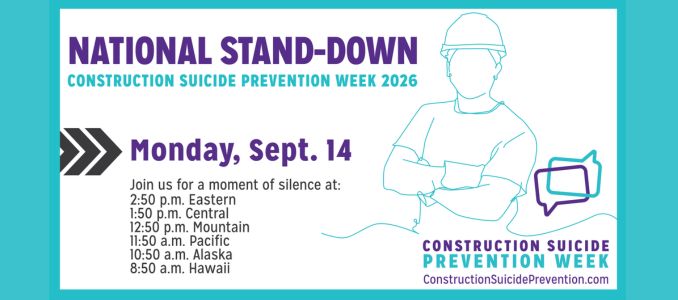
The upcoming stand-down is not merely a symbolic gesture but an operational directive. Employers are encouraged to halt all work activities for a designated minute of silence, often synchronized across time zones to emphasize national unity. Beyond this moment, the event serves as a platform for deeper engagement.
Participating organizations are encouraged to execute a comprehensive agenda that includes:

- Educational Seminars: Toolbox talks focused on recognizing the signs of depression, anxiety, and substance misuse.
- Resource Distribution: Providing workers with direct access to the 988 Suicide & Crisis Lifeline, internal Employee Assistance Programs (EAPs), and local peer-support networks.
- Visibility Campaigns: Displaying banners and posters that explicitly state that asking for help is a sign of strength rather than weakness, directly countering traditional perceptions of vulnerability.
- Leadership Pledges: Site superintendents and executive management are invited to sign public pledges, committing to long-term mental health support and the integration of mental wellness into standard safety meetings.
Analyzing the Structural Impediments to Care
The construction industry presents unique structural barriers to mental health support. Many workers operate as independent contractors or move from site to site, leading to a lack of continuity in healthcare coverage. This "gig-like" structure often prevents the development of long-term relationships with healthcare providers who could monitor a worker’s mental health trajectory.
Furthermore, the physical nature of the work often leads to high rates of opioid dependency as a means of managing chronic pain. This intersection of pain management and mental health is a primary area of focus for modern safety professionals. Industry analysts note that without a systemic shift in how pain is managed and how mental health is perceived, isolated stand-downs will have limited long-term impact. The objective of the current movement, therefore, is to transition from a "one-week" awareness event to a permanent safety culture shift.
Industry Response and Stakeholder Engagement
The response from major construction firms has been overwhelmingly positive, with many of the largest general contractors in the U.S. reporting full participation. Labor unions, which have historically focused on physical wages and working conditions, have also pivoted to include comprehensive mental health coverage in their collective bargaining agreements.

"We have spent decades mastering the art of the ‘Zero Accident’ policy," says one industry safety consultant. "We have reached a point where we can build skyscrapers with minimal physical injury. However, we have failed our workforce if they go home to a life that they feel is unmanageable. This stand-down is the industry’s formal admission that we have a moral, as well as an economic, responsibility to our people’s entire lives, not just their bodies while on the clock."
While the support is broad, experts caution that the challenge remains in reaching the "last mile"—small, independent contractors and subcontractors who may not have the HR departments or resources of large, national firms. Efforts are currently underway to create simplified, multilingual toolkits that can be easily implemented on small residential jobsites, where the suicide rates are statistically higher than in commercial construction.
Broader Impact and Future Implications
The long-term success of this initiative will be measured by more than just participation rates. Industry researchers are looking for a decrease in the stigma surrounding mental health disclosures, an increase in the utilization of EAP services, and, ultimately, a decline in suicide rates reported to the Bureau of Labor Statistics.

The economic implications are also significant. High turnover, absenteeism, and the loss of experienced, skilled tradespeople due to mental health crises represent a massive financial drain on the construction sector. By investing in mental health, firms are not only saving lives but are also protecting their human capital and ensuring the stability of their projects.
As the industry prepares for the upcoming moment of silence, the focus is on sustained momentum. The hope is that the stand-down will act as a catalyst for a permanent change in jobsite culture. By treating mental health with the same rigorous, protocol-driven approach as site safety, the construction industry is positioning itself as a leader in corporate social responsibility, setting a standard that other high-pressure industries may soon be forced to follow.
The silence that will sweep across jobsites nationwide is intended to be deafening—a clear message that the industry is no longer willing to lose its most valuable assets to a silent epidemic. It represents a pivot toward a future where the strength of a construction worker is measured not only by what they build, but by their ability to reach out when the burden becomes too heavy to carry alone. As the clock strikes the designated hour, millions of workers will stand together, turning their collective focus toward a healthier, more supportive, and ultimately more resilient future for the building trades.