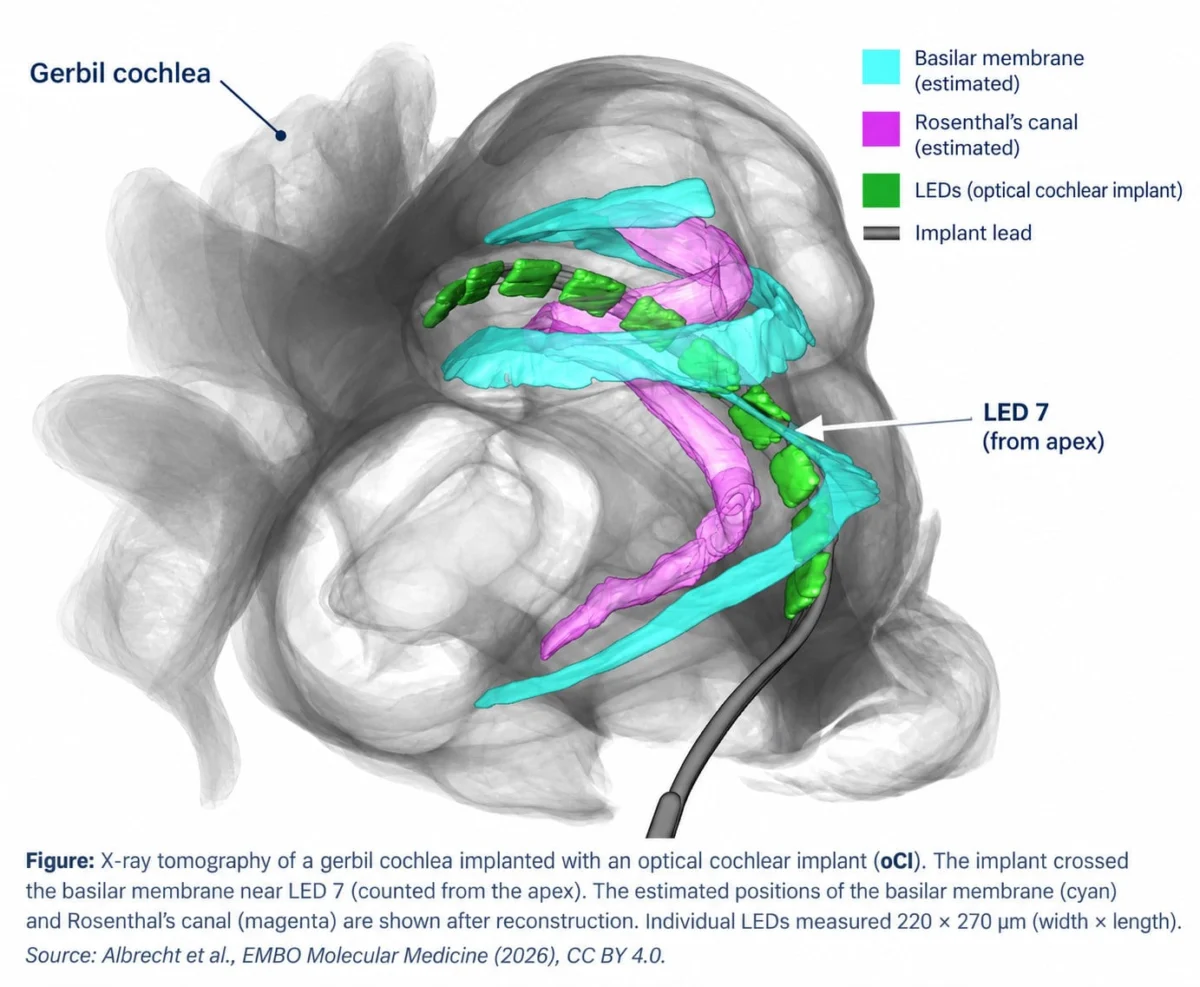
The landmark findings emerge from an exhaustive preclinical study conducted on Mongolian gerbils, a species often favored in auditory research due to the anatomical similarities of their cochlea to that of humans. The research meticulously combined advanced gene therapy techniques, introducing a specialized light-sensitive protein into auditory neurons, with cutting-edge experimental optical cochlear implants. These miniature devices were engineered to contain an array of up to 10 tiny light-emitting diodes (LEDs), capable of delivering targeted light pulses to the genetically modified neurons.
Under the leadership of first author Niels Albrecht and senior author Tobias Moser, a renowned figure in auditory neuroscience at the University Medical Center Göttingen, Germany, the research team meticulously observed and analyzed neural activity. Their findings unequivocally showed that optical stimulation generated more distinct and spatially confined patterns of auditory neural activity than its electrical counterpart. Crucially, this enhanced precision was achieved while requiring relatively minimal amounts of light energy, addressing a longstanding technical hurdle in the development of optical neuroprosthetics.
While the path to human clinical application remains fraught with substantial technical and biological challenges, these results provide compelling evidence that optical cochlear implants could eventually offer a transformative alternative to the established method of stimulating the auditory nerve. The implications extend beyond mere hearing restoration, hinting at a future where cochlear implant users might experience improved speech understanding in noisy environments, a richer appreciation of music, and an overall more nuanced perception of their acoustic world.
The Evolution of Cochlear Implants and Their Inherent Limitations
To fully appreciate the significance of this optical breakthrough, it’s essential to understand the context of conventional cochlear implants (CIs). Since their initial approval in the 1980s, CIs have revolutionized hearing rehabilitation for millions globally, converting acoustic sound waves into electrical signals that directly stimulate the auditory nerve. This ingenious technology bypasses damaged hair cells in the cochlea, restoring a sense of hearing to individuals for whom hearing aids are no longer effective. According to the National Institute on Deafness and Other Communication Disorders (NIDCD), over 700,000 people worldwide have received cochlear implants, with approximately 60,000 adults and 40,000 children in the United States alone benefiting from these devices.
However, despite their life-changing impact, conventional CIs face an intrinsic physical limitation: the spread of electrical current. The fluid-filled environment of the cochlea, while essential for natural hearing, allows electrical current from each electrode contact to diffuse, activating not just the intended cluster of auditory nerve fibers but also adjacent ones. This phenomenon, known as "current spread," means that even when an implant features multiple electrode contacts (modern CIs can have 12-22 channels), the discrete stimulation of specific sound frequencies (spectral resolution) is inherently limited.
This reduced spectral resolution is a primary factor contributing to the difficulties many CI users encounter in complex listening situations. Tasks such as understanding speech in the presence of background noise – a common real-world challenge – or discerning the intricate nuances of musical melodies remain significant hurdles. Imagine trying to differentiate instruments in an orchestra if all their sounds bled into one another; this is akin to the experience of a CI user with limited spectral resolution. The promise of optical cochlear implants, therefore, lies in their potential to overcome this fundamental constraint by delivering light to more spatially confined regions, thereby creating more independent channels of auditory information.
A New Paradigm: Optogenetics and Light-Based Stimulation
The concept of using light, rather than electricity, to stimulate neurons is rooted in the field of optogenetics. This revolutionary biotechnological technique, which gained prominence in the early 2000s, involves genetically engineering specific cells to express light-sensitive proteins called opsins. Once these opsins are incorporated into the cell membrane, they act as tiny light-gated ion channels. When exposed to light of a specific wavelength, these channels open, allowing ions to flow across the membrane and either excite or inhibit the neuron.
For optical cochlear implants, the goal is to make the auditory neurons in the spiral ganglion – the primary neurons that transmit sound information from the cochlea to the brain – responsive to light. Unlike conventional electrical implants, which directly stimulate these neurons with electrical pulses, optogenetic stimulation requires a preparatory step: the targeted delivery of a gene encoding an opsin to these neurons. This genetic modification is a critical differentiator and introduces both unique opportunities and complex challenges.
Methodology of the Preclinical Study: Gene Delivery Meets Micro-LEDs
The EMBO Molecular Medicine study meticulously combined gene delivery with advanced implant technology. Researchers utilized an adeno-associated viral (AAV) vector, a commonly used and relatively safe tool in gene therapy, to introduce a gene encoding a specific light-sensitive channelrhodopsin called ChReef. This gene was delivered directly into the spiral ganglion neurons of the Mongolian gerbils. ChReef was strategically chosen for its efficient responsiveness to green light, a wavelength that penetrates tissue effectively enough for neural stimulation while minimizing potential heat-related damage.

The experimental optical cochlear implants developed for this study were miniature marvels of engineering, incorporating between five and 10 green light-emitting diodes (LEDs). These LEDs were precisely positioned to target specific regions of the gerbil cochlea where the ChReef-expressing neurons resided. Following gene delivery and implant placement, the researchers monitored neural activity in the inferior colliculus, a crucial midbrain structure involved in auditory processing, which serves as a relay station for auditory information from the cochlea to higher brain centers.
This comprehensive approach allowed the team to conduct a direct comparison. They examined how the auditory system represented stimulation from individual optical channels, benchmarked against conventional electrical stimulation and, critically, against natural acoustic tones. It is important to underscore that this study focused on neural representations of auditory stimulation – how the brain processed the signals – rather than behavioral hearing outcomes. While neural activity is a proxy for perception, direct behavioral tests in genetically modified animals present additional complexities.
Key Findings: A Leap in Spectral Resolution
The results of the study painted a highly encouraging picture for the future of optical cochlear implants:
-
Energy Efficiency: Individual optical channels were capable of evoking robust auditory responses at remarkably low energy levels. Neural activity was reliably observed with light pulses as minuscule as approximately 150 nanojoules, or 0.15 microjoules. This finding addresses one of the most significant historical obstacles to optical CI development, as high power requirements would severely limit battery life and introduce considerable engineering and safety challenges for an implantable medical device. The successful use of sub-microjoule light pulses represents a substantial step forward in making optical CIs a practical reality.
-
Comparable Firing Rates: At higher stimulation levels, individual LEDs produced maximum neural firing rates comparable to those observed with acoustic pure tones presented at 51 dB SPL (decibels Sound Pressure Level). This indicates that optical stimulation can generate neural activity with an intensity similar to natural sounds, which is crucial for a robust auditory percept.
-
Enhanced Channel Separation: The most groundbreaking finding was the superior distinguishability of neural activation patterns. The patterns of neural activity generated by different optical channels were significantly more distinct from one another than those produced by electrical stimulation. This directly translates to improved spectral resolution – the ability to differentiate between different sound frequencies.
-
Tonotopic Organization: These highly resolved responses meticulously followed the cochlea’s inherent tonotopic organization. This refers to the orderly mapping of sound frequencies along the length of the cochlea, where high frequencies activate neurons at the base and low frequencies activate neurons at the apex. The optical implant successfully maintained this natural organization, suggesting a more faithful representation of sound.
-
Greater Functional Channels: Using sophisticated statistical analyses of neural activity, the researchers established that optical channels could be distinguished at smaller spatial separations than electrical channels. This strongly suggests that optical implants may eventually support a greater number of functionally independent stimulation channels, potentially leading to a richer and more detailed auditory experience.
While these results are profoundly positive, the researchers also acknowledged that the optical responses, though superior to electrical stimulation, did not yet achieve the frequency selectivity of natural acoustic hearing. Furthermore, they observed that some LEDs produced additional, unintended peaks of neural activation at very high stimulation intensities, indicating that optical stimulation was not perfectly confined to a single frequency region under all conditions. This highlights areas for further refinement in implant design and opsin characteristics.
Overcoming Energy Hurdles: A Critical Advance
The historical pursuit of optical cochlear implants has been consistently hampered by the significant amount of energy required to reliably activate auditory neurons. Early optogenetic tools and implant designs often demanded power levels that were impractical for a long-term implantable device, posing substantial challenges for battery life, device size, and potential tissue heating – a critical safety concern.
The current study’s success in demonstrating reliable auditory pathway activation with sub-microjoule light pulses, achieved by synergistically combining the highly efficient ChReef protein with optimized green LED-based implants, marks a pivotal moment. This breakthrough suggests that the combined advances in molecular engineering (designing more sensitive opsins) and implant microelectronics (developing energy-efficient miniature LEDs) are finally beginning to overcome some of the most formidable power limitations that have stalled earlier optical cochlear implant research. This energy efficiency is not merely a technical detail; it is a prerequisite for any future clinical translation.
Timeline of Innovation in Hearing Restoration

- 1957: André Djourno and Charles Eyriès perform the first human cochlear implantation, stimulating the auditory nerve with a single electrode.
- 1970s: Development of multi-channel cochlear implants begins, leading to improved speech understanding.
- 1984: The FDA approves the first multi-channel cochlear implant for adults in the United States.
- Early 2000s: The field of optogenetics emerges, demonstrating the ability to control neural activity with light.
- Mid-2000s onwards: Researchers begin exploring optogenetics for auditory applications, envisioning light-based cochlear implants. Early challenges include opsin sensitivity, light delivery, and energy requirements.
- 2010s: Significant improvements in opsin development (e.g., enhanced sensitivity, faster kinetics) and miniaturization of LEDs pave the way for more feasible optical CI prototypes.
- October 22, 2026: Publication of the Albrecht and Moser study in EMBO Molecular Medicine, demonstrating significantly improved frequency selectivity and energy efficiency in a preclinical optical CI model.
Challenges on the Path to Clinical Translation
Despite the highly encouraging results, the researchers are forthright about the significant limitations that must be addressed before optogenetic cochlear implants can be considered a viable option for individuals with severe or profound hearing loss. The journey from preclinical success to widespread clinical application is often long and arduous, particularly when gene therapy is involved.
-
Opsin Kinetics: One primary concern revolves around the response speed, or kinetics, of the ChReef protein. The researchers noted that its relatively slow closing kinetics could limit its ability to accurately follow rapid stimulation patterns. Natural speech and music contain rapidly changing timing information, and an opsin that cannot respond quickly enough might compromise the faithful representation of these crucial temporal cues. Future research will need to identify or engineer opsins with faster kinetics to better encode the dynamic nature of sound.
-
Sustained and Dynamic Activity: The current study primarily focused on examining spatial patterns of neural activation using individual stimulation pulses. It did not fully establish whether the technology could reliably reproduce the sustained and rapidly changing neural activity required for naturalistic sound processing over extended periods. Real-world hearing involves continuous, complex streams of auditory information, not just isolated pulses.
-
Safety of Gene Delivery: The investigators reported reduced spiral ganglion neuron density in some comparisons involving treated cochleae. This finding, while not universally observed, highlights the critical importance of further evaluating the long-term safety and biocompatibility of the gene-delivery approach. Any gene therapy destined for human use must demonstrate an impeccable safety profile, including no adverse effects on cell viability or function, and no unintended immune responses.
-
Implant Design and Biocompatibility: Translating the technology to humans will necessitate careful consideration of implant design, ensuring long-term stability, biocompatibility within the delicate cochlear environment, and robust performance. Miniaturization, surgical implantation procedures, and ensuring the device can withstand the physiological environment for decades are all complex engineering challenges.
-
Long-Term Performance and Energy Needs: While the current study showed improved energy efficiency, long-term power requirements for a perpetually operating implant still need rigorous assessment. Moreover, the stability of opsin expression over many years and its consistent performance in a living system are paramount.
-
Ethical and Regulatory Considerations: The integration of gene therapy into an implantable medical device introduces complex ethical and regulatory hurdles. Rigorous clinical trials, extensive safety data, and a thorough understanding of potential off-target effects of gene delivery will be required by regulatory bodies worldwide.
-
Behavioral Outcomes: Ultimately, the critical question remains whether improved neural channel separation can translate into meaningful improvements in sound perception and speech understanding in human users. Preclinical studies are foundational, but human trials will be necessary to demonstrate tangible clinical benefits.
Broader Implications for Future Hearing Restoration
The findings from Albrecht and Moser’s team add substantial weight to a burgeoning body of research exploring how optogenetics can overcome the inherent limitations of electrical auditory stimulation. For hearing healthcare professionals, the significance of this work lies in the tangible possibility of delivering significantly enhanced spectral information to the auditory system. Theoretically, more precise stimulation could support a better representation of complex sounds – from the nuances of human speech in a bustling crowd to the rich tapestry of musical compositions. While these clinical benefits remain unproven in humans, the potential for a paradigm shift in hearing quality is immense.
This study also vividly illustrates the exciting convergence of several cutting-edge scientific and engineering disciplines. Advances in gene delivery, molecular engineering (to design optimized light-sensitive proteins), and implantable microelectronics (to create efficient, miniature light sources) are all coming together to push the boundaries of experimental hearing restoration. This interdisciplinary synergy is critical for tackling the complex challenges of neuroprosthetics.
While conventional electrical cochlear implants remain the established clinical technology and continue to evolve, these new findings represent a crucial and encouraging step. They underscore the ongoing commitment of the scientific community to innovate and refine hearing solutions, moving closer to a future where optical stimulation could provide not just hearing, but a richer, more detailed, and natural auditory experience for millions worldwide. The journey is long, but the horizon for more precise hearing restoration has never appeared brighter.
Original research: Albrecht N, Koert E, Vavakou A, et al. Multichannel optical cochlear implants enable spectrally distinct auditory activity. EMBO Molecular Medicine. Published October 22, 2026. doi:10.1038/s44321-026-00541-2.