The Strategic Shift Toward User-Centric Accessibility
The primary catalyst for the 2025 update was a recognition that while the initial manual contained high-quality content, its structural delivery was not fully aligned with the practical needs of digital professionals. Following the initial launch in late 2024, the DfE’s digital teams monitored engagement metrics and conducted qualitative interviews with core user groups. While the data indicated a high volume of traffic, feedback suggested that users often struggled to find specific guidance during the active phases of product development.
The research focused on three critical pillars: discoverability of information, the utility of technical tools, and the reduction of cognitive load for users navigating the manual. The findings revealed that the "Knowledge Hub," which had served as a central repository for miscellaneous guidance, was perceived as a "dumping ground" for content. This prompted a total overhaul of the site’s information architecture, shifting the focus from a library-style organization to a workflow-integrated model.
Chronology of Development and Implementation
The journey toward the updated manual began almost immediately after the first version’s release in September 2024. By December 2024, the DfE accessibility team had gathered enough preliminary data to identify friction points in the user interface. Throughout the first quarter of 2025, the department conducted deep-dive sessions with interaction designers and content strategists to map out the "user journey" of an accessibility audit.
In the spring of 2025, the team began the iterative process of dismantling the "Knowledge Hub" and reallocating its contents into thematic sections that correspond with the Government Digital Service (GDS) Service Manual phases: Discovery, Alpha, Beta, and Live. This reorganization was designed to ensure that a designer looking for "alt-text" guidance or a developer looking for "aria-label" protocols would find them within the context of their specific task rather than in a generic list of articles. The final testing phase took place in June 2025, leading to the official "go-live" date on July 21.
Reforming Information Architecture: The Death of the Knowledge Hub
The most significant structural change in the July 2025 update is the removal of the "Knowledge Hub." In its place, the DfE has implemented a decentralized content strategy. The rationale behind this move was rooted in the psychology of search behavior. User research indicated that professionals do not typically browse accessibility manuals for general education; instead, they turn to them to solve specific problems during the design or coding process.
By redistributing the content, the DfE has placed guidance where it is most likely to be needed. For example, guidance on inclusive language has been moved to content design sections, while technical specifications for screen reader compatibility have been integrated into development-focused modules. This change addresses the "clutter" issue identified in the 2024 version and reduces the time-to-information, a key metric for agile delivery teams working under tight deadlines.
Enhancing Tool Guidance and Practical Application
Beyond structural changes, the manual has seen a qualitative shift in how it presents accessibility tools. Previously, the manual functioned largely as a directory, listing available software and providing installation instructions. However, feedback from delivery roles indicated a "knowledge gap" regarding the application of these tools.
The updated manual now prioritizes the "why" and "when" over the "how." The new guidance categorizes tools based on the specific user needs they address. Instead of a simple list of browser extensions, the manual now provides comparative analysis on which tools are best for testing color contrast versus those optimized for keyboard navigation audits. This transition from a technical manual to a strategic guide is intended to empower non-specialists to perform high-quality preliminary accessibility checks, thereby reducing the burden on dedicated accessibility auditors later in the development cycle.
Visual Overhaul and Cognitive Accessibility
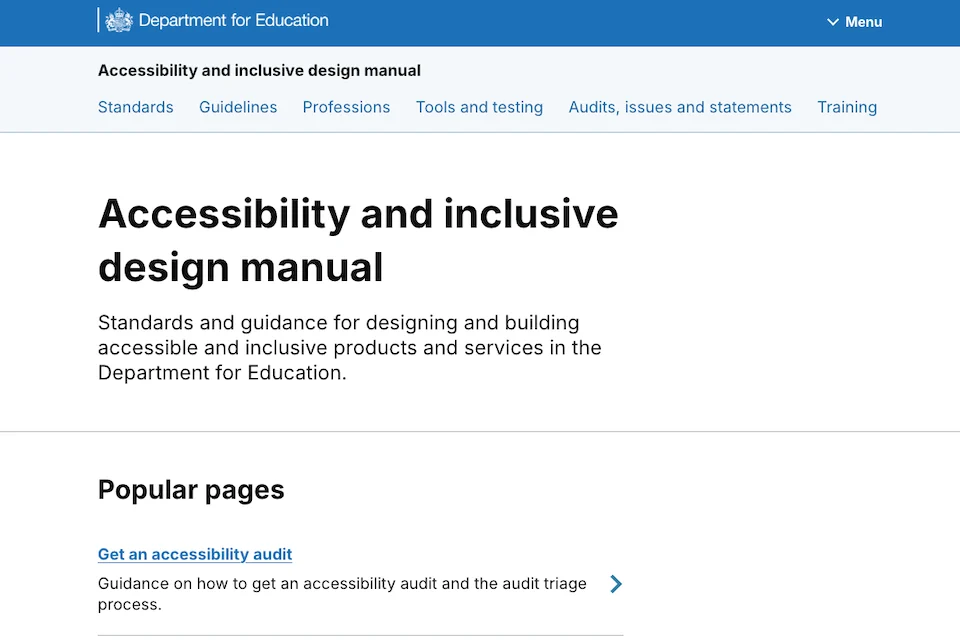
The redesign of the manual’s homepage reflects a broader trend in government digital design toward minimalism and clarity. The 2024 homepage was criticized for being "too busy," featuring an excess of icons, images, and a long-scroll format that contributed to information overload.
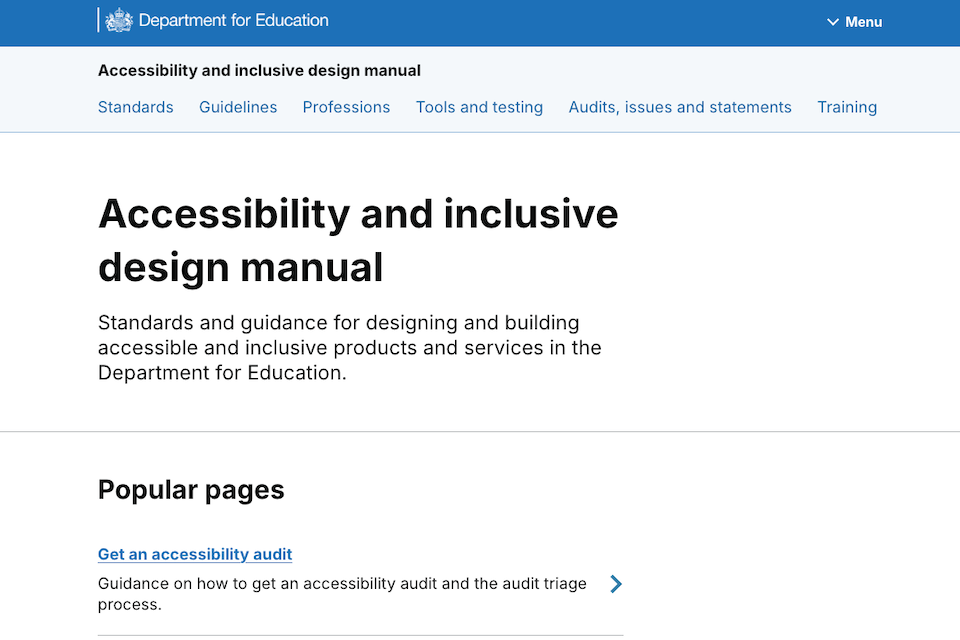
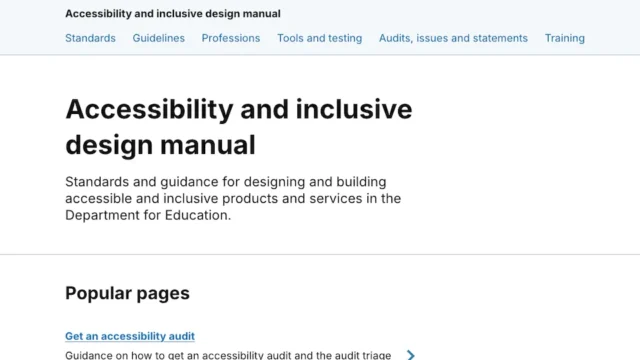
The 2025 version features a simplified interface with a revamped top navigation bar. The removal of unnecessary visual elements is not merely an aesthetic choice; it is a functional one. For users with neurodivergent conditions or those using assistive technologies, a cleaner interface reduces the cognitive effort required to navigate the site. By prioritizing a "search-first" and "task-first" layout, the DfE has aligned the manual with the very inclusive design principles it advocates.
Supporting Data and the Impact of Digital Inclusion
The importance of the DfE’s manual is underscored by broader UK digital trends. According to the Office for National Statistics (ONS), the gap in internet usage between disabled and non-disabled adults is narrowing, but barriers to service access remain a critical issue. Furthermore, the Public Sector Bodies (Websites and Mobile Applications) Accessibility Regulations 2018 mandate that all public sector websites meet the Web Content Accessibility Guidelines (WCAG) 2.2 AA standard.
The DfE manual serves as a vital bridge between these high-level legal requirements and the day-to-day work of government employees. Internal data from the DfE suggests that teams utilizing the manual have seen a measurable reduction in accessibility "bugs" identified during final audits. By providing clear, actionable guidance early in the design process, the department is effectively "shifting left" on accessibility, which is both more cost-effective and leads to better outcomes for end-users.
Official Responses and Sector Implications
While the manual was primarily developed for internal DfE teams, its public-facing nature has garnered attention across the wider public sector and the global design community. Digital leaders within the Cabinet Office have noted that the DfE’s approach to "learning out loud" and iterating on its own guidance serves as a model for other departments.
"The update to the DfE Accessibility and Inclusive Design Manual reflects a maturing of our digital culture," noted a senior digital strategist familiar with the project. "It moves us away from viewing accessibility as a checklist to be completed at the end of a project, and toward viewing it as a fundamental component of the design process itself."
The manual’s utility extends beyond the Department for Education. Because it is built on open standards and addresses universal design challenges, it is being adopted by local authorities, educational institutions, and private sector contractors who provide services to the government. This "multiplier effect" ensures that the DfE’s investment in user research provides value far beyond its own organizational boundaries.
Fact-Based Analysis of Implications
The 2025 update to the DfE manual signals a broader shift in how digital governance is managed in the UK. As services become increasingly "digital by default," the risk of excluding vulnerable populations grows. The DfE’s decision to reorganize its guidance around the "user journey" acknowledges that accessibility is not a static destination but a continuous process of refinement.
The implications for the education sector are particularly profound. As more classroom resources, student loan applications, and teacher certification processes move online, the accessibility of these platforms becomes a matter of educational equity. A student with visual impairments or a teacher with motor difficulties must be able to navigate DfE services with the same ease as any other user. By refining the manual to be more usable for developers, the DfE is directly contributing to a more equitable educational landscape.
Future Outlook: Continuous Improvement in a Rapidly Changing Landscape
The July 21 launch is not the final step for the DfE Accessibility and Inclusive Design Manual. The department has committed to a cycle of continuous improvement, acknowledging that as assistive technologies evolve—such as the integration of AI-driven screen readers and voice-controlled interfaces—the guidance must also adapt.
The DfE’s proactive approach in 2025 sets a high bar for digital service standards. By documenting not just the successes but also the areas where the initial 2024 version fell short, the department provides a transparent roadmap for other organizations looking to improve their own digital accessibility. As the manual continues to be used and critiqued by the global design community, it will remain a living document, evolving alongside the needs of the users it was built to serve.
In conclusion, the 1,200-word expansion of the DfE Accessibility and Inclusive Design Manual represents more than just a website update; it is a strategic realignment of digital resources to meet the legal, ethical, and functional demands of modern governance. Through rigorous user research, structural simplification, and a focus on practical application, the DfE has created a resource that ensures "inclusive design" is a reality rather than just a policy goal.