The current trajectory of industry leaders suggests that this transition is already underway. DHL’s Strategy 2030 explicitly prioritizes the integration of AI and machine learning across its global network, with the company estimating that 30% of its material-handling fleet will feature some form of robotic automation by the end of the decade. Similarly, FedEx is aggressively scaling its digital infrastructure, aiming to integrate AI into over 50% of its core operational workflows by 2028. This move toward "smart" warehouses is not merely a play for productivity; it is a necessary reaction to the increasing density of traffic within distribution centers.
The Evolving Landscape of Warehouse Hazards
The fundamental challenge for modern logistics safety is the convergence of human unpredictability and mechanical precision. As warehouses deploy more automated guided vehicles (AGVs) and autonomous mobile robots (AMRs), the number of interaction points between workers and machines grows exponentially. In a traditional warehouse, a forklift operator can rely on visual cues and established right-of-way rules. In a modern facility, a worker may be operating in a space shared with dozens of autonomous units that process navigation data in milliseconds.

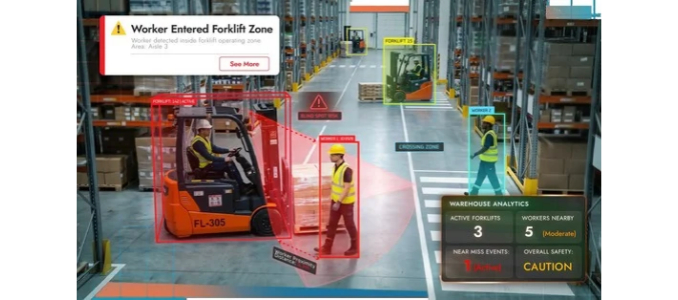
This dynamic environment creates a safety paradox: while automation removes some risks, such as repetitive strain or manual heavy lifting, it introduces high-velocity interaction risks that are difficult for human perception to manage. Fixed safety rules, such as physical barriers or designated walkways, are often too rigid for the fast-paced, fluid nature of modern logistics, where congestion can shift in seconds. AI-driven vision systems provide a solution by offering continuous, 360-degree monitoring that can predict potential collisions before they occur, alerting both the machine and the human to maintain safe distances.
The Persistent Crisis: Why Current Safety Measures Fall Short
Despite the influx of billions of dollars in logistics technology, the industry continues to struggle with high rates of workplace injury and fatality. Data from the U.S. Bureau of Labor Statistics (BLS) highlights a sobering reality: the warehousing and storage sector reported an injury and illness rate of 4.8 cases per 100 full-time workers in 2024. This figure remains significantly higher than other high-hazard industries, including manufacturing (2.7) and construction (2.2).

The most harrowing metric remains the annual fatality count. In 2024, transportation and material-moving occupations accounted for 1,391 fatal work injuries, the highest of any occupational category monitored by the BLS. These statistics serve as a grim reminder that traditional safety management—largely retrospective and reactive—has failed to keep pace with the modernization of the sector. The shift toward AI is therefore not just an technological upgrade; it is a necessary response to an industry-wide safety crisis that manual oversight can no longer address.
A Chronology of Integration: From Manual to Autonomous
The evolution of safety in logistics can be viewed through three distinct phases:

- Pre-2015 (The Era of Physical Barriers): Safety was defined by separation. Physical fencing, painted floor lines, and mechanical kill-switches were the primary tools. Risk management was centered on "keeping people away from machines."
- 2015–2023 (The Pilot Era): As robotics became more viable, companies began experimenting with "cobots" (collaborative robots) and basic proximity sensors. Safety systems remained siloed, with limited integration between the machine’s software and the facility’s broader management system.
- 2024–2030 (The AI-Integrated Era): The current shift focuses on "situational awareness." AI systems analyze live video feeds and sensor data to map human movement, predict "near misses," and automatically adjust machine speed or routing to avoid conflict. By 2030, this is expected to be the baseline for all major distribution hubs.
Implications for Global Operations and Regulatory Compliance
Industry analysts suggest that the adoption of AI-driven safety will have significant ripple effects on global logistics. First, the data generated by these AI systems will likely lead to a new era of proactive regulation. As safety monitoring becomes more granular, government agencies like OSHA (in the U.S.) or the European Agency for Safety and Health at Work may shift from prescriptive, rule-based standards to data-backed performance standards. Facilities that can prove their safety systems are capturing and mitigating risks in real-time may eventually benefit from lower insurance premiums and fewer regulatory inspections.
Second, the workforce is being fundamentally reshaped. There is growing concern regarding the "human-in-the-loop" requirement. While AI reduces the likelihood of accidents, it also creates a dependency. Safety training must now evolve to include "AI literacy," where workers are taught not only how to operate machines but how to interpret the signals and alerts provided by the AI monitoring system.

Expert Perspectives and Future Outlook
While industry leaders like DHL and FedEx are at the forefront, the transition to AI-standard safety is expected to permeate the broader logistics market, including smaller regional players. The "trickle-down" effect of technology is already visible in the proliferation of AI-based safety software startups that offer retrofittable camera kits for older warehouse equipment.
However, challenges remain. Privacy concerns regarding constant surveillance of workers, the cost of implementing high-end sensors across legacy infrastructure, and the potential for "alert fatigue"—where workers become desensitized to constant machine warnings—are significant hurdles. Safety experts emphasize that AI should be viewed as a tool to augment, not replace, a culture of safety. The technology provides the data, but the leadership must provide the commitment to act upon that data.

Looking toward 2030, the vision of a "zero-incident" warehouse is becoming a tangible goal rather than an aspirational one. The success of this transition will depend on the industry’s ability to balance rapid technological deployment with ethical data management and human-centric design. If the logistics sector can successfully integrate AI to monitor, predict, and prevent accidents, the impact on worker welfare will be profound, potentially reversing decades of stagnant safety statistics in the warehousing and transportation sectors.
As the industry moves closer to this future, the focus will increasingly shift from "how do we prevent accidents" to "how do we design environments where accidents are mathematically unlikely." By 2030, the warehouse will not just be a site of storage and distribution; it will be an intelligent, self-regulating ecosystem where safety is baked into the very code that governs the movement of goods. The transition is not merely inevitable; it is a foundational requirement for the future of global commerce.