Historical Context: From the Milan Conference to Modern Genetics
The current advocacy efforts by the NAD are deeply rooted in the historical trauma of the late 19th century. In 1880, the Second International Congress on Education of the Deaf, held in Milan, Italy, served as a catalyst for a global movement to suppress sign languages in favor of oralism. The Milan Conference resolutions effectively marginalized Deaf educators and sought to integrate Deaf individuals into hearing society by eliminating their linguistic identity. This existential threat to the community necessitated the formation of the NAD, which was established that same year to defend American Sign Language (ASL) and ensure that Deaf people retained control over their own lives and education.
For nearly 150 years, the NAD has operated on the premise that Deafness is not a medical pathology requiring a cure, but rather a linguistic and cultural identity. The organization maintains that the community is a robust minority group defined by ASL, shared history, and a distinct cultural perspective. The modern debate over gene therapy is viewed by many advocates as a technological extension of the oralist movement, which similarly sought to "normalize" Deaf individuals at the expense of their heritage.
The Technological Landscape of Gene Therapy
The scientific landscape has shifted dramatically over the last decade. Breakthroughs in CRISPR-Cas9 and other gene-editing technologies have opened doors for treatments targeting hereditary hearing loss, such as mutations in the OTOF (otoferlin) gene, which can cause profound sensorineural hearing loss. As of 2026, clinical trials for gene therapy have shown success in restoring some level of auditory function in select patient populations.
However, the rapid pace of these advancements has outstripped the accompanying ethical frameworks. While proponents of gene therapy argue that these interventions offer medical autonomy to parents and individuals seeking to restore hearing, critics—including the NAD—contend that the narrative framing of these technologies is inherently biased. The medical model of disability often categorizes Deafness as a "deficit" to be corrected, a perspective that the NAD argues ignores the social and cultural reality of millions of people who live full, productive lives without hearing.
Data and Ethical Implications
Statistical data regarding the Deaf community underscores the scale of the potential impact. According to the World Health Organization (WHO), over 1.5 billion people live with some degree of hearing loss globally, and this number is projected to increase due to demographic shifts. In the United States, the NAD represents a diverse population that relies on ASL as its primary mode of communication.
The ethical implications of gene therapy are vast. If genetic editing becomes a standard of care for children born with hearing loss, the societal view of Deafness may shift from a naturally occurring form of human diversity to a "preventable error." This shift carries the risk of decreasing societal support for inclusive education, ASL resources, and the accessibility infrastructure that the NAD has fought to establish through legislation like the Americans with Disabilities Act (ADA).
Official Responses and Stakeholder Positions
The NAD’s position has garnered attention from across the bioethics and scientific communities. While the organization acknowledges the legitimacy of gene therapy in addressing life-threatening conditions, it draws a hard line at the modification of human identity.
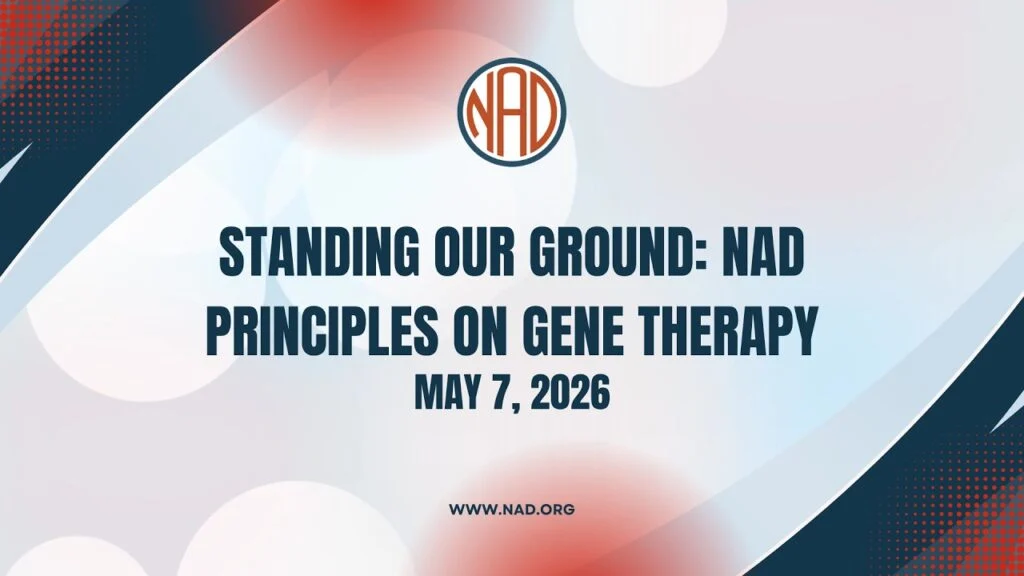
"We do not exist to be fixed," the NAD stated in its May 2026 announcement. This sentiment is supported by several disability rights groups who argue that "curative" medicine often fails to account for the quality of life enjoyed by disabled individuals. Conversely, some medical research entities emphasize that the goal of their work is to provide patients with the widest possible range of options.
The divide centers on the concept of "informed consent" and "informed choice." The NAD contends that currently, families are often presented with gene therapy through a lens that emphasizes the "loss" of hearing rather than the gain of a rich, linguistic culture. Consequently, the NAD is calling for a mandated inclusion of Deaf stakeholders in all stages of genetic research, from the initial hypothesis formation to the development of public health messaging.
A Call for Institutional Reform
The NAD has issued a specific call to action for the U.S. federal government and international scientific bodies. Their requirements for ethical engagement include:
- Inclusive Representation: Federal agencies, including the National Institutes of Health (NIH) and the Food and Drug Administration (FDA), must incorporate Deaf leaders into oversight committees that evaluate genetic research.
- Linguistic and Cultural Literacy: Researchers must undergo training regarding the Deaf community’s history and the role of ASL to ensure that communication with families is neutral and respectful of cultural identity.
- Transparency in Reporting: Studies must move away from language that pathologizes Deafness, adopting instead the "human diversity" framework.
- Sustained Dialogue: The scientific community should commit to ongoing, open-ended forums with the NAD to discuss the societal impacts of their work before innovations reach the public.
Broader Societal Impact
The implications of this policy shift extend far beyond the Deaf community. The debate serves as a bellwether for how society will handle the broader integration of gene-editing technologies in other areas of human variation. By challenging the necessity of "fixing" Deafness, the NAD is forcing a broader conversation about what it means to be human in the age of CRISPR.
If genetic science proceeds without these guardrails, there is a risk of creating a societal divide where those who are "genetically modified" are prioritized over those who retain their natural biological state. This could lead to a new form of eugenics, albeit one framed in the language of medical progress.
The NAD’s task force, established in response to these concerns, will focus on sustained advocacy to ensure that accessibility, not just biological modification, remains the priority for federal health policy. By maintaining that Deafness is a vibrant part of the human tapestry, the organization is asserting that the future of medicine must be guided by human rights, not merely technological capability.
Conclusion: Looking Ahead
As of mid-2026, the scientific community faces a pivotal decision: to proceed in a siloed, profit-and-innovation-driven trajectory, or to embrace a collaborative model that respects the autonomy of the communities it impacts. The NAD’s mandate remains unchanged from its 1880 origins. The organization is committed to a future where Deaf individuals are not viewed as subjects for clinical eradication, but as full, valued members of society.
The work of the newly formed NAD task force will be critical in the coming years. By monitoring clinical trials and engaging with policymakers, the NAD aims to ensure that the advancements of the 21st century do not come at the cost of the cultural and linguistic heritage of the Deaf community. The message is clear: scientific progress is only true progress if it elevates all of humanity, rather than attempting to erase the diversity that defines it. Through sustained engagement, advocacy, and a firm commitment to its historical mandate, the NAD is positioning itself to be a decisive voice in the future of genetic medicine, ensuring that the Deaf community remains a protected and vital part of the human experience.