The revision process was prompted by an extensive period of user research and data analysis. While initial feedback following the 2024 launch was positive, internal data indicated that while users were frequently accessing the content, they often struggled with navigation and the practical application of specific guidelines. By focusing on the lived experiences of digital professionals, the DfE Digital team identified several "friction points" that hindered the effectiveness of the original manual. The resulting updates prioritize clarity, searchability, and the "why" behind inclusive design, ensuring that accessibility is treated not as a final compliance check, but as a foundational element of the design process.
The Evolution of Digital Standards at the Department for Education
The journey toward the current iteration of the manual began nearly a year ago. In September 2024, the DfE published the first version of the Accessibility and Inclusive Design Manual with the goal of centralizing guidance that had previously been fragmented across various internal documents. This initial release was a response to the growing complexity of digital services and the increasing legal requirements placed on public sector bodies.
Under the Public Sector Bodies (Websites and Mobile Applications) (No. 2) Accessibility Regulations 2018, all government digital services must meet the Web Content Accessibility Guidelines (WCAG) 2.2 at the AA standard. However, the DfE recognized that meeting legal minimums is often insufficient for providing truly equitable services. Between late 2024 and early 2025, the department conducted a series of deep-dive research sessions with cross-functional teams. This research focused on three primary objectives: understanding how users navigate the manual, identifying which sections provided the most value, and uncovering gaps where professionals felt unsupported in their daily tasks.
The findings revealed that while the technical content was sound, the information architecture was misaligned with the way design and delivery teams actually work. This realization set the stage for the substantial reorganization that defines the July 2025 update.
Structural Overhaul: Moving Beyond the Knowledge Hub
One of the most significant changes in the updated manual is the complete removal of the section formerly known as the ‘Knowledge Hub.’ In the original version, the Knowledge Hub was intended to be a centralized library for all things related to accessibility theory and documentation. However, user feedback characterized the section as a "dumping ground" for content that did not fit elsewhere. This created a high cognitive load for users, who found themselves sifting through a cluttered interface to find specific answers.
In the 2025 update, the DfE took a more surgical approach to content placement. Instead of isolating knowledge into a single hub, the information was redistributed into sections that align with the specific stages of a user’s journey. For example, theoretical guidance on inclusive design principles was moved to the "Design" and "Strategy" sections, where it is most relevant to practitioners during the ideation phase.
This restructuring reflects a broader trend in technical documentation known as "content modeling," where information is categorized by its utility rather than its topic. By organizing content based on how people think and search—such as "How do I build an accessible form?" or "What are the legal requirements for a mobile app?"—the manual has become a more efficient tool for high-velocity delivery teams.
Redefining Guidance: Focus on People and Purpose
The second major pillar of the update involves the "Tools" guidance. In previous versions, this section functioned primarily as a directory of software and installation instructions. While helpful for technical setup, it failed to address the strategic needs of the workforce. Designers and developers reported that while they knew how to install an accessibility checker, they were often unsure when to use it or which tool was most appropriate for a specific task.
The improved manual now prioritizes the human element of tool usage. The guidance has been rewritten to answer critical questions:
- At what stage of the project should this tool be implemented?
- What specific accessibility barriers does this tool help identify?
- How should the results of these tools be interpreted to improve the user experience?
By shifting the focus from the technical specifications of the tools to the needs of the people using them, the DfE is fostering a culture of "shifting left." In the context of software development, "shifting left" refers to the practice of performing testing and quality assurance earlier in the lifecycle. By providing clearer guidance on tool selection and timing, the manual empowers teams to catch accessibility issues during the wireframing and prototyping stages, significantly reducing the cost and time required for remediation later.
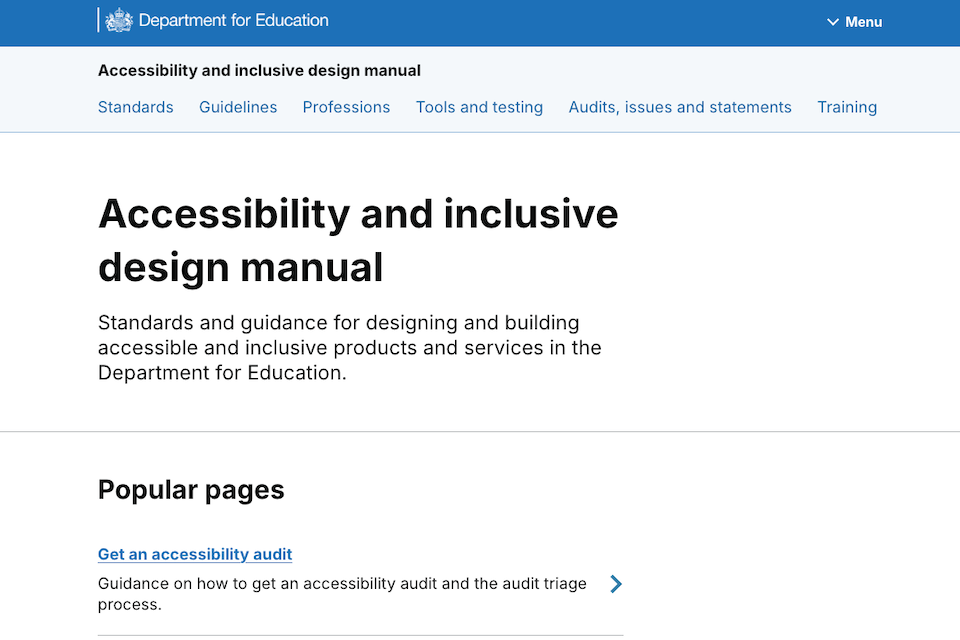
Simplifying the User Interface for Enhanced Accessibility
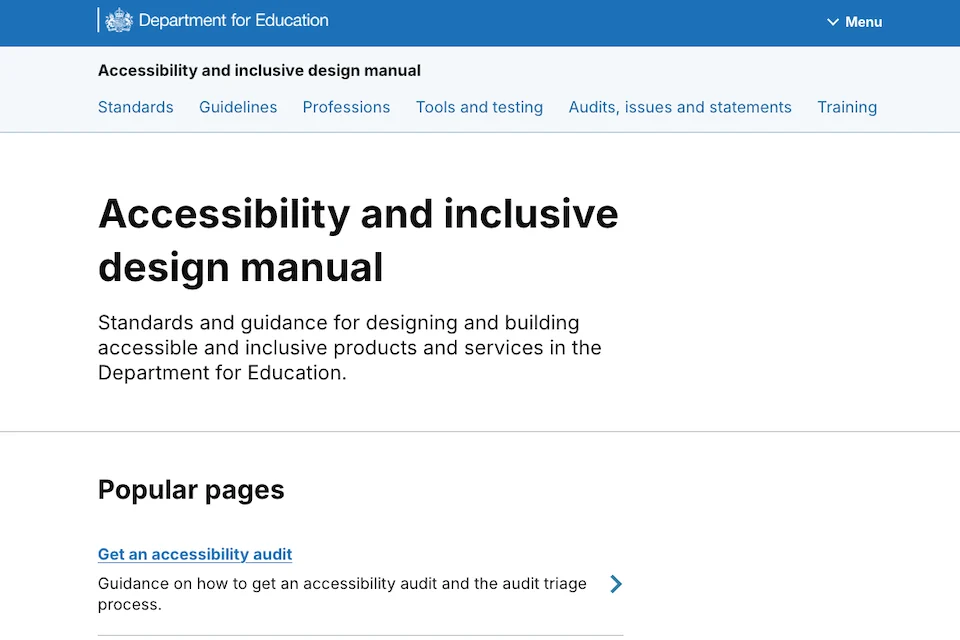
In an ironic but necessary twist, the original manual for accessibility was itself in need of an accessibility upgrade. User testing revealed that the homepage was overly complex, featuring a "long scroll" and an abundance of icons and images that distracted from the core navigation. For users with neurodivergent conditions or those using assistive technologies like screen readers, the busy layout presented unnecessary hurdles.
The July 2025 update introduced a simplified homepage that adheres to the "less is more" philosophy of government digital standards. Key improvements include:
- Reduced Visual Noise: The removal of non-essential icons and decorative imagery to create a cleaner, more focused interface.
- Streamlined Navigation: The top navigation bar was redesigned to provide clear, intuitive pathways to the most frequently used sections of the manual.
- Improved Searchability: The search function was optimized to deliver more relevant results, allowing users to bypass the homepage entirely if they are looking for specific technical solutions.
These changes ensure that the manual practices what it preaches, providing a seamless experience for the very professionals who are tasked with building accessible services for the public.
Supporting Data and the Economic Case for Inclusive Design
The DfE’s investment in this manual is supported by a growing body of data highlighting the importance of digital inclusion in the United Kingdom. According to the Family Resources Survey, approximately 16 million people in the UK (roughly 24% of the population) reported having a disability in the 2022-2023 period. For a government department like the DfE, which serves students, parents, and educators, ensuring that digital platforms are accessible is not just a legal requirement but a fundamental service delivery issue.
Research from the Cabinet Office and the Government Digital Service (GDS) has consistently shown that accessible design benefits everyone, not just those with permanent disabilities. Features like high-contrast text, clear headings, and logical navigation assist users with temporary impairments (such as a broken arm) or situational limitations (such as using a mobile device in bright sunlight).
Furthermore, there is a clear economic argument for the "inclusive by design" approach. Industry data suggests that fixing an accessibility bug after a product has been launched can be up to 30 times more expensive than addressing the issue during the initial design phase. By providing DfE teams with a superior manual, the department is likely to see long-term savings in development costs and a reduction in the need for manual support interventions for users who struggle with inaccessible websites.
Official Responses and Strategic Implications
While the manual was developed specifically for DfE internal teams, the department has taken the notable step of making the resource public. This "open by default" approach is a hallmark of the UK Government’s digital strategy, allowing the wider tech industry and other public sector bodies to benefit from the DfE’s research and expertise.
A spokesperson for the DfE Digital team emphasized that the manual is a living document. "The launch of the updated manual is not the end of the journey," the department noted. "We will continue to monitor how the guidance is used and iterate based on new technologies and evolving user needs."
Industry experts have praised the move, noting that the DfE’s manual fills a critical gap in practical, task-oriented accessibility guidance. While the WCAG provides the international standard, it can often be abstract and difficult to translate into daily design tasks. The DfE manual bridges this gap by providing contextualized examples that are relevant to the specific challenges of educational and public service platforms.
Looking Ahead: The Future of Inclusive Design in Government
The release of the improved DfE Accessibility and Inclusive Design Manual arrives at a time of rapid technological change. As artificial intelligence (AI) and automated testing become more integrated into the design process, the DfE is already looking toward future updates that will address the intersection of AI and accessibility.
The department’s proactive approach sets a benchmark for other government entities. As more services move online—from student loan applications to teacher certification portals—the manual will serve as the "north star" for quality assurance. The 2025 updates demonstrate that for the Department for Education, accessibility is not a checkbox to be ticked, but a continuous process of learning, listening, and refining.
By prioritizing the user journey, simplifying the interface, and focusing on the strategic application of tools, the DfE has created a resource that is as functional as it is informative. As digital professionals across the UK begin to adopt the new guidelines, the ultimate beneficiaries will be the millions of citizens who rely on the Department for Education for clear, accessible, and inclusive digital services.