The initiative reflects a broader shift within the Civil Service to move beyond mere compliance with the Public Sector Bodies (Websites and Mobile Applications) Accessibility Regulations 2018. By prioritizing "inclusive design" over simple "accessibility checklists," the DfE aims to ensure that educational services are usable by the widest possible audience, including the estimated 16 million people in the UK living with a disability.
Core Objectives and Research Methodology
The decision to restructure the manual was not arbitrary but rooted in qualitative and quantitative research conducted following the initial 2024 launch. While initial data indicated high traffic and positive reception, deep-dive sessions with internal stakeholders revealed friction points in how information was consumed and applied.
The DfE digital team focused its research on three primary pillars: discoverability, utility, and role-specific application. By observing how designers, product owners, and delivery leads interacted with the content, researchers identified that while the technical information was accurate, the organizational structure often hindered rapid implementation during the active phases of a project.
The research revealed that users were often overwhelmed by the volume of information, leading to "decision fatigue." This prompted a strategic pivot toward a "user journey" model, where information is presented according to the stage of the product lifecycle rather than by technical category.
Chronology of Development: From Launch to Evolution
The journey toward the current iteration of the manual began in the summer of 2024. The DfE recognized a gap in localized guidance that translated broad Web Content Accessibility Guidelines (WCAG) into actionable steps for educational digital services.
- September 2024: The first version of the DfE Accessibility and Inclusive Design Manual was published. It served as a centralized repository for accessibility standards and technical requirements.
- Late 2024 – Early 2025: The DfE User Research team conducted a series of audits and interviews. They analyzed telemetry data to see which pages were being bookmarked and where users were dropping off.
- Spring 2025: The "Knowledge Hub" section was identified as a significant pain point. Feedback described it as a "dumping ground" for miscellaneous information, which diluted the manual’s authority.
- May – June 2025: Iterative prototyping of a new homepage and navigation structure took place. The team focused on reducing cognitive load by simplifying visual elements.
- July 21, 2025: The updated manual went live, featuring a reorganized content hierarchy and a refined focus on the "why" and "how" of accessibility tools.
Reorganizing Content for Modern Workflows
One of the most drastic changes in the 2025 update was the complete removal of the "Knowledge Hub." In its place, the DfE implemented a logic-based distribution of content. The team recognized that a standalone section for "knowledge" suggested that accessibility was a separate academic pursuit rather than an integrated part of the design process.
Under the new structure, content previously housed in the hub has been integrated directly into the relevant stages of the design and delivery process. For example, guidance on cognitive impairments is now paired directly with UI design patterns, and legislative requirements are integrated into product management checklists. This ensures that the right information reaches the right person at the exact moment they are making a design or policy decision.
Furthermore, the DfE addressed the "searchability" issue. By aligning the manual’s architecture with the mental models of its users—specifically how designers search for "alt-text best practices" versus how delivery managers search for "compliance reporting"—the manual has reduced the time-to-information significantly.
Enhanced Guidance on Accessibility Tools
A critical component of the update involved a complete reimagining of the "Tools" section. Previously, this section served as a technical directory, listing software such as screen readers, contrast checkers, and automated testing suites, alongside installation instructions.
User feedback indicated that simply knowing how to install a tool was insufficient. Digital teams needed to understand why a specific tool was recommended and, crucially, what its limitations were. The updated manual now provides a contextual framework for each tool, answering three vital questions:
- What specific accessibility barriers does this tool help identify?
- At what stage of the development cycle should this tool be utilized?
- Who is the primary audience for this tool (e.g., developers for code linting vs. designers for color contrast)?
This shift moves the manual away from being a passive reference guide toward being an active decision-support system. By focusing on the "people needs" behind the tools, the DfE is encouraging teams to engage in manual testing and user testing with disabled people, rather than relying solely on automated scripts which typically only catch 30% to 40% of accessibility issues.
Streamlining the User Interface
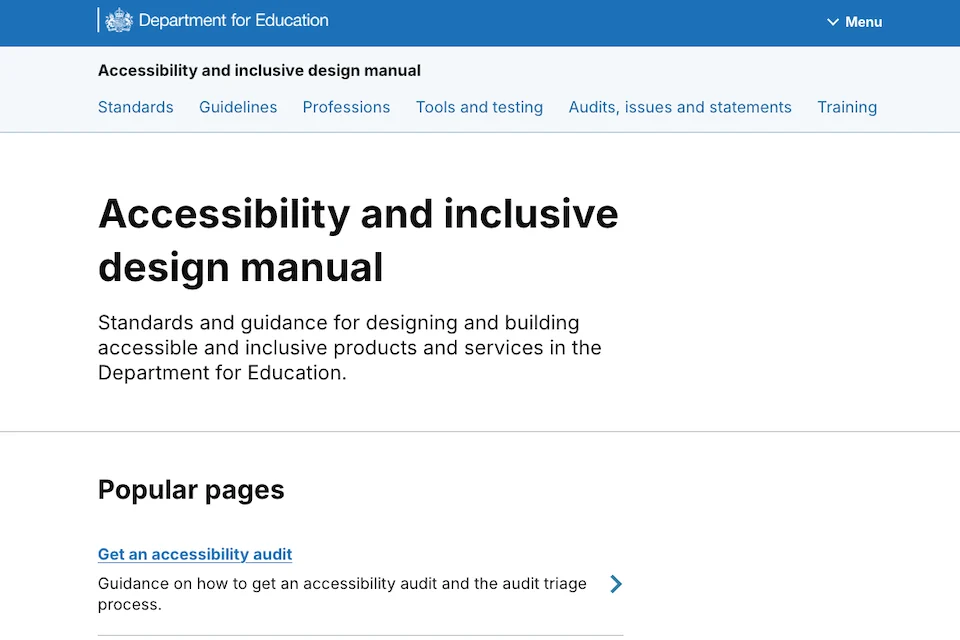
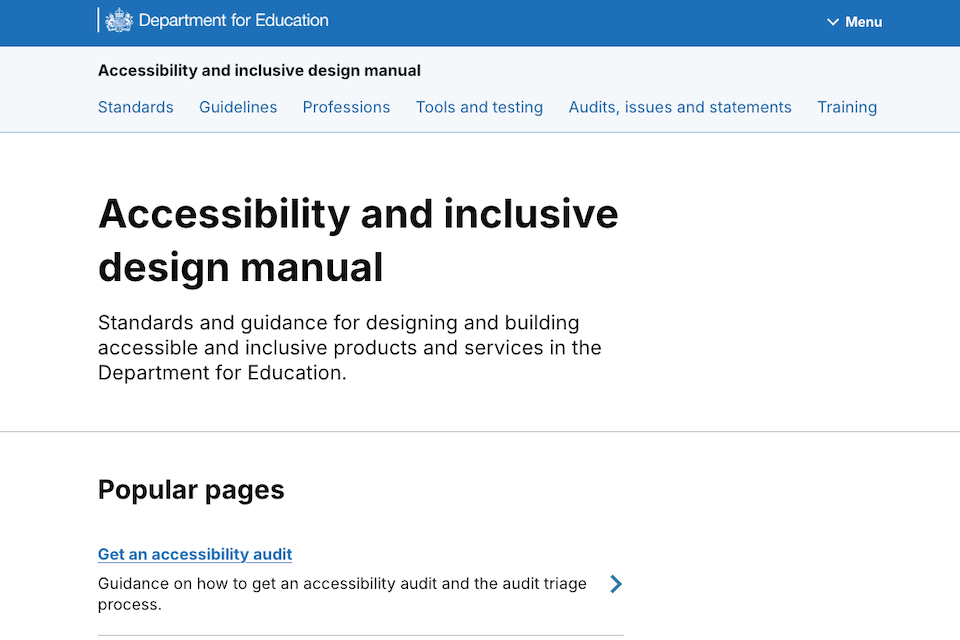
The visual and functional design of the manual itself was also a focus of the July 2025 update. The original homepage was criticized for being "too busy," featuring an excess of icons, images, and an exhaustive "long scroll" that made it difficult for users to orient themselves.
The DfE design team applied the very principles found within the manual to its own interface. The new homepage features:
- Simplified Navigation: A cleaner top-level menu that prioritizes the most frequently accessed sections.
- Reduced Cognitive Load: The removal of non-essential decorative imagery and icons that did not contribute to the user’s understanding of the content.
- Enhanced Typography and Layout: Improved whitespace and clear heading hierarchies to facilitate "scanning," which is the primary way professional users consume technical documentation.
Statistical Context and the Importance of Inclusive Design
The DfE’s investment in this manual comes at a time when digital accessibility is under increased scrutiny. According to data from the "2024 WebAIM Million" report, 95.9% of the top one million homepages had detectable WCAG 2 failures. In the public sector, the stakes are even higher, as citizens often have no alternative way to access essential services like student loans, teacher training applications, or school performance data.
In the UK, approximately 24% of the population reports having a long-term illness, impairment, or disability. For the DfE, this includes students with visual impairments, parents with neurodivergence, and teachers with motor-skill challenges. By refining the Accessibility and Inclusive Design Manual, the DfE is effectively future-proofing its services against legal challenges and ensuring equitable access to education-related digital infrastructure.
Official Responses and Strategic Implications
While the manual was developed by the DfE, its release has garnered attention from the Central Digital and Data Office (CDDO) and the Government Digital Service (GDS). While no official joint statement was issued, the alignment with GDS Service Standards is evident.
Design leaders within the DfE have emphasized that the manual is a "living document." The decision to make it publicly accessible—despite being designed for internal DfE teams—reflects the department’s commitment to the "open by default" principle of the UK Government Design Principles.
"Accessibility is not a destination; it is a continuous process of improvement," noted a senior DfE design source during the internal launch. "The 2025 update isn’t just about moving content around. It’s about recognizing that our teams are busy and need clear, actionable guidance that fits into their existing workflows. If we make it easier for our staff to build accessible services, the end-user—the public—is the ultimate winner."
Broader Impact on the Public Sector
The implications of the DfE’s updated manual extend far beyond a single department. By providing a high-quality, free resource, the DfE is setting a benchmark for other government bodies and private sector organizations.
The "shift-left" approach advocated in the manual—moving accessibility considerations to the very beginning of the design process—has been proven to be more cost-effective. Industry data suggests that fixing an accessibility bug during the design phase can be up to 100 times cheaper than fixing it after the product has been launched.
As local authorities and other departments look to refresh their own digital guidelines, the DfE Accessibility and Inclusive Design Manual serves as a modern template. It demonstrates that the key to effective digital governance is not just providing the "what" of technical standards, but the "how" of user-centric implementation.
The July 21 update represents a mature phase of digital service delivery within the DfE. By listening to its users and iteratively improving its own tools, the department is ensuring that the future of education technology in the UK is not only innovative but fundamentally inclusive for every citizen.