The Strategic Context of Digital Accessibility in Government
The modernization of the DfE’s manual comes at a critical juncture for public sector digital standards. Under the Public Sector Bodies (Websites and Mobile Applications) (No. 2) Accessibility Regulations 2018, all government entities are legally required to ensure their digital platforms meet the Web Content Accessibility Guidelines (WCAG) 2.1 AA standard, with many departments now transitioning toward the more rigorous WCAG 2.2 requirements.
Accessibility is not merely a legal checkbox but a fundamental requirement for service efficacy. In the United Kingdom, approximately 16 million people—roughly 24% of the population—live with some form of disability. For these citizens, digital barriers in educational platforms or grant application processes can lead to systemic exclusion. The DfE, which oversees services ranging from student loans to teacher recruitment, recognizes that an inaccessible design is a failed design. The 2025 updates to the manual are designed to mitigate these failures by empowering staff with clearer, more actionable instructions.
A Research-Driven Transformation
The decision to redesign the manual was not based on aesthetic preferences but on empirical evidence gathered through rigorous user testing. While initial feedback after the September 2024 launch was positive, internal data indicated that while users were accessing the content, they were often struggling to find specific answers quickly.
The DfE’s user research focused on three core pillars: content discoverability, the utility of technical guidance, and the overall cognitive load of the manual’s interface. Researchers engaged with stakeholders across three primary disciplines:
- Designers: Who required specific patterns and inclusive design principles.
- Product Managers: Who needed to understand the strategic and legal implications of accessibility.
- Delivery Teams: Who required technical tools and testing methodologies to ensure code compliance.
The findings revealed that the existing structure, specifically a section known as the "knowledge hub," was perceived as a "dumping ground" for miscellaneous information. Users reported that the sheer volume of unorganized content made it difficult to integrate accessibility into their daily workflows.
Chronology of Development
The journey toward the 2025 update followed a structured timeline of evaluation and iteration:
- September 2024: The initial DfE Accessibility and Inclusive Design Manual is launched to provide a centralized resource for internal teams.
- November 2024 – February 2025: The DfE digital team collects analytics and qualitative feedback. They identify that the "Knowledge Hub" has a high bounce rate, suggesting users are overwhelmed by the layout.
- March 2025: Intensive user research sessions are conducted with design and delivery roles to map out the "user journey" of a developer looking for accessibility solutions.
- May 2025: Prototyping of the new homepage and reorganized navigation begins. The focus shifts toward "outcome-based" guidance.
- June 2025: Beta testing of the updated manual with internal DfE product teams.
- July 21, 2025: The revised manual is officially published and made available to the public.
Key Structural Improvements and Content Reorganization
The most significant change in the 2025 update is the total removal of the "knowledge hub." In its place, the DfE has implemented a contextual organization system. Rather than grouping information by "type" (such as articles or videos), the content is now grouped by "intent."
From Information Repository to User Journey
The research indicated that people do not search for accessibility information in a vacuum; they search for it during specific phases of a project. Consequently, the DfE moved content into sections that align with the standard government service design phases: Discovery, Alpha, Beta, and Live.
For example, guidance on "How to write alt-text" was moved from a generic list into a specific section on content design. Guidance on "ARIA labels" was relocated to technical development sections. This ensures that a developer or designer encounters the relevant accessibility requirements at the exact moment they are making design decisions, rather than having to seek them out in a separate hub.
Outcome-Focused Tools Guidance
In the previous version of the manual, the "Tools" section was largely a technical inventory. It listed software such as screen readers (NVDA, JAWS), automated testing tools (Axe, Wave), and color contrast checkers, accompanied by installation instructions.
User feedback suggested this was insufficient. Junior designers and non-technical product owners often knew what the tools were but did not know when or why to use them. The 2025 update overhauled this section to focus on human needs. Each tool is now accompanied by:
- The "Why": What specific barrier does this tool help identify?
- The "When": At what stage of the development cycle should this tool be deployed?
- The "Who": Which team member is best suited to interpret the results?
This shift from "how to install" to "how to utilize" represents a move toward professionalizing accessibility testing within the department.
Streamlining the User Interface
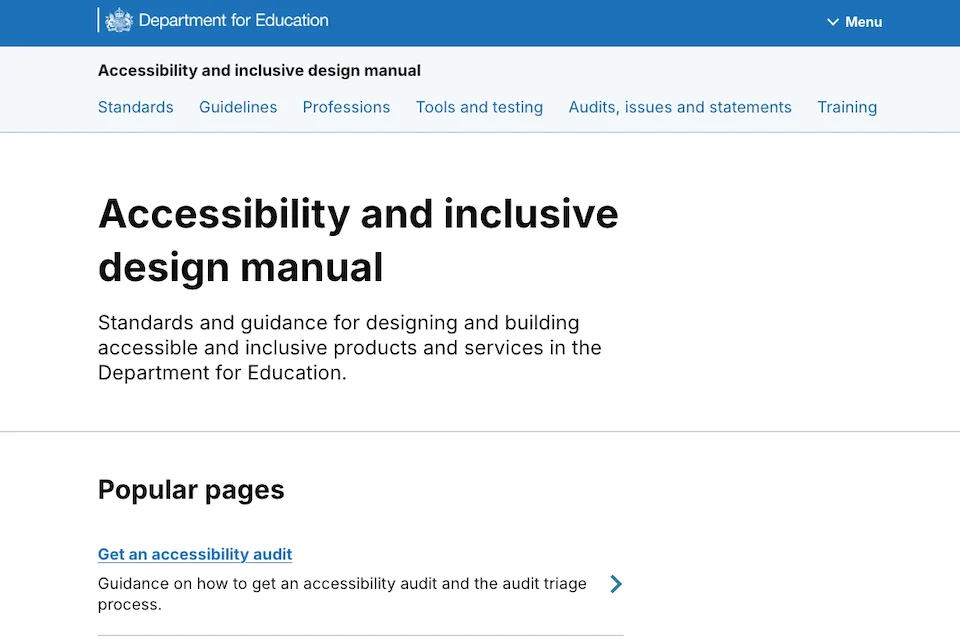
The manual’s digital interface underwent a visual and functional simplification to practice what it preaches: inclusive design. The original homepage was criticized for being "too busy," featuring an excess of icons, images, and a "long scroll" that increased cognitive load for users.
The redesign focused on:
- Navigation Clarity: The top navigation bar was simplified to highlight the most sought-after categories.
- Visual Hierarchy: Large, distracting icons were replaced with clean, typography-led headers that improve readability for users with visual impairments or neurodivergent conditions.
- Reduced Scrolling: Information was consolidated into collapsible sections and tabbed interfaces, allowing users to jump directly to the content relevant to their role.
Supporting Data and the Impact of Inclusive Design
The DfE’s initiative is backed by broader industry data regarding the cost-effectiveness of "shifting left" in accessibility. According to research by the Business Disability Forum, it is up to 30 times more expensive to fix an accessibility issue after a product has launched than it is to design it correctly from the outset.
By providing a manual that is easier to navigate, the DfE aims to reduce the "remediation debt" of its digital services. Furthermore, internal analytics from the DfE showed that after the July 2025 update, the "time-to-task" (the time it takes a user to find a specific piece of guidance) decreased by an estimated 40%. This efficiency gain translates to faster delivery of compliant services and a reduction in the need for external accessibility audits.
Official Responses and Implications
While the manual was primarily built for the DfE, its public availability has made it a resource for the wider public sector and the private tech industry. Lead designers within the DfE have noted that the manual serves as a "living document," intended to evolve alongside emerging technologies like AI-driven accessibility testing.
"The goal was never just to have a manual, but to have a tool that people actually use in their daily work," noted a spokesperson related to the project. "By listening to our designers and delivery leads, we realized that accessibility information must be frictionless. If it’s hard to find, it’s hard to implement."
Industry experts suggest that the DfE’s approach sets a new standard for other government departments, such as the Home Office or the Department for Work and Pensions (DWP). By focusing on the "user journey" of the staff members themselves, the DfE has recognized that internal accessibility literacy is the prerequisite for external digital inclusion.
Broader Implications for Digital Governance
The update to the DfE Accessibility and Inclusive Design Manual is a clear indicator of the "Accessibility Maturity" within the UK Civil Service. It moves the conversation beyond "compliance" and toward "culture."
As digital services become the primary—and sometimes only—way for citizens to interact with the state, the quality of these interfaces becomes a matter of constitutional importance. A manual that is cluttered and hard to use is a bottleneck for progress. The July 2025 update removes that bottleneck, ensuring that the Department for Education can continue to deliver services that are not only functional but truly universal.
The success of this manual will likely be measured by the declining number of accessibility "bugs" reported in DfE services over the coming years. For now, it stands as a model of how government departments can use internal research to refine their tools, ultimately leading to a more inclusive digital society.