The update comes at a critical time for the public sector. As digital transformation continues to reshape how citizens interact with government services—from applying for student loans to managing teacher certifications—the necessity for these platforms to be accessible to all, including the approximately 16 million people in the UK living with a disability, has never been higher. By refining the manual, the DfE aims to lower the barrier for product teams to implement high-quality, inclusive design from the earliest stages of development.
Strategic Context and the Push for Inclusive Design
The DfE’s focus on accessibility is rooted in both legal necessity and moral imperative. Under the Public Sector Bodies (Websites and Mobile Applications) (No. 2) Accessibility Regulations 2018, all public sector digital services must meet the Web Content Accessibility Guidelines (WCAG) 2.2 AA standard. Failure to comply not only risks legal challenges from the Equality and Human Rights Commission (EHRC) but also excludes a significant portion of the population from essential services.
Internal data from the DfE suggests that while awareness of accessibility has increased since 2020, the practical application of these standards remains a challenge for many delivery teams. Designers and developers often struggle with "compliance fatigue," where accessibility is viewed as a final "check-box" exercise rather than a foundational element of the design process. The 2025 update to the manual specifically addresses this by reorganizing content around the actual workflows of design, product, and delivery roles.
A Chronology of Iteration: From Launch to Relaunch
The journey toward the current version of the manual began shortly after its initial publication in late 2024. While the first version was praised for its breadth of information, user analytics and qualitative feedback suggested that the sheer volume of content was becoming a hindrance.
In early 2025, the DfE’s accessibility team initiated a formal research phase. This involved deep-dive interviews and usability testing with internal stakeholders, including content designers, front-end developers, and product managers. The goal was to identify "friction points" where users were getting lost or failing to find the specific guidance they needed to solve immediate technical problems.
By March 2025, the research findings were synthesized into three primary focus areas: the reorganization of the "knowledge hub," the practical application of accessibility tools, and the simplification of the user interface. Throughout the spring of 2025, the team worked on "de-cluttering" the information architecture, leading to the final deployment of the improved manual in July.
Re-engineering Information Architecture: The End of the Knowledge Hub
One of the most significant structural changes in the July 2025 update was the complete removal of the "knowledge hub" section. During the research phase, users frequently described the hub as a "dumping ground" for miscellaneous information. While the content within it was objectively valuable, its lack of clear categorization made it difficult for users to determine which articles were relevant to their specific project phase.
The DfE team opted to dismantle this siloed approach. Instead of housing "knowledge" in a separate wing of the site, the information was integrated directly into the user journey. For example, guidance on "how to write accessible alt-text" was moved from the general knowledge hub into the specific sections related to content design and image implementation.
This shift reflects a broader trend in information science known as "task-based architecture." By aligning information with the user’s mental model—thinking about what they are trying to do rather than what they are trying to know—the DfE has significantly reduced the cognitive load required to navigate the manual.
Shifting Focus: From Tool Installation to Human Needs
The 2025 update also overhauled the guidance regarding accessibility auditing tools. In the previous version, the "Tools" section functioned primarily as a technical directory, listing software such as axe-core, WAVE, and various screen readers, alongside instructions on how to install them.
User feedback revealed that teams did not just need to know how to install a tool; they needed to know when to use it and why it mattered for the end-user. The updated manual now prioritizes the human element of testing. Each tool is now categorized by the specific user need it addresses. For instance, instead of a generic entry for "Screen Readers," the manual now explains how a developer can use a screen reader to verify the logical heading structure of a page, ensuring that a visually impaired student can navigate a complex form efficiently.
This pedagogical shift encourages teams to think beyond automated testing. While automated tools can catch roughly 30% to 40% of accessibility issues, the DfE’s new guidance emphasizes manual testing and user research with people with lived experience of disabilities, which remains the gold standard for inclusive design.
User Interface and Experience Overhaul
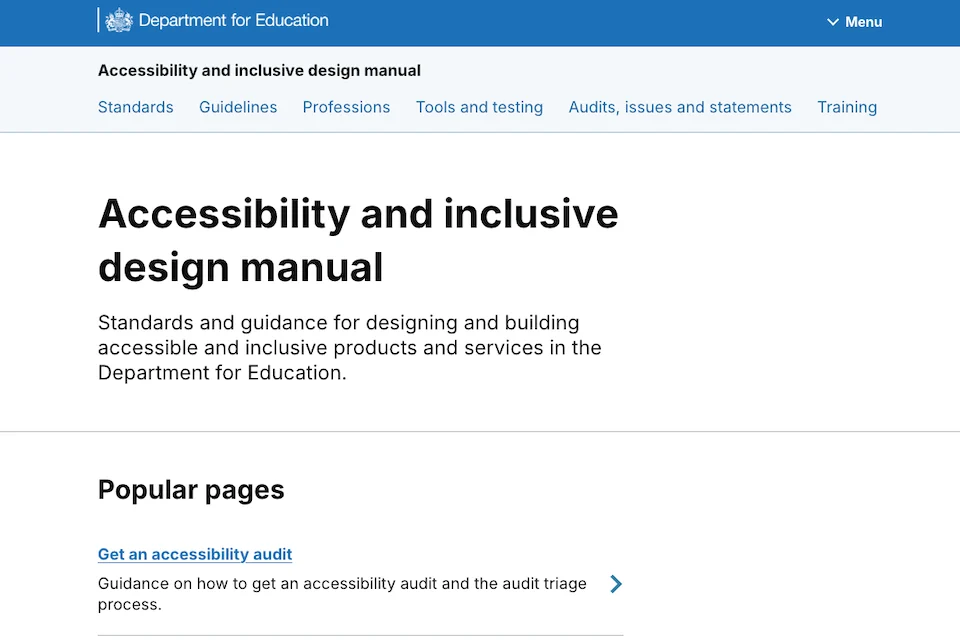
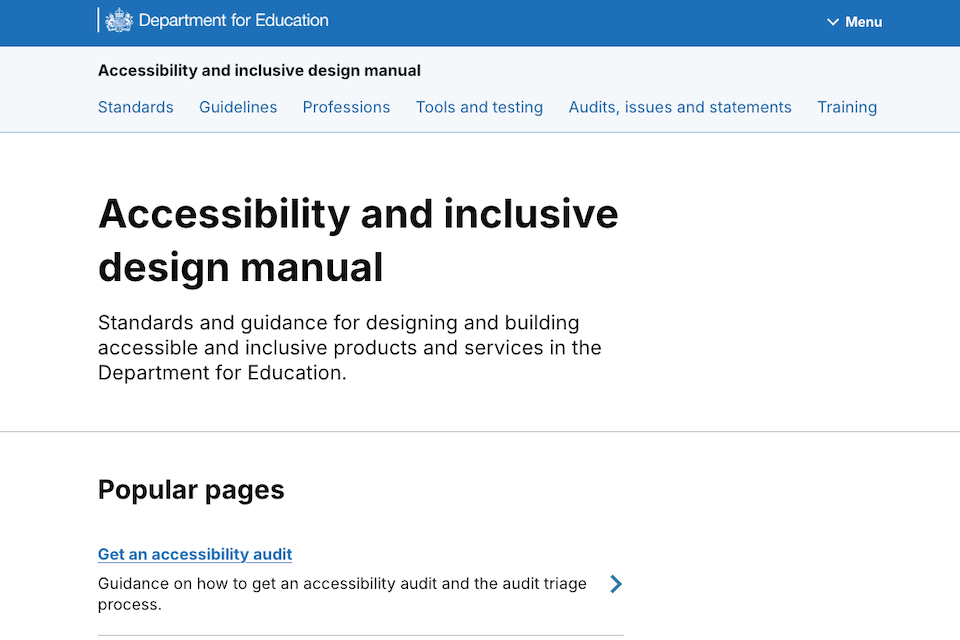
The visual and navigational elements of the manual were not spared in the update. The original homepage was identified as a major pain point; users described it as "too busy," featuring an excessive number of icons, decorative images, and a long scroll that buried vital information.
In the world of government digital services, where the GDS (Government Digital Service) "Design System" champions minimalism and clarity, the old manual’s homepage was an outlier. The July 2025 redesign stripped away these distractions. The new homepage features a streamlined navigation bar and a clear, search-centric layout. By reducing visual noise, the DfE has ensured that the manual itself practices what it preaches: a highly accessible interface that is easy to use for neurodivergent individuals or those using assistive technologies like screen magnifiers.
Supporting Data and the Cost of Inaccessibility
The drive to improve the manual is supported by sobering data regarding the state of digital accessibility. According to the "WebAIM Million" report, an annual accessibility analysis of the top one million websites, 95.9% of homepages had detectable WCAG 2 failures in 2024. Common issues included low-contrast text, missing image alt-text, and empty links—all of which are addressed in detail in the DfE’s updated manual.
Furthermore, research by the Digital Accessibility Centre (DAC) indicates that inaccessible services lead to a significant increase in "failure demand"—the cost to the government when a citizen cannot complete a task online and is forced to use more expensive channels like telephone helplines or in-person visits. By investing in a better design manual, the DfE is effectively implementing a cost-saving measure that reduces the long-term operational burden on the department.
Official Responses and Industry Implications
While the manual was primarily designed for internal DfE teams, its influence is expected to reach far beyond the department. The DfE has maintained an "open by default" policy, making the manual accessible to the public. This move has been welcomed by accessibility advocates and private sector contractors who often look to government standards as a benchmark for high-quality design.
Lead accessibility specialists within the government have noted that this update represents a shift toward "maturity" in digital service delivery. By focusing on the "how-to" and the "user journey," the DfE is moving away from a culture of compliance and toward a culture of empathy. Statements from within the design community suggest that the DfE manual is now being viewed as a "living document" that will continue to evolve as assistive technologies and web standards change.
Broader Impact and Future Outlook
The July 2025 update to the Department for Education Accessibility and Inclusive Design Manual is more than just a website refresh; it is a strategic alignment of resources with the needs of a modern, diverse workforce. As the DfE continues to roll out major digital initiatives, such as the unified "Apply for Teacher Training" service and enhanced digital platforms for early years providers, the manual will serve as the architectural blueprint for ensuring no one is left behind.
Looking forward, the DfE plans to continue monitoring usage data to further refine the content. There is also potential for the manual to serve as a template for other government departments, fostering a more unified approach to accessibility across the entirety of the UK civil service.
In an era where digital access is increasingly synonymous with social equity, the DfE’s commitment to refining its inclusive design practices sets a high standard. By prioritizing the needs of the people who build these services, the department is ultimately prioritizing the needs of the millions of students, teachers, and parents who rely on them every day. The 2025 manual stands as a testament to the idea that in digital design, "good enough" is only achieved when a service works for everyone.