This overhaul follows nearly a year of intensive data analysis and qualitative user research involving professionals across design, product management, and delivery roles. By prioritizing the lived experience of those who build government services, the DfE aims to ensure that accessibility is not merely a checkbox exercise but a foundational element of the development lifecycle. While the manual was built specifically for internal DfE teams, its public availability underscores a broader strategy to influence accessibility standards across the public and private sectors globally.
The Evolution of Digital Standards at the Department for Education
The DfE’s focus on accessibility is rooted in a broader legal and ethical framework. Under the Public Sector Bodies (Websites and Mobile Applications) (No. 2) Accessibility Regulations 2018, all public sector websites and apps are required to meet specific accessibility standards, generally aligned with the Web Content Accessibility Guidelines (WCAG) version 2.2 at the AA level. However, the DfE has historically sought to go beyond mere compliance, aiming for "inclusive design"—a methodology that considers the full range of human diversity.
When the manual was first introduced in late 2024, it was met with positive feedback for its depth of content. However, as usage data accumulated, it became clear that the sheer volume of information was creating navigation challenges. Internal analytics suggested that while users were accessing the site frequently, they were often struggling to locate specific guidance during high-pressure delivery phases. This prompted a strategic review of the manual’s information architecture, leading to the 2025 refinements.
A Chronological Overview of the Manual’s Development
The journey toward the July 2025 update began almost immediately after the manual’s initial launch. The timeline of development reflects a rigorous, evidence-based approach to iterative design:
- September 2024: The DfE launches the first iteration of the Accessibility and Inclusive Design Manual. The launch is part of a departmental push to centralize fragmented guidance and provide a "single source of truth" for digital teams.
- October 2024 – February 2025: Continuous monitoring of user behavior via heatmaps and search queries. The DfE digital team identifies a high "bounce rate" from the "Knowledge Hub" section, suggesting that users were overwhelmed by the unstructured layout.
- March 2025: A dedicated research phase is initiated. The DfE conducts deep-dive interviews and usability testing with 30 participants representing different roles: content designers, interaction designers, product managers, and software engineers.
- April – June 2025: The development team begins reorganizing the content. This period involves "card sorting" exercises to determine how users naturally categorize information related to accessibility testing, legal requirements, and design patterns.
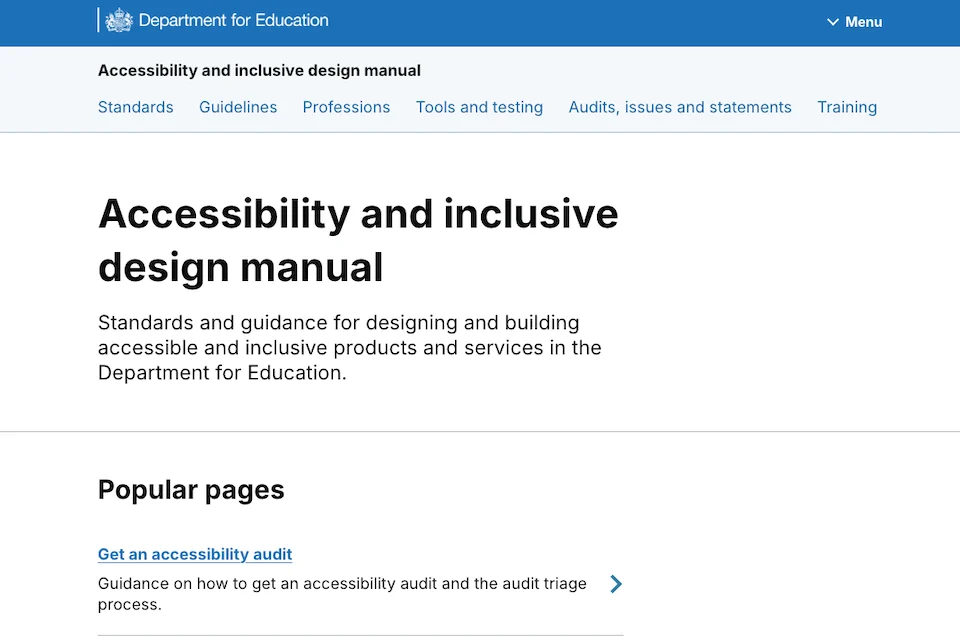
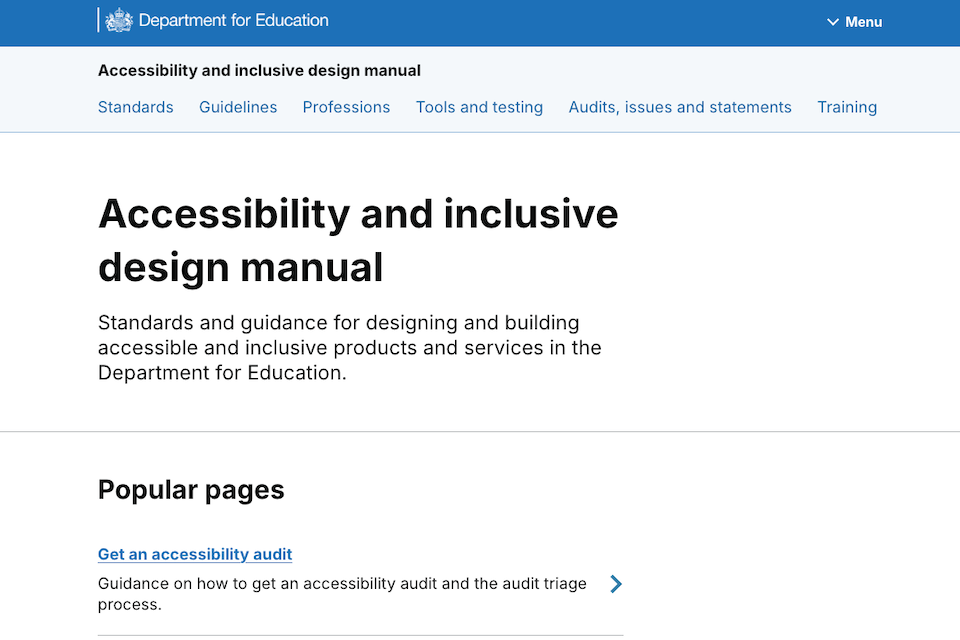
- July 21, 2025: The updated manual is officially deployed. The new version features a simplified homepage, a restructured navigation system, and enhanced guidance on the practical application of accessibility tools.
Strategic Structural Changes: Moving Beyond the Knowledge Hub
One of the most significant changes in the 2025 update was the complete removal of the "Knowledge Hub." In the initial version, this section served as a centralized library for all theoretical and supplementary information. However, user research revealed that participants viewed the hub as a "dumping ground" for content that did not fit elsewhere. This lack of clear categorization led to cognitive overload, making it difficult for designers to find specific answers to technical questions.
In the updated manual, the content from the Knowledge Hub has been redistributed into sections that align with the natural user journey of a digital project. For instance, guidance on "inclusive research" has been moved to the discovery phase documentation, while technical specifications for "ARIA labels" have been integrated directly into the development and coding sections. This reorganization reflects the "information scent" principle, ensuring that users can find what they need based on the task they are currently performing rather than having to understand the manual’s internal logic.
Enhancing Guidance for Tools and Practical Application
A recurring theme in the user research was the need for more practical, hands-on guidance regarding accessibility tools. Previously, the manual provided a list of recommended software and instructions on how to install them. Feedback indicated that this was insufficient for teams who were unsure when to use certain tools or how to interpret the results they produced.
The July 2025 update addresses this by shifting the focus from tool installation to tool utility. The new guidance answers three critical questions for every tool listed:
- Why should I use this tool? (e.g., Identifying color contrast issues or checking screen reader compatibility).
- When in the project lifecycle is it most effective? (e.g., During the design prototyping phase versus the final QA testing).
- What do the results mean? (e.g., Distinguishing between an automated warning and a manual test failure).
By providing context-rich guidance, the DfE is empowering teams to perform more effective self-audits, reducing the reliance on external accessibility consultants and accelerating the delivery of compliant services.
User Interface and Experience Redesign
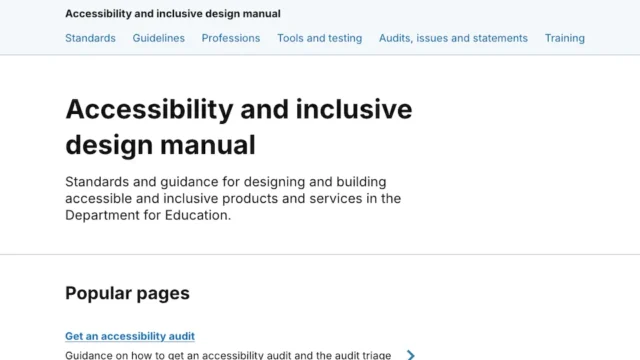
The visual and navigational interface of the manual underwent a substantial simplification. The original homepage was criticized for being "too busy," featuring an array of icons, decorative images, and a long scroll that buried essential links. This was particularly problematic for users with visual impairments or neurodivergent conditions, who may find cluttered layouts distracting or difficult to navigate via keyboard.
The redesign involved:
- Streamlining the Top Navigation: The global navigation bar was refined to include only the most critical categories, reducing the number of clicks required to reach deep-level content.
- Removing Redundant Visuals: Icons and images that did not add functional value were removed to improve page load speeds and reduce visual noise.
- Optimizing for Mobile and Screen Readers: The underlying code was cleaned up to ensure that the manual itself is a model of the accessibility standards it advocates, providing a seamless experience for users relying on assistive technologies.
Supporting Data and the Impact of Accessibility in Public Services
The DfE’s investment in this manual is supported by compelling data regarding the necessity of inclusive design. According to the UK’s Office for National Statistics (ONS), approximately 16 million people in the UK—nearly 24% of the population—report having a disability. In the context of education, this includes students with Special Educational Needs and Disabilities (SEND), parents with visual or motor impairments, and teachers who may require assistive technology to manage administrative tasks.
Furthermore, research by the Government Digital Service (GDS) has shown that accessible services are faster and easier for all users to navigate, not just those with disabilities. This is known as the "curb-cut effect," where improvements made for a specific group end up benefiting the wider population. By making the manual more intuitive, the DfE is effectively lowering the barrier to entry for its own staff to create high-quality, efficient digital products.
Economically, the move toward "built-in" accessibility is also a cost-saving measure. Industry data suggests that fixing an accessibility issue during the design phase is up to 30 times cheaper than fixing it after a product has been launched. By providing clear, actionable guidance from the start, the DfE manual helps prevent costly retrofitting and legal challenges.
Official Responses and the Design Community
While the DfE has not released formal external statements from senior ministers, the digital design community within the UK government has reacted with widespread approval. Leading accessibility advocates have noted that the DfE’s willingness to "work in the open" and iterate based on user feedback sets a high bar for other departments.
"The update to the DfE manual is a masterclass in user-centered design," said one senior interaction designer from a peer department. "It acknowledges that accessibility isn’t just a set of rules, but a workflow. By reorganizing the content to fit how we actually work, they’ve made it much more likely that these standards will be adopted across the board."
The DfE digital team emphasized that the manual remains a "living document." They have committed to ongoing reviews and have invited users from both inside and outside the government to provide feedback via their GitHub repository and community forums.
Broader Implications and Future Outlook
The DfE Accessibility and Inclusive Design Manual is part of a global trend toward standardized, open-source design systems. By making the manual public, the DfE is contributing to a global commons of knowledge that benefits smaller organizations, non-profits, and educational institutions that may not have the resources to conduct their own extensive accessibility research.
Looking ahead, the DfE plans to integrate more guidance on emerging technologies, such as the use of Artificial Intelligence (AI) in creating accessible content and the challenges of designing for immersive environments like Virtual Reality (VR) in education. As digital transformation continues to reshape the educational landscape, the manual will serve as a critical anchor, ensuring that progress does not come at the expense of exclusion.
In conclusion, the July 2025 update to the DfE Accessibility and Inclusive Design Manual is more than just a website refresh; it is a strategic realignment of how the department approaches digital service delivery. By focusing on people’s needs, simplifying complex information, and providing practical tools, the DfE is ensuring that the future of education is accessible to everyone. The manual stands as a testament to the idea that in the digital age, inclusion is not an optional feature, but a fundamental requirement for a functioning democracy.