
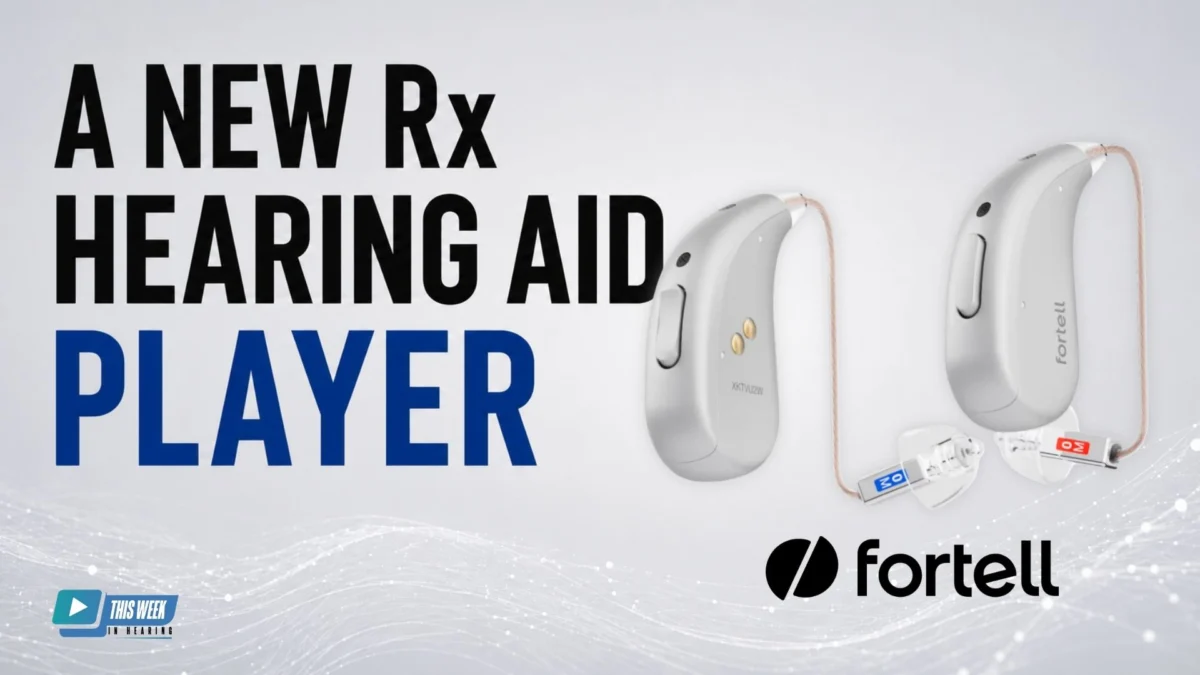
Disrupting the Hearing Aid Landscape with AI and Direct Care
Fortell’s strategy marks a significant departure from the traditional manufacturer-to-distributor model prevalent in the hearing aid sector. Instead, the company has opted to establish and operate its own clinics, initially launching in New York City in December, followed by expansions into Greenwich and Palm Beach. This vertical integration allows Fortell to maintain stringent control over the entire patient journey, from initial fitting and technology optimization by dedicated audiologists to ongoing support and care. This model also facilitates direct feedback loops, enabling rapid iteration and refinement of their AI-powered devices.
The company’s genesis is deeply personal for CEO Matt de Jonge, who witnessed his grandparents’ gradual withdrawal from social interactions despite using expensive hearing aids. This experience, he recounts, instilled a "guilt" that evolved into an "obsession" with making hearing aids fundamentally more effective. Cole Morris, a fellow Bridgewater Associates alum and health economist, joined de Jonge, convinced by the profound impact better hearing aids could have not just on health outcomes but on overall quality of life, mitigating downstream effects like falls, lost income, depression, and cognitive decline. Their shared conviction was that existing solutions, despite incremental improvements over decades, had largely failed to address the core problem of speech intelligibility in complex noise environments.
The AI Breakthrough: Tackling the "Cocktail Party Problem"
The central pillar of Fortell’s innovation lies in its advanced AI technology, particularly its application of source separation and Spatial AI. De Jonge acknowledges the industry’s historical skepticism, where the idea of AI fundamentally enhancing a listener’s ability was considered "impossible." He notes that while many companies have incorporated "AI" into their marketing, few have leveraged it to achieve a true breakthrough in listening performance. Fortell’s team, drawing on their unique experience in developing real-time AI algorithms and custom chips at previous companies, spent five years in intensive research and development to address this challenge head-on.
The core of their technology involves using AI to separate incoming audio into "important" and "unimportant" channels in real-time. This allows audiologists to then "remix" these channels, optimizing the signal-to-noise ratio (SNR) for the wearer. A particularly novel aspect is their Spatial AI, which interprets sound based on both its content and its origin point. This capability powers their signature Front Voices mode, designed to prioritize speakers directly in front of the wearer while actively reducing competing voices from other directions. This represents a significant leap from conventional directional microphones, which offer a more generalized noise reduction.
Fortell’s devices offer four distinct modes:
- Live Music Mode: Optimized for restoring the enjoyment and authenticity of musical experiences.
- Conventional Mode: Functions as a traditional high-end hearing aid, focused on restoring audibility without aggressive sound manipulation.
- All Day AI Mode: The default setting for most users, providing omnidirectional hearing while intelligently identifying and amplifying voices of interest and attenuating distracting sounds, all while preserving situational awareness. This mode operates automatically, requiring minimal user intervention.
- Front Voices Mode: This "turbo mode" is manually activated via a button press or a companion app and is specifically engineered for the noisiest, multi-talker environments. It aggressively focuses on sounds within the wearer’s "cone of vision," significantly enhancing speech intelligibility by suppressing peripheral talkers.
The manual activation of Front Voices mode is a deliberate design choice. Given the highly interventional nature of actively removing voices, Fortell prioritizes user control to prevent unintended or undesirable sound manipulation. The company emphasizes respecting the user’s intelligence and empowering them to choose when to engage this powerful processing, while their audiologists guide them on how to maximize its benefits and understand its limitations.
Clinical Validation and User Preference
The efficacy of Fortell’s technology is not merely anecdotal; it is substantiated by rigorous clinical studies, for which Cole Morris served as the first author. The company emphasizes the importance of robust scientific evidence, a point where they felt many existing hearing aid white papers fell short, often focusing on subjective improvements rather than measurable gains in speech intelligibility. Fortell’s studies were conducted in partnership with esteemed academics, including Marco Svirsky and Bill Shapiro from NYU for the intelligibility study, and Joe Montano and Barbara Weinstein for the subjective preference study. This collaboration aimed to ensure scientific rigor, minimize bias through blinding and randomization, and provide external scrutiny of their findings.
The intelligibility study, a speech-in-noise test, placed participants in a challenging multi-talker noise environment, measuring their ability to correctly understand words from a speaker in front of them while competing voices were played from other directions. The results were compelling: participants wearing Fortell’s hearing aids could understand words equally well at a 9 dB more challenging Signal-to-Noise Ratio (SNR) compared to a leading AI-powered control hearing aid. To put this in perspective, conventional directional microphones, often touted as a key noise-reduction feature, typically offer an improvement of around 3 dB. A 9 dB improvement, even when compared to a device already utilizing directional microphones, represents a "pretty astonishing result," according to Morris.
The second study, a "Pepsi challenge" style preference test, involved participants listening to recorded audio tracks from Fortell devices and the latest technology from five major legacy hearing aid manufacturers in multi-talker noise. Blinded participants then rated which track they found easier to understand. The findings were overwhelmingly in favor of Fortell, with 19 out of 20 participants preferring Fortell to all five competitors, and one participant tying with one competitor while preferring Fortell over the other four. These "decisive" results underscored the perceived superiority of Fortell’s processing in real-world challenging environments.
While the studies primarily focused on intelligibility and preference, the co-founders acknowledge the critical importance of reducing listening effort and cognitive fatigue. Although not directly measured in these initial studies, anecdotal evidence from patients frequently highlights a significant reduction in end-of-day exhaustion, suggesting a strong correlation between improved intelligibility and decreased cognitive load. This aspect is crucial for preventing the social isolation often associated with hearing loss, as individuals are more likely to engage in challenging listening environments if the effort required is substantially reduced. Fortell expresses enthusiasm for future research utilizing neural imaging techniques and pupillometry to rigorously quantify these improvements in listening effort.
A New Model for Hearing Care Delivery
Fortell’s decision to forgo a traditional distribution network in favor of company-owned clinics stems from a foundational principle: to deliver an experience superior to what was available to their own family members. Their "North Star" is to combine "the most sophisticated technology with the best and brightest audiologists and a concierge level of support." This three-pillar approach—cutting-edge hearing aids, expert audiological care, and ultra-high levels of customer support—necessitated controlling every detail of the patient experience.
This direct-to-consumer model ensures that the complex AI technology is fitted and optimized by audiologists who are deeply trained in Fortell’s specific innovations. The company dedicates significant resources to identifying and recruiting audiologists who are not only skilled but also "curious enough to learn" and genuinely committed to patient-centric care. This hands-on approach allows for personalized adjustments, fine-tuning the various modes and their intensity to match individual preferences and hearing loss profiles.
From a pricing perspective, Fortell positions itself in the premium segment, with hearing aids priced at approximately $6,800. However, this cost is designed to be a high-value package, including five years of unlimited audiological care from a dedicated audiologist and a three-year comprehensive warranty that covers loss or damage. This bundled offering, according to Fortell, is priced below comparable top-spec offerings from established manufacturers available at academic medical centers and private practices. This strategy aims to make advanced, high-value care accessible while simultaneously funding the company’s aggressive and ongoing investment in research and development. The co-founders acknowledge that delivering consistent innovation in a stagnant industry is expensive, and their pricing model reflects this commitment to continuous improvement.
Industry Context and Implications
The hearing aid industry, for decades, has been characterized by incremental advancements rather than revolutionary breakthroughs. As Matt de Jonge points out, the last major leap occurred 30 years ago with the transition from analog to digital devices and the introduction of wide dynamic range compressive amplification. Subsequent innovations, such as Bluetooth connectivity, anti-feedback algorithms, and beamforming, have been valuable but largely iterative. This prolonged period of relative stagnation has left many patients with persistent challenges, particularly in noise.
Fortell’s emergence challenges this status quo. By making a "breakthrough that patients have deserved but not gotten," they are poised to disrupt a market dominated by a few established manufacturers. Their success could pressure competitors to accelerate their own AI research and development, potentially spurring a new era of innovation across the industry. The direct-to-consumer clinic model, while not entirely unique in healthcare, is a novel approach for a prescription hearing aid manufacturer, offering an alternative to the traditional independent audiology practice or large retail chains. This model allows for greater consistency in patient experience and brand messaging, but also presents scalability challenges compared to leveraging existing distribution networks.
The company’s focus on speech-in-noise performance is particularly timely given the broader societal trends. An aging global population means a growing prevalence of age-related hearing loss, with significant numbers struggling with communication in everyday social settings. The World Health Organization estimates that over 1.5 billion people globally experience some degree of hearing loss, with 430 million requiring rehabilitation. Untreated hearing loss carries a substantial economic and social burden, estimated at nearly $1 trillion globally each year due to lost productivity and societal costs. By directly addressing the most frustrating aspect of hearing loss, Fortell aims to significantly improve the quality of life for millions, fostering greater social engagement and reducing the risk of associated health issues.
Future Outlook and Continuous Innovation
Looking ahead, Fortell has ambitious plans for expansion and continued technological advancement. The company aims to significantly expand its clinical footprint, both within the United States and internationally, to reach a broader patient base. This geographic growth will be critical for scaling their unique service model.
Crucially, Fortell views its current technology as merely the beginning of an ongoing journey. Shortly after the initial conversation with Shari Eberts, the company introduced AI 2.0, a significant software update that further refines speech-in-noise performance. This update incorporates expanded real-world training data and enhanced signal-processing algorithms, reflecting Fortell’s commitment to continuous improvement. De Jonge and Morris emphasize that the "human auditory system is so majestically complicated" that the problem of hearing care "will never be solved" definitively, but rather continually improved upon. Their long-term goal is to reach a point where patients with hearing loss spend "a lot less time thinking about their hearing loss and a lot more time having fun, enjoying the people around them."
Fortell’s entry into the prescription hearing aid market represents a bold and potentially transformative moment for an industry ripe for disruption. By coupling advanced, proprietary AI with a dedicated, audiologist-centric care model and a commitment to continuous innovation, the company is not just selling hearing aids; it is striving to redefine the experience of hearing and empower individuals to reclaim their place in the world of sound and conversation.