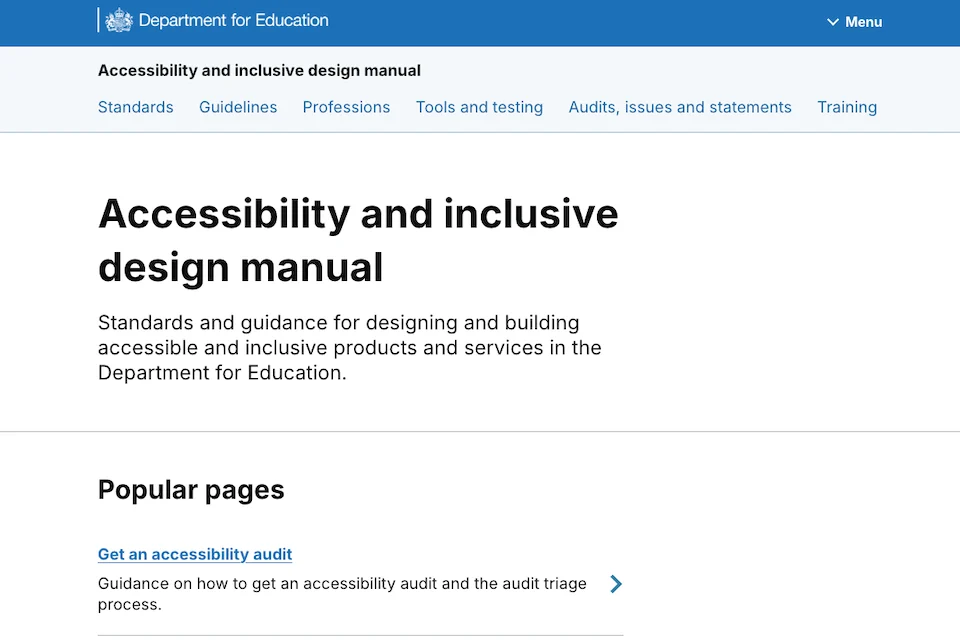
The initiative follows the initial launch of the manual in September 2024. Although the first iteration was met with generally positive feedback and showed healthy engagement metrics, subsequent user research revealed that the practical application of the guidance was occasionally hindered by complex information architecture. By focusing on the lived experiences of those building digital services, the DfE has transitioned from a compliance-heavy "knowledge repository" to a more intuitive, journey-based guidance system.
The Evolution of Accessibility Standards at the DfE
The journey toward the 2025 update began shortly after the original manual’s debut in late 2024. In the months following the initial rollout, the DfE’s digital teams conducted extensive qualitative research, engaging with professionals across various roles, including interaction designers, content designers, and technical delivery managers. This research was driven by the recognition that while the "what" of accessibility was well-documented, the "how" and "when" remained points of friction for many teams.
The timeline of this evolution reflects a structured approach to continuous improvement. Following the September 2024 launch, the DfE spent the first quarter of 2025 gathering data on search patterns, page dwell times, and user feedback. By the second quarter, the focus shifted to a redesign phase, where the feedback was translated into architectural changes. This led to the mid-summer launch on July 21, 2025, providing a modernized framework that aligns with the latest Web Content Accessibility Guidelines (WCAG 2.2) and the UK Government Digital Service (GDS) Service Standard.
The DfE’s commitment to this project is rooted in the legal and ethical requirements of the Public Sector Bodies (Websites and Mobile Applications) (No. 2) Accessibility Regulations 2018. With approximately 16 million people in the UK—nearly one in four—identifying as having a disability, the department recognized that accessibility is not a "bolt-on" feature but a fundamental requirement of modern governance.
Structural Overhaul: Moving Beyond the Knowledge Hub
One of the most significant changes in the 2025 update was the complete removal of the "Knowledge Hub" section. In the 2024 version, the Knowledge Hub served as a centralized repository for theoretical information, case studies, and deep-dive articles. However, user research indicated that this section had become what designers described as a "dumping ground" for content that did not fit elsewhere. This created a high cognitive load for users who were trying to find specific answers during the fast-paced delivery phases of a project.
The DfE research team identified that users do not think in terms of "knowledge categories" when they are in the middle of a sprint. Instead, they think in terms of the "User Journey"—the specific stage of design or development they are currently navigating. To address this, the content previously housed in the Knowledge Hub was unbundled and reintegrated into sections of the manual that correspond to the actual workflow of a digital team.
For example, guidance on "How to write accessible alt-text" was moved from a generic theory section directly into the "Content Design" phase guidance. Similarly, technical specifications for ARIA (Accessible Rich Internet Applications) labels were moved into the "Development and Coding" section. This reorganization ensures that information is surfaced at the point of need, reducing the time spent searching and increasing the likelihood that accessibility best practices are implemented correctly from the start.
Transitioning from Tools to Outcomes
Prior to the July 2025 update, the "Tools" section of the manual was largely a directory. It provided a list of software, browser extensions, and testing suites, accompanied by instructions on how to install them. While functional, user feedback suggested this was insufficient for teams who were not accessibility specialists. Designers and developers wanted to know why a specific tool was recommended, what specific problems it could solve, and how to interpret the data it produced.
The updated manual has refocused this guidance on people’s needs rather than just software capabilities. Each tool is now categorized by the specific user need it addresses. Instead of a list that begins with "Install Axe DevTools," the manual now frames the guidance around questions such as:
- "How do I test the color contrast of my UI components?"
- "Which tool should I use to simulate screen reader navigation for a blind user?"
- "How can I automate 40% of my accessibility checks to save time for manual testing?"
This shift emphasizes the human element of accessibility. By explaining the limitations of automated tools—which typically only catch about 30% to 40% of accessibility issues—the manual encourages teams to engage in more rigorous manual testing and user research with people with disabilities. The guidance now includes detailed instructions on how to use tools to identify barriers for specific user groups, such as those with motor impairments who rely on keyboard-only navigation.
Streamlining the User Interface for Greater Clarity
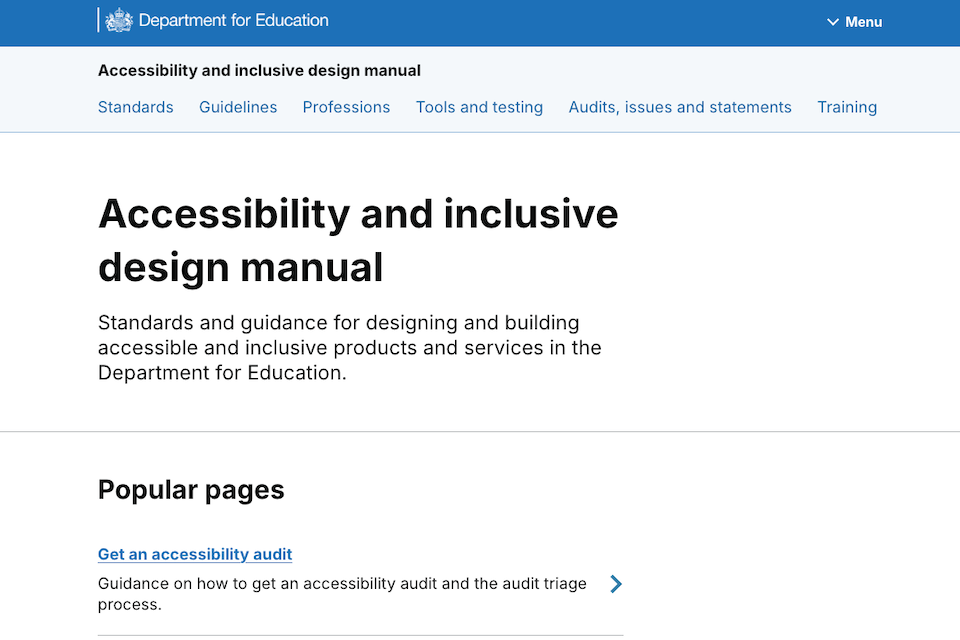
The visual and navigational layout of the manual underwent a major simplification to practice what it preaches: inclusive design. The previous homepage was criticized for being "too busy," featuring an array of icons, decorative images, and a long-scroll format that made it difficult for users to get a quick overview of the available resources.
The DfE digital team implemented several key UI changes:
- Simplified Navigation: The top-level navigation was pruned to include only the most essential categories, ensuring that the "information scent" was clear from the moment a user landed on the site.
- Visual De-cluttering: Excessive icons and images were removed in favor of a clean, typography-focused design that prioritizes readability and high contrast.
- Task-Oriented Homepage: The new homepage is designed around "top tasks," allowing users to jump directly to sections like "Testing," "Design Standards," or "Legal Requirements."
These changes were informed by accessibility data suggesting that "busy" layouts can be particularly challenging for users with neurodivergent conditions, such as ADHD or dyslexia, who may struggle with visual overstimulation. By creating a calmer, more focused interface, the DfE has made the manual more accessible to the very people who are tasked with building accessible services.
Broader Impact and Industry Implications
While the manual is a DfE-led initiative, its implications reach far beyond a single government department. The decision to keep the manual open-source and publicly accessible reflects a growing trend in the UK Civil Service toward "Working in the Open." By sharing their research and their refined architecture, the DfE provides a blueprint for other local authorities and public bodies that may lack the resources to conduct such extensive user research.
Industry experts have noted that the DfE’s move from a "Knowledge Hub" to a "Journey-Based" model reflects a maturing of the accessibility field. In the early 2020s, many organizations focused on creating "checklists" for accessibility. The 2025 DfE manual suggests a shift toward "Inclusive Design," which considers the full range of human diversity from the outset, rather than simply checking for WCAG compliance at the end of a project.
Furthermore, the focus on "Tools for People" addresses a critical skills gap in the tech industry. As digital services become more complex, the ability to use accessibility testing tools effectively is becoming a core competency for developers and designers. By providing clear, outcome-oriented guidance, the DfE is helping to upskill the digital workforce, which in turn leads to better public services for all citizens.
Conclusion and Future Outlook
The July 21, 2025, update to the DfE Accessibility and Inclusive Design Manual represents a milestone in the department’s digital strategy. It is an acknowledgment that documentation must be as user-friendly as the services it describes. By listening to the feedback of designers and developers, the DfE has transformed a static manual into a dynamic, living resource that fits seamlessly into the modern digital delivery lifecycle.
As the department looks toward 2026, the focus is expected to shift toward emerging technologies, including the role of Artificial Intelligence in both assisting and hindering accessibility. The current framework, however, provides a robust foundation. The removal of the cluttered Knowledge Hub, the refinement of tool-based guidance, and the simplification of the user interface all serve a single, clear goal: ensuring that every student, teacher, and parent in the UK can access the educational services they need without barriers.
The DfE has signaled that this is not the final version of the manual. In line with agile principles, the team will continue to monitor usage data and gather feedback, ensuring that as the web evolves, the DfE’s standards for inclusion evolve alongside it. For now, the 2025 manual stands as a leading example of how a large government department can iterate on its own internal processes to drive better outcomes for the public.