

The Evolving Landscape of Meniere’s Disease: An Overview of the Four Stages
Meniere’s disease is broadly categorized into four stages: early, middle, late, and advanced (sometimes referred to as the "burnout" phase). These stages serve as descriptive tools to illustrate potential patterns of symptom progression rather than definitive diagnostic criteria. It is important to reiterate that not all individuals will progress through all four stages, and the sequence of symptoms is not always predictable.
A General Framework for Symptom Progression:
| Stage | Vertigo | Hearing Loss | Tinnitus/Fullness | Balance |
|---|---|---|---|---|
| Early | Sudden, intense attacks (20 minutes to hours) | Fluctuating, may normalize between episodes | Ringing, ear fullness | Normal between attacks |
| Middle | Less frequent or severe | More persistent and noticeable | Constant tinnitus, ear pressure | Mild imbalance may begin |
| Late | Less frequent or severe | Significant and more permanent | Ongoing tinnitus and ear fullness | Persistent balance problems (worse in dark) |
| Advanced | Rare or absent | Permanent, often severe | Constant tinnitus and ear fullness | Ongoing imbalance, possible drop attacks |
Important Note: This table illustrates common symptom patterns. Individual progression may vary, and symptoms can overlap or follow a different course.

Stage 1: The Early Onset of Meniere’s Disease
The initial phase of Meniere’s disease is often characterized by fluctuating and unpredictable symptoms. Individuals may experience sudden, disorienting vertigo attacks, often described as a sensation of the room spinning. Alternatively, the first noticeable symptoms might be changes in hearing, persistent tinnitus, a feeling of pressure or fullness in the ear, or a general sense of imbalance.
During this early stage, hearing loss typically fluctuates. It may manifest as muffled or reduced hearing in the affected ear during an episode, with hearing subsequently improving. Tinnitus, commonly perceived as a ringing, buzzing, roaring, or humming sound, is also a frequent symptom. Aural fullness, akin to pressure, blockage, or congestion in the ear, is another hallmark. The intermittent nature of these symptoms can lead to confusion, with individuals sometimes attributing them to stress, fatigue, migraines, or ear infections.
To aid in diagnosis and management, maintaining a symptom diary during this stage is highly beneficial. Documenting the timing, duration, and intensity of vertigo attacks, along with any accompanying hearing changes, tinnitus, or ear fullness, provides valuable information for healthcare professionals.
Stage 2: The Middle or Intermediate Phase
As Meniere’s disease progresses into the middle or intermediate stage, symptoms tend to become more pronounced and impactful on daily life. While vertigo attacks may continue, some individuals report a decrease in their frequency or severity compared to the early stage. However, unpredictable attacks can still occur.
A significant shift often observed in this stage is that hearing loss may become more persistent, with less complete recovery between episodes. Tinnitus can also transition to a more constant presence, and the sensation of ear fullness may persist for longer durations.

These changes can lead to increased communication difficulties. Individuals may find it harder to hear in noisy environments, follow conversations in group settings, or understand speech directed from the affected side. The interplay of hearing and balance issues can also result in a mild sense of unsteadiness even between vertigo attacks. While periods of remission are still possible, the symptoms in this stage often feel less like isolated incidents and more like an ongoing aspect of daily life.
Stage 3: The Late Stage of Meniere’s Disease
In the late stage of Meniere’s disease, a notable trend is often a reduction in the frequency or severity of vertigo attacks. However, this reduction does not necessarily signify an improvement in the condition. Instead, the primary challenges tend to shift towards more permanent and significant hearing loss and balance impairments.
Hearing loss in the affected ear can become substantial and more constant. Tinnitus may persist, and some individuals continue to experience aural fullness or pressure. Balance problems can become more pronounced, particularly in challenging environments such as low light, uneven terrain, or when fatigued.
The impact on an individual’s confidence and independence can be considerable in this stage. Many may start to avoid activities that carry a risk of sudden balance disruption, such as crowded places, driving, or navigating stairs. Comprehensive support from an Ear, Nose, and Throat (ENT) specialist, an audiologist, and potentially a balance therapist becomes crucial to identify practical strategies for navigating daily life.
Crucial Distinction: It is vital to understand that a decrease in vertigo does not equate to recovery. In the later stages of Meniere’s disease, long-term changes in hearing and balance can persist even if vertigo attacks become less frequent.
Stage 4: The Advanced or "Burnout" Phase
The advanced stage of Meniere’s disease is sometimes referred to as the "burnout" phase. This designation typically signifies a reduction or cessation of vertigo attacks, while the underlying long-term damage to the inner ear remains. However, this pattern is not universally experienced, and the "burnout" phase is not considered a universally defined stage.
At this stage, hearing loss in the affected ear can be permanent and severe. Tinnitus and aural fullness may also continue. Balance problems can persist because the inner ear may no longer reliably transmit balance signals to the brain. In some cases, individuals may experience "drop attacks," which are sudden falls without loss of consciousness or prior warning. These episodes pose a significant risk of injury and necessitate prompt medical evaluation.
The Unpredictable Timeline of Meniere’s Disease
There is no predetermined timeline for the progression through the four stages of Meniere’s disease. Some individuals may experience fluctuating symptoms for many years, while others may develop more persistent hearing loss or balance problems over time. It is also common for individuals not to progress through all four stages, and symptoms associated with different stages can manifest concurrently.
The variability in symptom presentation underscores the importance of viewing the four-stage model as a generalized framework for understanding potential symptom evolution, rather than a fixed pathway. Regular follow-up appointments with an ENT specialist or audiologist are essential for monitoring symptoms and adjusting treatment strategies as needed.
Navigating the Attack Cycle: Before, During, and Between Episodes
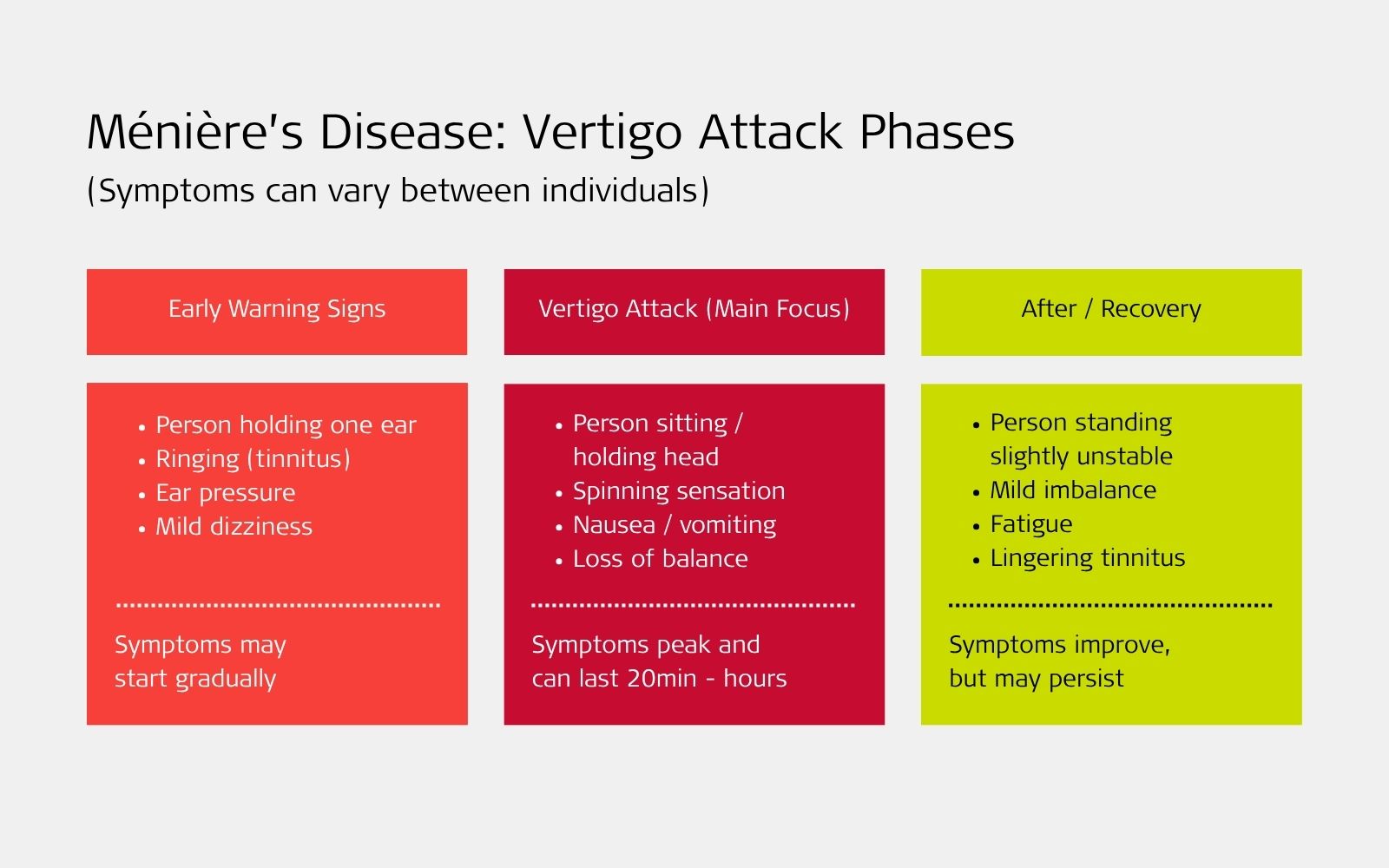
Meniere’s disease symptoms often manifest in distinct episodes, rather than as a constant, uniform experience. Many individuals describe a pattern involving early warning signs, the active phase of symptoms, and a recovery or remission period. However, the experience of these phases can vary significantly from person to person.

Early Warning Signs: Some individuals report subtle pre-attack indicators. These may include an increased sense of fullness in the affected ear, louder tinnitus, muffled hearing, mild dizziness, or a general feeling that their balance is "off." These warning signs, when present, can provide an opportunity to move to a safer location, avoid driving, sit or lie down, and inform others of their impending symptoms.
During a Vertigo Attack: The hallmark of a vertigo attack is the sensation that the surroundings are spinning or moving, even when the individual is stationary. These attacks typically range from 20 minutes to several hours in duration and can be accompanied by nausea, vomiting, sweating, and difficulty walking. The recommended response is usually to sit or lie down, avoid sudden head movements, and wait for the sensation to subside. If vertigo attacks are new, severe, frequent, or associated with sudden hearing changes, seeking immediate medical attention is crucial.
Between Episodes and Remission: The period between attacks can vary greatly. Some individuals feel almost completely normal, while others may experience lingering fatigue, persistent imbalance, or a sense that their balance has not fully recovered. Tinnitus and hearing difficulties may also persist. Hearing fluctuations are particularly common in the earlier stages, while symptoms may become more persistent in some individuals as the disease progresses. Periods of remission, where symptoms significantly subside or disappear for months or even years, are also common. This variability further highlights the utility of a symptom diary in tracking the condition’s course.
The Underlying Mechanisms: Why Symptoms Change Over Time
The development and progression of Meniere’s disease are fundamentally linked to abnormal changes in fluid pressure within the inner ear, a condition known as endolymphatic hydrops. The inner ear houses delicate structures responsible for converting sound vibrations into auditory signals and detecting head movements for balance.
When fluid pressure within the inner ear becomes abnormal, the signals generated for hearing and balance can be distorted. Initially, these distortions may manifest as intermittent symptoms. However, with repeated disruption, the delicate sensory hair cells and other structures within the inner ear can be damaged. This progressive damage is why symptoms often evolve from fluctuating hearing loss and episodic vertigo to more permanent hearing loss, persistent tinnitus, and chronic imbalance.
Diagnosing Meniere’s Disease: A Multifaceted Approach
A diagnosis of Meniere’s disease should always be made by a qualified healthcare professional, typically an ENT specialist. There isn’t a single definitive test that confirms the condition in all cases. Diagnosis is generally based on a comprehensive evaluation that includes:
- Symptom Assessment: Detailed discussion of the patient’s experiences, including the nature, frequency, and duration of vertigo, hearing loss, tinnitus, and aural fullness.
- Medical History: Review of the patient’s overall health, including any pre-existing conditions or family history of ear disorders.
- Hearing Tests (Audiometry): These tests assess hearing function and can reveal patterns of hearing loss characteristic of Meniere’s disease, often affecting lower frequencies initially.
- Vestibular Function Tests: These assessments evaluate the balance system of the inner ear to identify any abnormalities.
- Ruling Out Other Conditions: Because dizziness, tinnitus, and hearing loss can be symptoms of various other medical issues, specialists will meticulously rule out other potential causes. These may include migraine-associated vertigo, vestibular neuritis, ear infections, neurological disorders, or other inner ear conditions.
Treatment and Long-Term Management Strategies
Currently, there is no cure for Meniere’s disease. However, a range of treatment options exists to effectively manage symptoms, mitigate safety risks, and enhance the quality of life for affected individuals. Treatment plans are highly individualized, taking into account the patient’s specific symptoms, hearing status, balance function, overall health, and the stage of the disease.
Lifestyle and Safety Adjustments: Many patients benefit from modifications to their diet (e.g., reducing salt intake), stress management techniques, identifying and avoiding personal triggers, and implementing safety measures at home and work to prevent falls.
Medication: Medications may be prescribed to help manage acute vertigo attacks and associated nausea or vomiting. The choice of medication depends on the individual’s medical history and should be discussed with a healthcare provider.
Vestibular Rehabilitation Therapy (VRT): For individuals experiencing chronic imbalance, VRT can be highly effective. This specialized physical therapy aims to retrain the brain’s ability to process balance information and compensate for inner ear dysfunction, thereby reducing long-term balance problems.

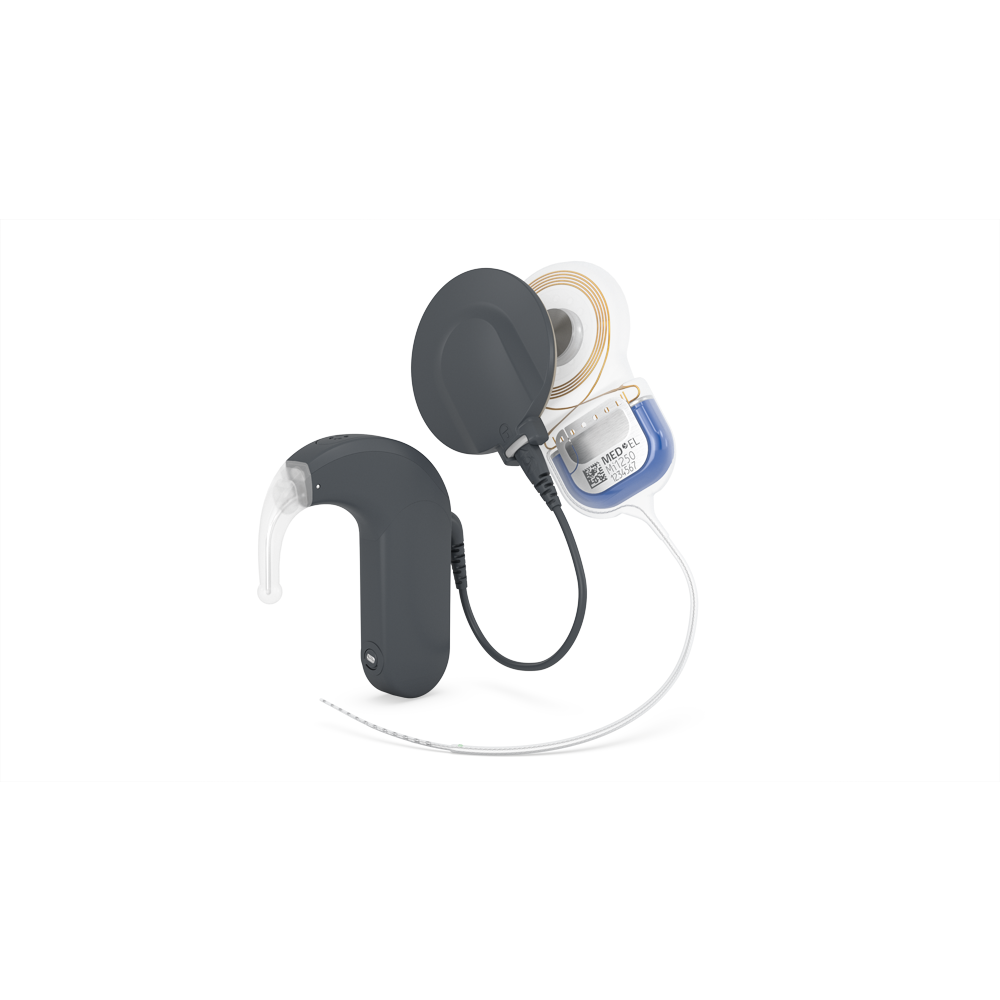
Hearing Support: As hearing loss progresses and begins to impact daily communication, an ENT specialist or audiologist can discuss various hearing support options. These may include hearing aids, CROS systems (for single-sided deafness), bone conduction solutions, or, in cases of severe to profound hearing loss, cochlear implants.
Real-Life Experiences with Hearing Support: Helen, an audiologist from Australia, experienced single-sided deafness due to Meniere’s disease. Following implantation of a MED-EL cochlear implant, she reported a significant positive impact: "My MED-EL cochlear implant also silenced my tinnitus, which is really quite amazing and a huge relief." Helen’s experience highlights how advanced hearing solutions can address not only hearing loss but also debilitating tinnitus, a common and distressing symptom of Meniere’s disease. For individuals facing long-term, severe hearing loss, improved access to sound through hearing support can bolster confidence in daily activities and social interactions, thereby increasing personal independence.
Long-Term Outlook and When to Seek Medical Help
The long-term prognosis for individuals with Meniere’s disease varies considerably. Some may experience infrequent attacks with extended symptom-free intervals, while others may develop more persistent and progressive hearing and balance difficulties. While symptoms may stabilize, they typically do not resolve completely. Although Meniere’s disease most commonly affects one ear, in some instances, it can eventually impact both ears.
Seek medical advice if you experience:
- Recurring vertigo attacks.
- Fluctuating or progressive hearing loss.
- Persistent tinnitus.
- A sensation of fullness or pressure in the ear.
Any new or severe dizziness, particularly when accompanied by symptoms such as weakness, speech difficulties, chest pain, severe headaches, or other urgent warning signs, requires immediate medical evaluation.

Key Takeaway: Understanding the Nuances of Meniere’s Disease
The concept of four stages of Meniere’s disease offers a valuable framework for comprehending the potential progression of symptoms over time. However, it is essential to recognize these stages as general descriptors of possible symptom patterns rather than a definitive, linear progression that all individuals will follow. Each person’s experience with Meniere’s disease is unique, and self-diagnosis based solely on these stages is not recommended. With appropriate medical support, many individuals can effectively manage their symptoms, reduce safety risks, and access vital hearing support when long-term hearing loss impacts their daily lives.
If you are experiencing symptoms such as vertigo, tinnitus, ear fullness, or changes in hearing, consulting an ENT specialist or a hearing care professional is the crucial next step to understand your condition and explore available management options.