Historical Context: The 1880 Milan Conference and the Modern Era
To understand the weight of the NAD’s current stance, one must look back to the 1880 International Congress on the Education of the Deaf in Milan, Italy. That event served as a catalyst for the founding of the NAD in the United States. During the Milan Conference, educators and administrators—many of whom did not share the lived experience of Deaf individuals—voted to ban the use of sign language in classrooms, favoring the “oralist” method of instruction. This systemic push to suppress sign language and assimilate Deaf individuals into the hearing world resulted in significant cultural trauma and the marginalization of a linguistic minority.
For nearly a century and a half, the NAD has operated under the principle that the Deaf community constitutes a distinct cultural and linguistic group, defined by American Sign Language (ASL) and a shared history. The 2026 position statement serves as a modern mirror to the 1880 crisis. Where the Milan Conference represented a threat through pedagogical policy, the current era of CRISPR and gene-editing technologies represents an existential threat through biological intervention. The NAD argues that the underlying philosophy remains the same: the pathologization of human difference.
The Science of Genetic Intervention: Potential and Peril
The rise of gene therapy, particularly advancements in adeno-associated virus (AAV) vector delivery systems, has opened doors to treating hereditary hearing loss, such as those caused by mutations in the OTOF gene (DFNB9). While clinical trials have shown success in restoring some auditory capacity in patients with specific genetic conditions, these scientific breakthroughs have ignited a firestorm of ethical debate.
The primary point of contention is the medical model versus the social model of disability. The medical model views deafness as a biological impairment to be repaired or “fixed” via clinical intervention. Conversely, the social model, which the NAD champions, identifies deafness as a social, cultural, and linguistic status. The NAD contends that by labeling deafness strictly as a clinical deficit, researchers ignore the vibrant, autonomous existence of the Deaf community. The organization’s leadership notes that the pursuit of a “cure” risks prioritizing the elimination of a specific human trait over the well-being and autonomy of the individuals possessing that trait.
Chronology of Advocacy and Technological Advancement
- 1880: The International Congress on the Education of the Deaf in Milan establishes an international precedent for the suppression of sign language, leading to the formation of the NAD.
- 1990s–2000s: The advent of widespread cochlear implantation sparks the first major modern debate regarding the role of medical technology in the Deaf community.
- 2012: The development of CRISPR-Cas9 technology revolutionizes gene editing, making precise interventions in the human genome faster and more affordable.
- 2023–2024: Multiple international clinical trials report the successful restoration of hearing in pediatric patients using gene therapy, triggering intensified internal discussions within the NAD.
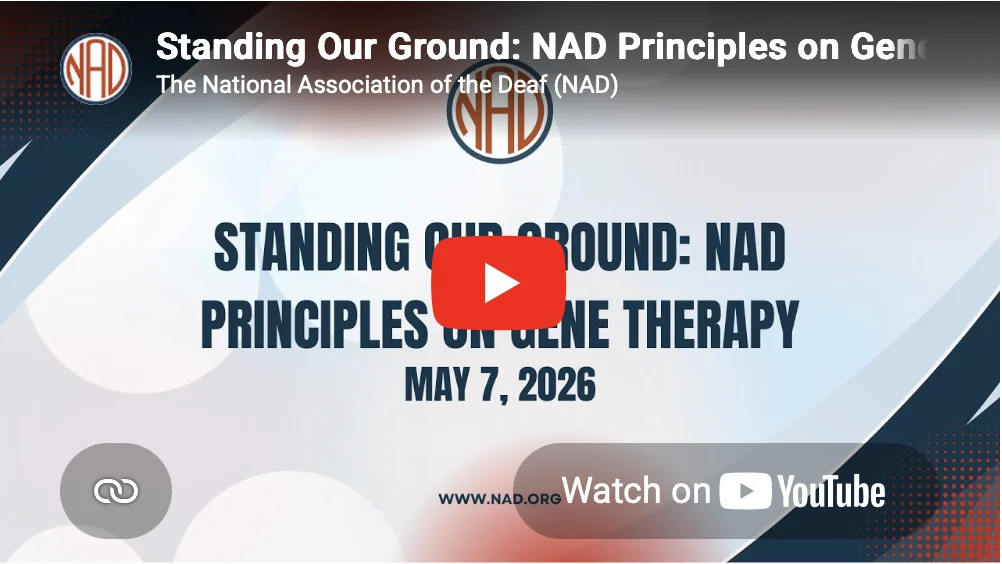
- May 7, 2026: The NAD formally releases its comprehensive position statement, “Standing Our Ground,” establishing a framework for ethical engagement with geneticists and medical researchers.
Supporting Data and Demographic Significance
The Deaf community is not a monolith, but it is substantial. Data from the National Institute on Deafness and Other Communication Disorders (NIDCD) suggests that roughly 15% of American adults report some trouble hearing, with a significant subset identifying as culturally Deaf. The economic and social implications of genetic intervention are profound. Research from the World Health Organization (WHO) indicates that hearing loss is a major public health priority, yet the NAD argues that global health metrics often fail to account for the quality of life or the cultural richness inherent in Deaf communities.
Furthermore, economic studies regarding the "cost" of disability often overlook the economic contributions of Deaf professionals, artists, and educators. By shifting the narrative from “curing” to “inclusion,” the NAD proposes a redistribution of resources—moving funding from exclusively curative research toward universal accessibility, communication technology, and bilingual education programs.
Official Responses and Academic Perspectives
The response from the scientific community has been polarized. Bioethicists, such as those at the Hastings Center, have long cautioned that the “normalization” of human traits through technology could lead to a narrowed definition of human worth. Dr. Elena Vance, a geneticist specializing in sensory development, noted in a recent commentary that "the scientific community must distinguish between curing a disease that causes pain or death and modifying a trait that does not inherently impede a fulfilling, healthy life."
However, industry representatives and some medical associations maintain that the primary directive of medicine is to offer choices to patients and parents. The tension lies in whether these technologies will be marketed as an elective medical service or framed as a social imperative, which could lead to implicit pressure on parents of Deaf children to pursue gene therapy.
Implications for the Future of Human Diversity
The NAD’s 2026 position statement calls for a paradigm shift in how research is funded and conducted. Key demands include:
- Community-Led Research: Ensuring that Deaf individuals have a seat at the table in institutional review boards (IRBs) and research design committees.
- Informed Consent and Counseling: Mandating that families of children with hearing-related genetic conditions receive comprehensive counseling that includes the Deaf community’s perspective, rather than a strictly clinical view.
- Ethical Oversight: Establishing federal guidelines that restrict the use of gene editing in ways that seek to eradicate cultural or linguistic identities.
The broader implication of this stance is a fundamental question about the future of human evolution. If society begins to treat genetic variance as a series of bugs to be patched, the richness of human biodiversity is at risk. The NAD argues that there is an inherent value in having a diverse population that processes the world through different sensory modalities.
Conclusion: A Mandate for Inclusion
As the NAD looks toward the future, it has announced the creation of a specialized task force dedicated to the ongoing monitoring of genetic research. This task force will act as a liaison between the Deaf community and the scientific establishment, ensuring that the voice of the community is not sidelined as technology advances.
The organization’s message is clear: The Deaf community is not an error in the human genome. It is a group of people with a shared language, history, and culture that has survived over a century of systemic opposition. By asserting its position on gene therapy, the NAD is not merely protecting its history; it is securing a place for future generations to exist as they are. The path forward, according to the NAD, is not through the alteration of DNA, but through the realization of a truly accessible, inclusive, and diverse society that recognizes the inherent dignity of all its members, regardless of their hearing status. In the years to come, the success of this advocacy will be measured by whether the scientific community chooses to innovate in ways that celebrate human difference rather than attempting to delete it from the record of human experience.