

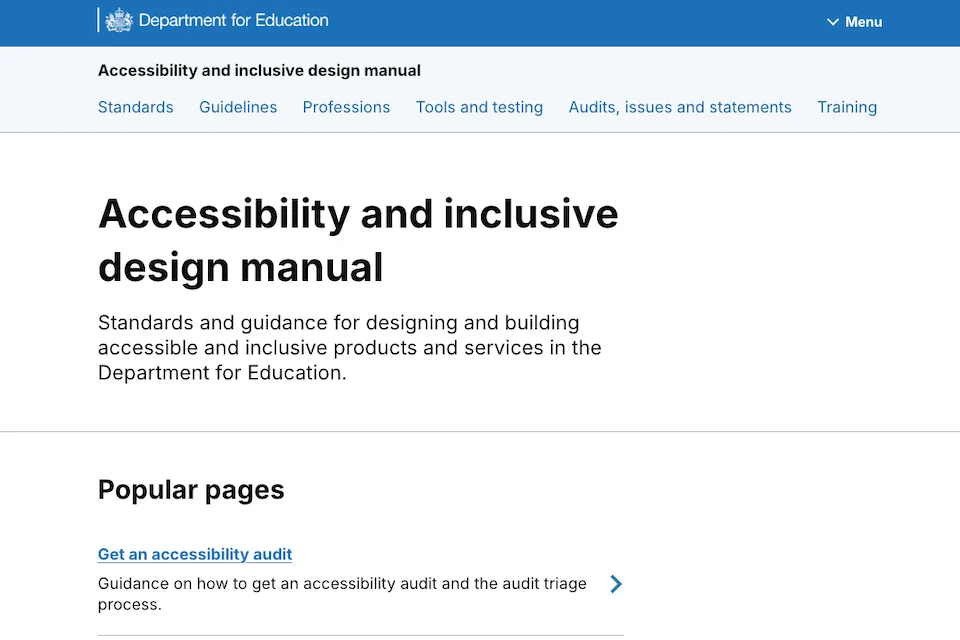
The Department for Education (DfE) has officially released a comprehensive update to its Accessibility and Inclusive Design Manual, marking a significant milestone in the UK government’s ongoing commitment to digital inclusivity. The revised manual, which went live on July 21, 2025, represents the culmination of nearly a year of intensive user research, data analysis, and iterative design. By streamlining navigation and refocusing content on practical user journeys, the DfE aims to provide its design, product, and delivery teams—as well as the wider public—with a more intuitive resource for building services that work for everyone.
This update follows the initial launch of the manual in September 2024. While the first iteration was met with generally positive feedback and steady engagement metrics, internal audits and user testing revealed critical areas where the resource was failing to meet the high standards of usability it sought to promote. The DfE’s digital teams recognized that a manual dedicated to accessibility must itself be a paragon of inclusive design, leading to a rigorous overhaul of the platform’s information architecture and user interface.
The Evolution of the DfE Accessibility Manual: A Chronology
The journey toward the July 2025 update began shortly after the manual’s debut in late 2024. Despite the manual’s success in centralizing accessibility guidelines, the DfE digital team observed that certain sections were underutilized or caused confusion during high-pressure delivery cycles. To address these issues, the department initiated a structured research phase spanning late 2024 and early 2025.
In October 2024, the DfE began collecting qualitative feedback from internal stakeholders, including interaction designers, content designers, and product managers. This was followed by a quantitative analysis of site traffic, which identified "drop-off" points where users were failing to find the specific guidance they needed. By early 2025, the department moved into a deep-dive research phase, conducting one-on-one sessions with users in various roles to observe how they interacted with the manual in real-time.
The findings from this research led to a design sprint in the spring of 2025, where prototypes for a new homepage and restructured content sections were tested. The final adjustments were implemented in June 2025, leading to the official relaunch on July 21. This timeline highlights a shift in government digital strategy from a "launch and leave" mentality to a "continuous improvement" model, ensuring that resources remain relevant as technology and accessibility standards evolve.
Reconstructing Information Architecture: Moving Beyond the Knowledge Hub
One of the most significant changes in the 2025 update is the complete removal of the "knowledge hub" section. During the research phase, users consistently reported that while the content within the hub was valuable, the organizational structure felt cluttered and disorganized. Research participants frequently referred to the hub as a "dumping ground" for information that did not fit neatly elsewhere.
To rectify this, the DfE team dismantled the hub and redistributed its contents into sections that align more closely with the natural thought processes of digital professionals. Instead of forcing users to browse through a generic repository, the information is now integrated into specific stages of the user journey or categorized by functional needs. For example, guidance on "how people use assistive technology" was moved from the hub to a more prominent position within the fundamental design principles section.
This reorganization is rooted in the principles of Information Architecture (IA), focusing on "findability" and "discoverability." By mapping content to the specific tasks a designer or developer performs—such as conducting a service assessment or writing alt-text—the manual reduces the cognitive load on the user. This ensures that accessibility guidance is not treated as an academic afterthought but as an integrated component of the daily workflow.
Enhancing Tool Guidance: From Installation to Implementation
The 2025 update also overhauled the "tools" section of the manual. Previously, this section served primarily as a technical directory, listing various accessibility testing tools and providing instructions on how to install them. However, user feedback indicated that simply knowing how to install a tool was insufficient; teams needed to know which tool to use for specific tasks and when in the development cycle to use them.
The revised guidance now focuses on the human element of accessibility testing. It provides a clearer breakdown of automated versus manual testing tools, helping teams understand that while automated scanners are efficient for catching low-hanging fruit, they cannot replace the nuance of manual testing by experts or users with lived experience.
The updated manual now answers three critical questions for every tool listed:
- Why should this tool be used?
- At what stage of the project is it most effective?
- What are the limitations of the tool?
By framing tools in the context of specific needs, the DfE is fostering a more sophisticated approach to quality assurance. This change reflects a broader industry shift toward "shifting left"—the practice of integrating accessibility testing earlier in the design and development process rather than waiting until the final stages of a project.
Simplifying the User Interface: A Leaner Homepage
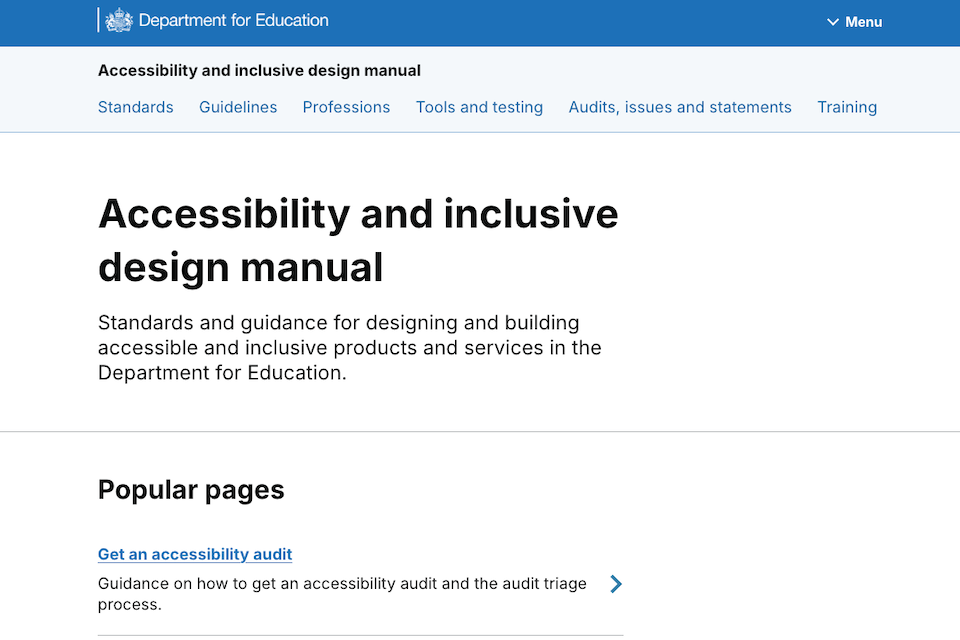
The visual and structural layout of the manual’s homepage underwent a radical simplification to improve accessibility and speed. The 2024 version of the homepage was criticized for being "too busy," featuring an excess of icons, decorative images, and a long-scroll format that hindered quick navigation. Furthermore, the top navigation bar was found to be unclear, often leading users to dead ends or redundant pages.
In the July 2025 version, the DfE removed unnecessary visual clutter. The new homepage prioritizes high-level categories with clear, descriptive headings and concise summaries. The navigation was rebuilt to ensure that the most frequently accessed resources are no more than two clicks away from the landing page.
This "less is more" approach is particularly beneficial for users with cognitive disabilities or those using screen readers, as it minimizes the amount of information that must be processed at once. By adhering to the "Web Content Accessibility Guidelines" (WCAG) 2.2 standards, the DfE has ensured that the manual itself serves as a functional demonstration of the inclusive design principles it advocates.
Supporting Data and the Regulatory Context
The drive to improve the DfE Accessibility and Inclusive Design Manual is set against a backdrop of increasing regulatory scrutiny and a growing awareness of the "digital divide." In the United Kingdom, the Public Sector Bodies (Websites and Mobile Applications) (No. 2) Accessibility Regulations 2018 require all public sector digital services to be accessible to all users, including those with disabilities.
According to data from the Department for Work and Pensions (DWP), there are approximately 16 million people in the UK reported as having a disability, representing roughly 24% of the population. Furthermore, research by the Office for National Statistics (ONS) suggests that disabled adults are more likely to be "digitally excluded," making the accessibility of government services a matter of social equity.
The WebAIM Million study, an annual accessibility audit of the top one million homepages, consistently shows that over 96% of websites have detectable WCAG failures. By providing a robust, user-tested manual, the DfE is attempting to buck this trend within the public sector. The department’s data showed that since the update, the time spent on the manual’s "how-to" pages has increased, while the "bounce rate" (the percentage of visitors who leave after viewing only one page) has decreased, suggesting that users are finding the information more relevant and engaging.
Broader Impact and Implications for the Public Sector
While the manual was specifically developed for DfE teams, its impact extends far beyond a single department. The DfE has maintained an "open by default" policy, making the manual accessible to any organization or individual involved in building digital services. This transparency allows local authorities, non-profits, and private sector contractors to leverage high-quality, government-vetted guidance without having to develop their own resources from scratch.
Industry experts suggest that the DfE’s iterative approach sets a new standard for how government "Service Manuals" should be maintained. Rather than being static documents, these resources must function as living ecosystems that adapt to user feedback. The success of the DfE’s research-led update is likely to influence other departments, such as the Ministry of Justice (MoJ) and the Department for Work and Pensions (DWP), to conduct similar audits of their internal design resources.
Furthermore, the emphasis on "inclusive design" rather than just "accessibility" signals a shift in philosophy. While accessibility often focuses on technical compliance (such as ensuring a site is screen-reader friendly), inclusive design looks at the broader human experience, considering factors like neurodiversity, language barriers, and temporary impairments. By centering the manual on people’s needs rather than just technical checklists, the DfE is promoting a more empathetic and effective approach to digital governance.
Conclusion: A Commitment to Continuous Improvement
The July 2025 update to the DfE Accessibility and Inclusive Design Manual is not a final destination but a milestone in a continuous journey. The department has indicated that it will continue to monitor user data and solicit feedback to ensure the manual keeps pace with technological advancements, such as the integration of Artificial Intelligence in testing and the evolving WCAG 3.0 standards.
By prioritizing user research and being willing to dismantle and rebuild existing structures—like the "knowledge hub"—the DfE has demonstrated a commitment to excellence in digital service delivery. As the UK government continues its digital transformation, resources like this manual will be essential in ensuring that no citizen is left behind in an increasingly online world. The DfE’s proactive stance serves as a reminder that accessibility is not a one-time fix but a core discipline that requires constant attention, refinement, and, above all, a focus on the end-user.