Chronology of Development and the Need for Change
The journey toward the current manual began in September 2024, when the DfE first published the Accessibility and Inclusive Design Manual as a centralized resource for digital professionals. While the initial launch was met with positive feedback and steady engagement data, internal audits and user metrics suggested that while the content was being consumed, users were encountering friction in navigating the repository.
Between late 2024 and the second quarter of 2025, the DfE’s digital team conducted a series of qualitative research sessions. These sessions targeted three primary cohorts within the Digital, Data, and Technology (DDaT) profession: designers, product managers, and delivery roles. The research was designed to evaluate three specific areas: the findability of information, the utility of the existing "Knowledge Hub," and the effectiveness of the guidance regarding accessibility testing tools.
The findings revealed that while the core educational content was highly valued, the structural "Knowledge Hub" had inadvertently become a "dumping ground" for miscellaneous information. This lack of a clear taxonomy led to increased cognitive load for users who were often searching for specific solutions under tight delivery deadlines. Consequently, the decision was made to overhaul the manual’s information architecture to better align with the natural workflows of digital service teams.
Structural Overhaul: Moving Beyond the Knowledge Hub
A primary focus of the July 2025 update was the complete removal of the "Knowledge Hub" section. In its place, the DfE implemented a more intuitive content strategy that integrates resources directly into the user journey. The team recognized that users do not look for "knowledge" in the abstract; they look for guidance on specific tasks such as writing alt-text, structuring HTML headers, or designing accessible navigation menus.
By reorganizing the content based on how professionals think and search, the DfE has effectively reduced the "time to information." For example, guidance that was previously buried in the Knowledge Hub has been redistributed into thematic sections such as "Content Design," "Interaction Design," and "Technical Development." This shift reflects a broader trend in government digital standards—moving away from static documentation toward dynamic, task-oriented resources that mirror the Service Manual guidelines provided by the Government Digital Service (GDS).
Enhancing Guidance for Accessibility Tools
The research phase highlighted a significant gap in the manual’s treatment of accessibility tools. Previously, the "Tools" section functioned primarily as a directory—a list of software and browser extensions with instructions on how to install them. However, user feedback indicated that simply knowing what a tool was did not suffice. Professionals needed to understand why a tool was necessary, when in the development lifecycle to use it, and how to interpret its outputs.
In response, the updated manual now provides context-heavy guidance for each tool. This includes:
- Persona-Based Utility: Explaining how specific tools simulate the experiences of users with visual, auditory, motor, or cognitive impairments.
- Workflow Integration: Guidance on integrating automated testing tools into the Continuous Integration/Continuous Deployment (CI/CD) pipeline versus when to conduct manual keyboard testing or screen reader audits.
- Limitations Awareness: Factual analysis of what automated tools can and cannot catch, emphasizing that automated testing typically only identifies 30% to 40% of accessibility barriers, thereby necessitating manual intervention.
By shifting the focus from "installation" to "application," the DfE is empowering its teams to move beyond "tick-box" compliance toward a more holistic understanding of inclusive design.
User Interface and Experience Improvements
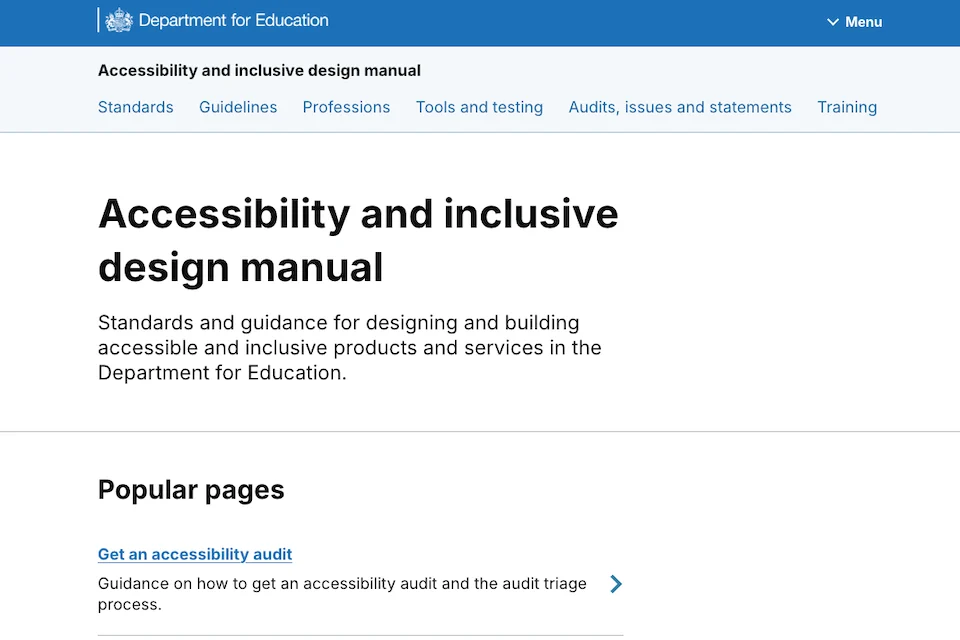
The visual and navigational elements of the manual were also subjected to a major redesign. The original homepage was identified as a barrier to efficiency; it featured a "busy" layout characterized by an overabundance of icons, large images, and a long scroll depth. This layout often forced users to hunt for the search bar or the main navigation menu, detracting from the site’s primary purpose as a quick-reference tool.
The July 2025 update introduced a simplified homepage that prioritizes clarity and speed. The redesign included:
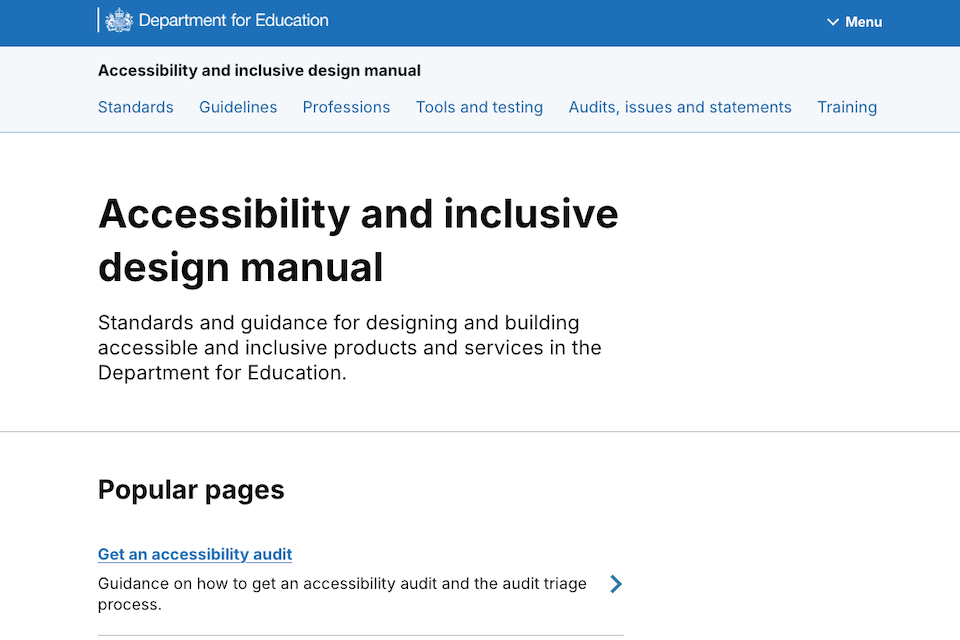
- Streamlined Navigation: A revised top-level navigation menu that categorizes information by professional role and project phase.
- Reduced Visual Noise: The removal of non-essential imagery and icons to focus the user’s attention on the text-based guidance.
- Optimized Hierarchy: A restructured information hierarchy that places the most frequently accessed resources "above the fold," reducing the need for excessive scrolling.
These changes align with the "F-pattern" of web reading and minimize the physical effort required for users with motor impairments to navigate the site, practicing the very inclusive design principles the manual advocates.
Supporting Data and Regulatory Context
The drive to improve the DfE Accessibility and Inclusive Design Manual is situated within a broader legal and data-driven framework. Under the Web Content Accessibility Guidelines (WCAG) 2.2, which became the new standard for UK government services in recent years, departments are required to meet Level AA standards. Failure to comply not only poses legal risks but also excludes a significant portion of the population from essential services.
According to the Office for National Statistics (ONS), the number of people reporting a disability in the UK has been steadily increasing, partly due to an aging population and better diagnosis of neurodivergent conditions. Furthermore, data from the "Click-Away Pound" survey suggests that 71% of disabled web users will abandon a website that they find difficult to use. For a department like the DfE, which manages student loans, school admissions, and teacher training applications, the stakes of digital exclusion are exceptionally high.
The DfE’s internal data showed that while the 2024 manual had high traffic, the "bounce rate" on certain complex pages was higher than desired. The 2025 updates were specifically engineered to address these drop-off points by breaking down complex technical requirements into "plain English" guidance.
Broader Implications for the Public Sector
While the manual was developed specifically for DfE teams, its release has broader implications for the UK public sector and the global design community. The DfE has maintained an "open by default" policy, making the manual accessible to anyone designing or building digital services.
This move follows the precedent set by the GDS and other departments like the Home Office and the Department for Work and Pensions (DWP), which have also shared their internal design systems and accessibility libraries. By providing a high-quality, free resource, the DfE is helping to set a cross-governmental standard. This is particularly beneficial for smaller local authorities and non-departmental public bodies (NDPBs) that may not have the budget or personnel to conduct their own extensive accessibility research.
Furthermore, the manual serves as a critical resource for private-sector contractors who bid for government work. By making the DfE’s expectations explicit and the tools for achieving them accessible, the department is effectively raising the quality of the entire digital supply chain.
Analysis of Inclusive Design as a Cost-Saving Measure
From a fiscal perspective, the emphasis on inclusive design from the outset—often referred to as "shifting left" in the development process—is a strategic cost-saving measure. Fact-based analysis from various industry leaders, including Forrester and Gartner, suggests that it is up to 30 times more expensive to fix an accessibility issue during the maintenance phase than it is to address it during the initial design phase.
By providing DfE staff with a manual that is easier to use and more comprehensive, the department is reducing the likelihood of costly "retrofitting" projects. Moreover, accessible design often results in better Search Engine Optimization (SEO) and faster load times, which reduces server costs and improves the user experience for people on low-bandwidth connections or older mobile devices.
Future Outlook and Continuous Improvement
The July 21 relaunch is not the final step in the manual’s evolution. The DfE has indicated that the manual will remain a "living document," subject to regular updates as technology and user needs change. Future iterations are expected to delve deeper into the implications of Artificial Intelligence (AI) in accessibility—both as a tool for creating accessible content and as a potential barrier if not implemented inclusively.
The DfE’s proactive approach in seeking user feedback and being willing to dismantle sections that were not working (such as the Knowledge Hub) demonstrates a mature "user-first" philosophy. As digital services become the primary—and sometimes only—way for citizens to interact with the Department for Education, the importance of such a manual cannot be overstated. It stands as a foundational document for ensuring that the future of education in the UK is digitally accessible to every student, parent, and educator, regardless of their physical or cognitive abilities.