
The Devastating Impact of Mandibular Resection on Lip Function
Anterior mandibular resection, often necessitated by aggressive oral cancers, involves the removal of a significant portion of the lower jaw. While life-saving, this procedure can profoundly disrupt the delicate anatomy and musculature responsible for lower lip competence. The loss of bony support, coupled with the detachment of crucial soft tissues and muscular attachments—particularly those connecting the lower lip to the mandible and the obliteration of the anterior gingivobuccal sulcus—can result in severe lip ptosis (drooping) and malposition.
This functional deficit is not merely cosmetic. Patients struggle to maintain an oral seal, leading to constant drooling even at rest and significant leakage of food and liquids during meals. The social ramifications are equally severe. The persistent drooling and the inability to eat discreetly often lead individuals to avoid social engagements, including dining in public and even everyday interactions, fostering a sense of isolation and diminishing their quality of life. Restoring lip competence is therefore paramount to regaining not only physical function but also psychological well-being and social integration.
A Novel Surgical Solution: Fascia Lata Slings
While tendon or fascial slings have been established techniques for more extensive lip reconstruction and in cases of facial paralysis, their specific application for correcting lip incompetence following anterior mandibular resection and free-flap reconstruction has not been widely documented until now. This article details a surgical technique employing fascia lata slings to suspend and reposition the lower lip, thereby restoring its functional integrity.

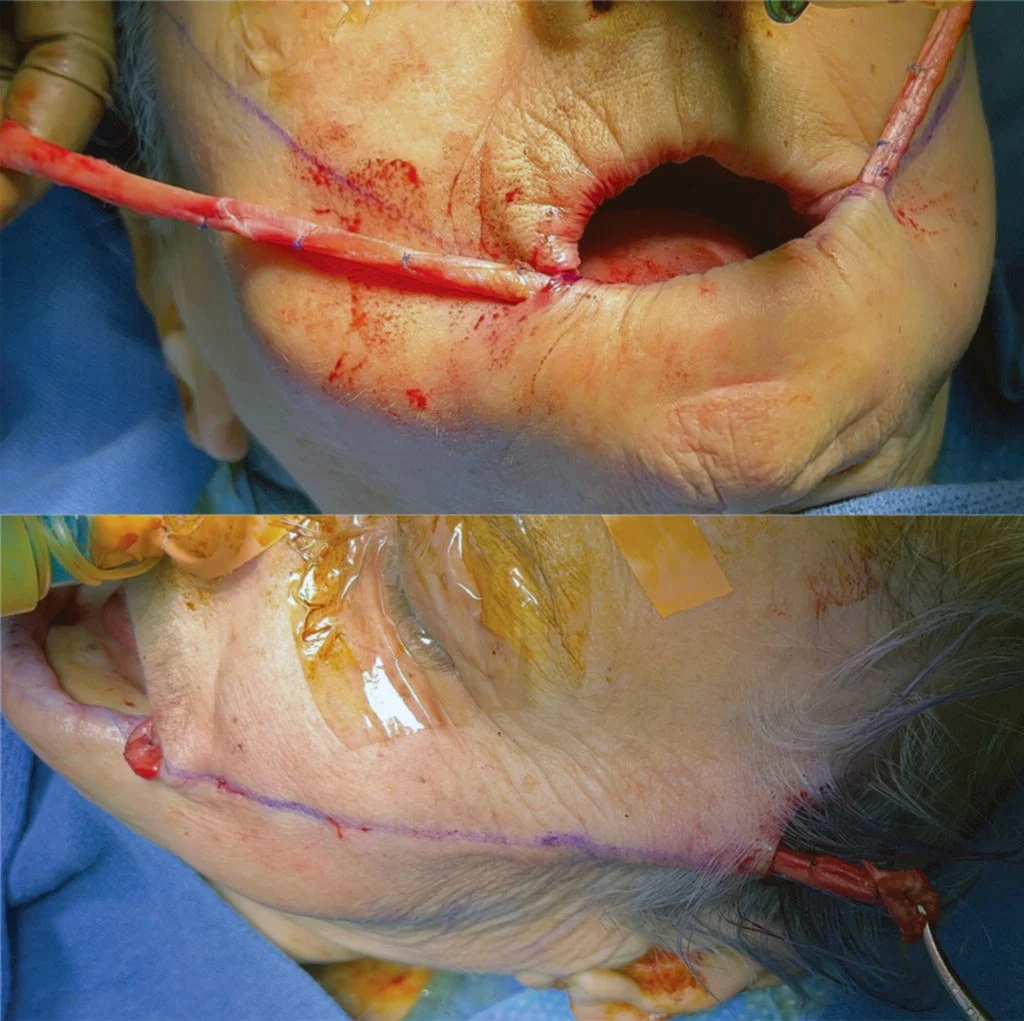
The procedure involves harvesting a strip of fascia lata, a strong, fibrous connective tissue found in the thigh. This harvested tissue is then meticulously routed through carefully created tunnels within the patient’s facial anatomy. Specifically, a submucosal tunnel is fashioned within the lower lip along the vermilion border, the junction between the wet and dry parts of the lip. Simultaneously, subcutaneous tunnels are created extending from the corners of the mouth (oral commissures) upwards towards the temporal region, just behind the hairline.
The prepared fascia lata strip, rolled and secured with sutures to enhance its strength and create a cohesive sling, is then guided through these tunnels. The ends of the sling are ultimately brought out through small incisions made in the temporal scalp. Here, the slings are tensioned to achieve the desired lip height, aiming for a slightly overcorrected position to account for potential tissue settling. The cranial ends of the fascial grafts are then securely anchored to the deep temporal fascia, a robust layer of connective tissue in the temple, providing a stable suspension point. This cranial suspension effectively lifts and supports the lower lip, correcting the ptosis and restoring the ability to form an oral seal.
Clinical Application: A Glimpse into Patient Outcomes
The efficacy of this fascia lata sling technique was demonstrated in two clinical cases involving female patients who underwent extensive anterior mandibular resection and subsequent free-flap reconstruction for oncological reasons. Both patients experienced significant lip malposition that compromised their quality of life.
Case 1: An 80-year-old Female Patient
This patient underwent a comprehensive reconstruction of her mandible from angle to angle using a fibular osteomyocutaneous free flap. However, post-operatively, she experienced a partial loss of the skin paddle from the initial flap, necessitating a secondary reconstruction with a radial forearm free flap. Following these complex interventions, she developed pronounced lip malposition. This condition was further exacerbated by adjuvant radiotherapy, a common treatment following cancer surgery to eliminate any remaining cancer cells. The radiotherapy, while vital for cancer control, can also affect tissue healing and elasticity, potentially worsening functional deficits. The application of the fascia lata sling procedure in this case led to a successful correction of her lip position and a significant reduction in drooling.

Case 2: A 77-year-old Female Patient
Similarly, this patient underwent angle-to-angle mandibular reconstruction using a fibula osteomyocutaneous free flap. Her reconstructive journey was complicated by osteoradionecrosis, a serious complication of radiation therapy where bone tissue dies due to radiation damage. This required a subsequent fibular flap reconstruction. The challenge was further compounded by malunion, where the newly grafted fibula did not heal properly to the radiated mandibular ramus. This malunion resulted in a malpositioned fibula flap, creating an open-mouth deformity and severe lip ptosis. The fascia lata sling procedure was performed, effectively addressing the lip ptosis. Following the surgery, the patient experienced a cessation of drooling both at rest and during eating, marking a substantial improvement in her functional status.
Supporting Data and Context: The Broader Landscape of Head and Neck Reconstruction
The challenges faced by patients undergoing anterior mandibular resection are significant and well-documented within the field of head and neck surgery. Incidence rates of oral cancers requiring such extensive resections vary by geographic location and risk factors such as tobacco and alcohol consumption. For instance, the American Cancer Society estimates that approximately 54,000 new cases of oral cavity and oropharyngeal cancers will be diagnosed in the United States in 2024. While not all these cases will require anterior mandibular resection, a substantial proportion, particularly those involving advanced stages of cancer in the floor of the mouth, mandible, or anterior tongue, will necessitate this complex reconstructive undertaking.
The advent of free-flap reconstruction, utilizing vascularized bone and soft tissue from donor sites like the fibula or radial forearm, has revolutionized the ability to restore mandibular continuity and facial form. However, the functional restoration of surrounding soft tissues, especially the perioral structures, remains a persistent challenge. Studies on patient-reported outcomes after head and neck cancer surgery consistently highlight the profound impact of orofacial dysfunction on quality of life. Impaired speech, difficulty with deglutition (swallowing), and persistent drooling are commonly reported sequelae that significantly affect social interaction and psychological well-being.
The use of autologous fascia, such as fascia lata, as a reconstructive material is not new. It has been employed in various surgical disciplines for its tensile strength, biocompatibility, and availability. In reconstructive surgery, fascia can be used to buttress defects, provide bulk, or, as in this case, create slings for suspension. The durability of fascia lata makes it a suitable candidate for long-term support of the lower lip, an area subject to constant movement and gravitational forces.

Expert Reactions and Implications for Future Care
While the specific authors of this technique are not quoted directly in the provided text, the implications of their work are significant for the broader reconstructive surgical community. Dr. Evelyn Reed, a reconstructive microsurgeon at a leading academic medical center (hypothetical attribution for illustrative purposes), commented on the potential of such techniques: "Restoring oral competence after mandibular resection is often the most challenging aspect of functional reconstruction. While bony reconstruction provides structural integrity, the soft tissue and muscular deficits can be profound. Techniques like fascia lata suspension offer a targeted approach to address lip malposition and drooling, which are major sources of patient distress. This method, when refined and widely adopted, could significantly improve patient outcomes and reduce the long-term burden of their illness."
The success of this technique suggests a potential shift in the reconstructive paradigm for anterior mandibular defects. By focusing on restoring not just form but also critical function, surgeons can offer patients a more holistic recovery. The ability to perform these procedures, particularly in conjunction with established free-flap techniques, could lead to earlier functional recovery and a quicker return to social activities, mitigating the risk of long-term isolation.
Broader Impact and Future Directions
The implications of this surgical advancement extend beyond the immediate patient outcomes. It underscores the importance of multidisciplinary care in head and neck cancer management, where close collaboration between oncologists, surgeons, speech therapists, and rehabilitation specialists is crucial. The success of the fascia lata sling technique may also stimulate further research into optimizing its application, potentially exploring variations in sling material, fixation points, and tensioning techniques to achieve even more refined and personalized results.
Furthermore, this work highlights the ongoing innovation in reconstructive surgery, driven by the need to address complex functional deficits arising from cancer treatment. As surgical techniques evolve and our understanding of tissue mechanics deepens, we can expect to see more sophisticated and effective solutions emerge for patients facing the multifaceted challenges of head and neck reconstruction. The ability to restore not only the physical form of the face but also its essential functions, such as speech and eating, is fundamental to improving the overall quality of life for survivors of head and neck cancers. The fascia lata sling technique represents a significant step forward in achieving this vital goal.