The Magnitude of the Crisis
The urgency behind this event is rooted in sobering statistical data that highlights a stark disparity between physical and mental health outcomes in the construction industry. According to the Center for Construction Research and Training (CPWR), suicide claims nearly five times as many construction workers as on-the-job physical accidents. This statistic is particularly alarming given the industry’s rigorous focus on preventing falls, equipment malfunctions, and other traditional site hazards.
Furthermore, data from the Bureau of Labor Statistics (BLS) confirms that the suicide rate among construction workers is approximately four times higher than the national average. When viewed against the backdrop of an industry employing more than 8 million people nationwide, these numbers represent a systemic failure that experts argue requires immediate, institutionalized intervention. The demographic profile of the construction workforce—which is predominantly male and often characterized by a "tough it out" culture—creates unique barriers to seeking help, as workers may fear that expressing vulnerability will be perceived as a weakness or a threat to their employment security.
A Chronology of Advocacy
The origins of the Construction Suicide Prevention Week stand-down can be traced back to a growing coalition of trade associations, labor unions, and private contractors who recognized that traditional safety programs were incomplete. In the early 2010s, industry researchers began identifying a troubling trend in mortality rates that could not be explained by site injuries alone. By the late 2010s, groups such as the Construction Industry Alliance for Suicide Prevention (CIASP) began formalizing resources specifically tailored for the field.
The progression of this movement has been marked by several key phases:

- 2015–2017: Initial research identifies the disproportionate rate of suicide in the construction sector compared to other industries.
- 2018–2020: The introduction of "Toolbox Talks" focused on mental health, allowing supervisors to introduce the topic during morning briefings.
- 2021–2023: The formalization of an annual, nationwide awareness week, supported by federal labor agencies and national construction organizations.
- 2024–2026: A shift from purely awareness-based campaigns to actionable, site-specific policies, including mandated mental health first-aid training for site foremen.
Bridging the Gap: Physical vs. Mental Safety
For decades, the construction industry has operated under a "safety first" mantra, primarily focused on the mitigation of physical risk. While this focus has led to significant reductions in traumatic workplace injuries, it has left a void regarding the internal pressures faced by the workforce. Industry leaders are now pressing for a "Total Worker Health" approach, which asserts that mental health management must receive the same organizational priority as fall protection or site security.
The stand-down is intended to be more than a symbolic gesture. During the pause in work, participating organizations are encouraged to distribute comprehensive mental health toolkits. These resources often include information on how to identify signs of depression or burnout in colleagues, access to Employee Assistance Programs (EAPs), and information on national crisis hotlines. By normalizing these discussions during regular working hours, companies are attempting to integrate mental health support into the daily rhythm of the jobsite.
Industry Responses and Stakeholder Perspectives
The initiative has garnered widespread support from major construction stakeholders, including general contractors, subcontractors, and architectural firms. "The goal is to foster a culture where asking for help is seen as a sign of professional strength rather than a liability," says a representative from a leading national construction association.

Labor advocates emphasize that the high-stress environment of construction—characterized by demanding deadlines, long periods away from home, chronic physical pain, and economic instability—creates a perfect storm for mental health struggles. By providing a platform for this conversation, organizers hope to empower workers to utilize available resources before a crisis reaches a breaking point.
Employers are also noting the business case for mental health support. Reduced absenteeism, higher employee retention, and improved jobsite safety are often cited as long-term benefits of a workforce that feels supported and mentally healthy. Several large-scale infrastructure projects have already begun implementing mandatory "Mental Health First Aid" training for all lead supervisors, ensuring that those in positions of authority have the skills necessary to intervene when a worker shows signs of distress.
Implications for Future Safety Standards
The implications of this movement extend far beyond the duration of the stand-down. As the industry moves toward 2030, there is a mounting push to codify mental health awareness into official Occupational Safety and Health Administration (OSHA) recommendations. While the current focus remains on voluntary participation and cultural change, there is growing sentiment that the scale of the suicide crisis warrants a more formalized regulatory response.

Some industry analysts suggest that future construction contracts may soon include provisions for mental health support as a standard operating requirement, much like existing requirements for personal protective equipment (PPE). If this shift occurs, the "stand-down" event will likely be remembered as the tipping point that moved mental health from the periphery of industry discourse to the center of professional safety standards.
The Role of Education and Resource Distribution
A critical component of the upcoming stand-down is the educational outreach planned for jobsites. Simply pausing work is insufficient if workers do not have access to long-term support. Consequently, companies are being encouraged to:
- Display Pledge Banners: Visible commitments on jobsites that signal the company’s dedication to mental health.
- Conduct Toolbox Talks: Dedicated sessions where workers can discuss stressors in a non-judgmental environment.
- Provide Crisis Information: Ensuring every worker has access to the 988 Suicide & Crisis Lifeline and other regional mental health resources.
- Training for Leadership: Equipping foremen and superintendents with the tools to initiate conversations about well-being without fear of infringing on privacy or professionalism.
Addressing the Stigma
The primary obstacle to progress remains the cultural resistance to addressing mental health. In an industry defined by stoicism and grit, admitting to mental health struggles can feel like an admission of failure. The stand-down serves as a high-visibility counter-narrative to this belief. By having leadership participate alongside field crews, the hierarchy of the jobsite is temporarily leveled, emphasizing that mental health is a universal human concern that does not discriminate based on position or skill set.

Looking Ahead
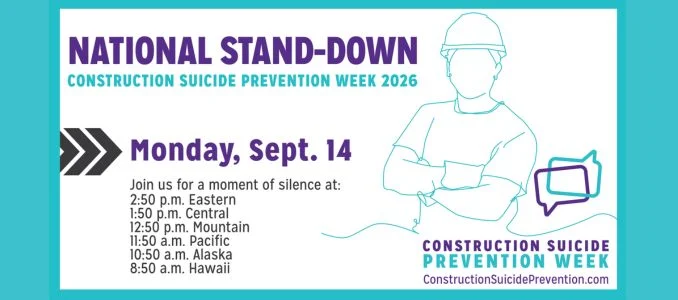
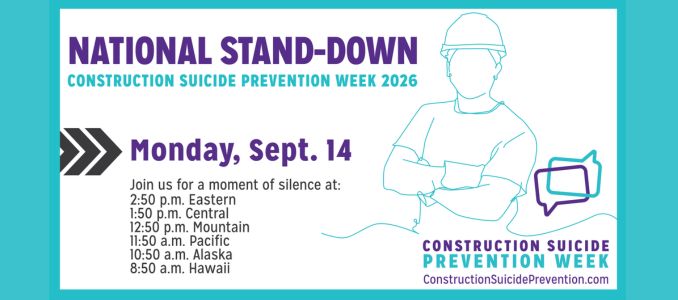
As the industry prepares for this national moment of silence, the focus remains on sustaining the momentum. The success of the event will not be measured by the silence held for one minute, but by the conversations that continue long after the work resumes. For the 8 million workers across the country, this initiative represents a long-overdue acknowledgement that the most important asset on any construction site is the individual worker.
The collective action scheduled for this week reflects an evolving understanding of safety—one that acknowledges that the most dangerous hazards are not always the ones that can be seen, but the ones that are felt in silence. By bringing these issues into the light, the construction industry is positioning itself to lead a necessary, systemic shift in the American workforce, ensuring that the health of its people is as durable as the structures they build. As the industry looks toward the future, the integration of mental health into the fabric of safety culture will likely serve as a defining characteristic of modern construction management, potentially saving thousands of lives and transforming the standard of care for generations of builders to come.