The Integration Imperative: Streamlining Clinical Workflows for Enhanced Patient Care
For decades, audiology professionals have navigated a fragmented landscape of tools and systems, often requiring them to switch between different software applications or even hardware for various stages of patient assessment and hearing aid fitting. This multi-system approach, while effective, introduced inefficiencies, increased appointment times, and potentially created barriers to consistent, evidence-based care. The integration by Auditdata is a direct response to this industry-wide challenge, aiming to simplify the clinical journey from initial diagnosis to successful hearing aid fitting and post-fitting evaluation. By bringing NAL-NL3 and the Oldenburg Matrix Sentence Test into the Measure™ platform, Auditdata enables clinicians to access these crucial functionalities within a unified environment, thereby making both processes more accessible and practical during routine clinical care.
The significance of this integration extends beyond mere convenience. It represents a philosophical shift towards a more holistic and data-driven approach to audiology. According to the World Health Organization (WHO), over 5% of the world’s population – or 430 million people – require rehabilitation for disabling hearing loss. The effectiveness of hearing interventions, particularly hearing aids, is paramount to improving quality of life for this vast demographic. Ensuring that hearing aids are optimally fitted and that their performance in real-world scenarios, such as understanding speech in background noise, can be accurately measured, are cornerstones of successful rehabilitation. Auditdata’s integration facilitates this by connecting the two critical pillars of hearing care: prescriptive fitting and objective performance evaluation.
Unveiling NAL-NL3: A New Era in Hearing Aid Prescription
At the heart of this integration is NAL-NL3, developed by Australia’s National Acoustic Laboratories (NAL), a globally respected independent research body. NAL-NL3 is not merely an update; it represents the first new NAL hearing aid prescription in 15 years, succeeding the highly influential and widely adopted NAL-NL2. The lineage of NAL prescriptions, beginning with NAL-R, NAL-NL1, and NAL-NL2, has consistently set the gold standard for evidence-based hearing aid fitting, aiming to provide optimal loudness and speech intelligibility for users. The 15-year gap since NAL-NL2’s introduction underscores the rigorous research and extensive validation undertaken to develop its successor.
NAL-NL3 builds upon the foundational principles of its predecessors but introduces a profoundly more data-driven and modular approach. Its development leveraged an unprecedented scale of data, drawing from millions of real-world hearing aid fittings, extensive real-ear measurements, and invaluable user feedback. This vast dataset was then subjected to sophisticated machine-learning analysis, allowing NAL to refine fitting recommendations with unparalleled precision. This iterative, evidence-based development process ensures that NAL-NL3 offers a more robust and personalized fitting experience than ever before.
The core NAL-NL3 Prescription is immediately available within Auditdata Measure™ release 6.6.0. However, the true innovation of NAL-NL3 becomes even more apparent with the upcoming release of Measure™ 6.7.0, which will introduce two additional, specialized modules: Comfort in Noise and Minimal Hearing Loss. These modules represent a significant evolution in fitting philosophy, moving beyond the concept of a singular prescription intended to address every listening situation. Instead, NAL-NL3 offers a core prescription augmented by targeted approaches designed to meet specific and often complex listening needs.
The Comfort in Noise module is specifically engineered to enhance listening comfort in noisy environments without compromising speech understanding, a common complaint among hearing aid users. Traditional fittings often struggle to balance these two competing demands. The Minimal Hearing Loss module addresses an often-overlooked demographic: individuals who report significant difficulty understanding speech in noise despite having little measurable hearing loss on a standard audiogram. These individuals may not traditionally be considered candidates for amplification, yet their quality of life can be significantly impacted. NAL Director Brent Edwards highlighted that the development of NAL-NL3 began by identifying precisely these areas where existing fitting prescriptions fell short of fully addressing patients’ nuanced needs. "With their adoption of the NAL-NL3 Fitting System, Auditdata is making the gold standard fitting prescription available to more clinicians around the world," Edwards stated, emphasizing the global reach and impact of this integration.
Addressing the "Cocktail Party Problem": The Oldenburg Matrix Sentence Test
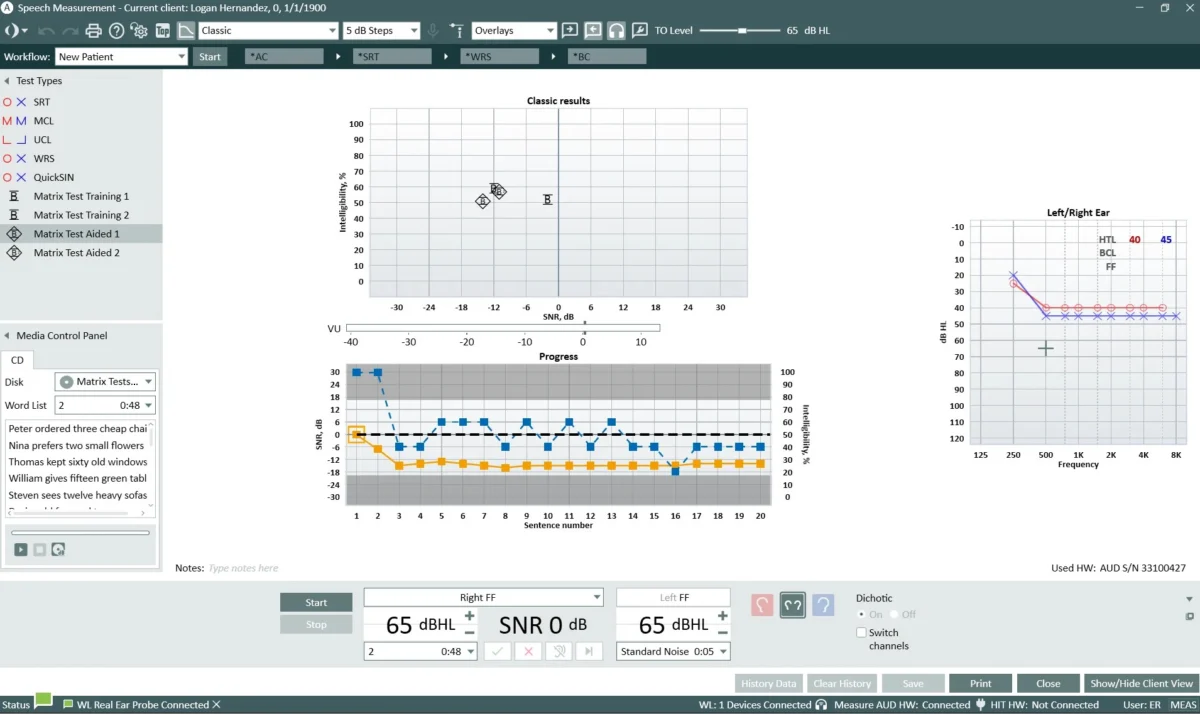
Complementing the advanced fitting capabilities of NAL-NL3, Auditdata has simultaneously integrated the Oldenburg Matrix Sentence Test into its Measure™ platform. Developed and validated by Hörzentrum Oldenburg in Germany, this test provides a standardized and highly reliable method for measuring speech recognition in noise – often referred to as the "cocktail party problem." While traditional audiometry assesses hearing thresholds in quiet environments, it often fails to predict a person’s ability to understand speech in real-world, noisy conditions, which is a primary concern for most individuals with hearing loss.
The Matrix approach is ingeniously designed. It utilizes sentences constructed from a fixed set of words arranged in a predictable grammatical structure (e.g., "The man ordered seven red hats"). However, the specific words within this structure are randomized, minimizing contextual cues that might allow a listener to guess the answer. This design ensures that the test primarily measures the listener’s ability to discern speech sounds amidst noise, rather than their cognitive ability to infer meaning. The inherent structure provides a highly repeatable measure of speech recognition, making it an ideal tool for tracking progress over time or comparing performance under different hearing aid settings or conditions.
A critical feature of the Oldenburg Matrix Sentence Test within Auditdata Measure™ is its automated adaptability. The test dynamically adjusts the signal-to-noise ratio (SNR) based on the patient’s responses, efficiently determining their individual speech recognition threshold. This adaptive methodology enhances accuracy and reduces testing time. Furthermore, Auditdata’s initial implementation supports 15 languages, a crucial innovation that allows testing to be performed in a patient’s native language, even if the clinician does not speak that language. This multilingual capability is vital in increasingly diverse societies and for international research. Hörzentrum Oldenburg emphasizes that international Matrix tests were specifically developed to provide comparable measurement methods across languages, a consideration that is gaining paramount importance in both clinical care and global research initiatives. Dr. Dirk Oetting, Project Manager at Hörzentrum Oldenburg, underscored the importance of this integration, stating, "Speech-in-noise testing belongs in every clinic. Seeing the Matrix Sentence Test reach audiologists worldwide through Measure™ is exactly the impact our research was made for."

Synergistic Impact: Connecting Fitting with Real-World Performance
The combined power of NAL-NL3 and the Oldenburg Matrix Sentence Test within a single workflow represents a paradigm shift in audiological practice. Together, these additions provide clinicians with a more direct and empirical way to connect hearing aid fitting parameters with one of the most common and debilitating challenges reported by people with hearing loss: understanding conversation in background noise.
The clinical utility is clear: an audiologist can first assess a patient’s baseline speech-in-noise performance using the Oldenburg Matrix Test. Following this, they can fit hearing aids precisely using the advanced NAL-NL3 targets, potentially leveraging the specialized Comfort in Noise or Minimal Hearing Loss modules. Crucially, the clinician can then repeat the speech-in-noise testing to objectively quantify and demonstrate whether performance has improved. This "test-fit-test" cycle provides concrete, measurable evidence of the amplification’s effectiveness. For patients, this translates into a tangible demonstration of how their hearing aids directly impact their ability to understand speech in challenging listening conditions, fostering greater confidence and satisfaction with their devices. This objective feedback can significantly improve patient acceptance and adherence to hearing aid use, a long-standing challenge in audiology.
The Power of Independence and Standardization
A particularly noteworthy aspect of this integration is the independent origin of both NAL-NL3 and the Oldenburg Matrix methodology. Neither tool was developed by Auditdata itself, nor by a hearing aid manufacturer. NAL-NL3 originates from the National Acoustic Laboratories in Australia, a government-funded research institution, while the Matrix testing methodology was developed through Hörzentrum Oldenburg in Germany, an academic research center. Their integration into Auditdata Measure™ places both these highly respected, manufacturer-agnostic, and research-backed approaches within the same clinical environment. This independence is critical, as it assures clinicians of unbiased, scientifically validated tools, free from commercial influence often associated with proprietary manufacturer-specific fitting algorithms or diagnostic tests. This promotes evidence-based practice and elevates the standard of care across the industry.
For larger hearing-care organizations, the adoption of such standardized and integrated testing methodologies offers additional significant advantages. It facilitates easier comparison of outcomes across different clinicians, various clinic locations, and over extended periods. This capability is particularly invaluable when managing diverse patient populations, especially those who speak different languages, as the multilingual support of the Oldenburg Matrix Test ensures consistent measurement criteria. Such standardization supports quality assurance, performance benchmarking, and continuous improvement initiatives within large clinical networks.
Auditdata’s Vision and Future Outlook
This integration reinforces Auditdata’s commitment to advancing audiological care through innovative software solutions. By acting as a central hub for cutting-edge, independent tools, Auditdata positions its Measure™ platform as an indispensable asset for modern audiology clinics. The company’s vision appears to be centered on empowering clinicians with efficient, accurate, and comprehensive tools that translate directly into improved patient outcomes.
The global audiology software market is experiencing significant growth, driven by an aging population, increased awareness of hearing health, and technological advancements. Integrations like these are crucial for companies like Auditdata to maintain a competitive edge and to drive the industry forward. The move reflects a broader trend towards digitalization and data-driven decision-making in healthcare, where software platforms are increasingly becoming the central nervous system of clinical operations.
Key Dates and Availability
Audiology professionals will have the opportunity to experience NAL-NL3 and the Oldenburg Matrix Sentence Test firsthand at EUHA 2026 in Hannover, Germany, from October 14–16. This prominent international congress for hearing aid acousticians will serve as a key platform for Auditdata to demonstrate the practical benefits and advanced functionalities of these integrations.
The core NAL-NL3 Prescription and the Oldenburg Matrix Sentence Test are already available to users beginning with Auditdata Measure™ release 6.6.0. The highly anticipated NAL-NL3 Comfort in Noise and Minimal Hearing Loss modules are planned for subsequent release with Measure™ 6.7.0, further expanding the platform’s capabilities and addressing a wider spectrum of patient needs. This phased rollout ensures that clinicians can immediately benefit from the core advancements while anticipating further specialized enhancements designed to tackle complex audiological challenges.
Source: Auditdata