The introduction of Auracast in these prominent local venues signifies a pivotal moment for accessibility in New Mexico, offering a sophisticated complement to existing hearing loop systems. For individuals with hearing loss, Auracast provides an additional, highly versatile pathway to receive clear, direct audio through their personal compatible hearing aids, earbuds, or specialized loaner receivers. This dual approach ensures comprehensive coverage and caters to a wider range of user preferences and device capabilities, moving closer to universal audio access.
Understanding Auracast: A Paradigm Shift in Audio Transmission
Auracast is not merely an incremental upgrade; it represents a fundamental shift in how Bluetooth audio can be consumed in public and private spaces. Built upon the foundation of Bluetooth® LE Audio, Auracast Broadcast Audio allows an audio source to broadcast one or more audio streams to an unlimited number of nearby Auracast receivers. Unlike traditional point-to-point Bluetooth connections, which are limited to a single or a few paired devices, Auracast enables a one-to-many broadcast model, akin to a private radio station that only compatible devices can tune into. This capability is particularly transformative for assistive listening, multilingual events, public information broadcasts, and personalized audio experiences in shared environments.
The technology addresses several long-standing challenges associated with conventional assistive listening systems. Historically, venues have relied on a patchwork of solutions such as hearing loops (telecoils), FM systems, and infrared (IR) systems. While effective for many, each technology has inherent limitations. Hearing loops require specific telecoil-enabled hearing aids and can suffer from electromagnetic interference in certain environments. FM systems, while portable, can be prone to interference and privacy concerns. IR systems require line-of-sight and are often unsuitable for outdoor or brightly lit environments. Auracast, leveraging the ubiquitous Bluetooth standard, offers a robust, low-latency, and energy-efficient solution that promises greater universality, discretion, and ease of use, fostering a more inclusive environment without requiring specialized, often stigmatizing, dedicated receivers.
Albuquerque’s Pioneers: Early Adoption in Local Institutions
Albuquerque’s early embrace of Auracast underscores a commitment to innovation in accessibility, driven in part by a strong local advocacy community.
Grace Lutheran Church, a beacon of community engagement, selected the Infinium Auracast system, manufactured in the United States by Williams AV. Williams AV is a recognized leader in commercial audio-visual solutions, known for its robust and reliable products designed for demanding environments. The Infinium system is a patented, modular Auracast™ broadcast audio platform engineered specifically for commercial AV applications. Its design prioritizes real-time, high-fidelity audio delivery, making it ideal not only for assistive listening but also for supporting multilingual events, providing audio descriptions for visual content, and enhancing overall audio experiences in large venues. The installation at Grace Lutheran Church was expertly carried out by Pace Audio of Albuquerque, a local firm with extensive experience in professional sound systems. This strategic deployment allows visitors to connect to the Auracast broadcast seamlessly using their personal compatible hearing aids or earbuds. For those without compatible personal devices, the church thoughtfully provides loaner receivers equipped with earphones, ensuring that the benefits of the technology are accessible to all congregants and visitors. This proactive step by Grace Lutheran Church highlights a forward-thinking approach to worship inclusivity, ensuring that sermons, music, and announcements are crystal clear for every attendee.
Concurrently, Albuquerque Hearing and Balance, a prominent audiology clinic, has also become an early adopter, demonstrating the technology’s practical utility and educational potential. Mike Langner, a licensed retired radio engineer, spearheaded the installation of the Taiwan-based MoerLabs TVHearMore™ transmitter in both the clinic’s East and West Side waiting rooms. While primarily marketed as a TV streamer, the MoerLabs device showcases remarkable versatility, functioning effectively as a flexible Auracast™ transmitter suitable for a variety of modest-sized public venues, including classrooms, conference rooms, and waiting areas. Its scalability is a key advantage, as multiple transmitters can be synchronized to cover larger spaces seamlessly. At the clinic, the system serves a dual purpose: it acts as a live demonstration platform for prospective hearing aid users, allowing them to experience the transformative clarity of Auracast firsthand, while simultaneously providing clear audio access for waiting room visitors who possess compatible hearing aids or earbuds. This integration allows patients to familiarize themselves with the technology in a practical, low-stakes environment, potentially influencing their choices for future hearing solutions. The user experience is designed for simplicity; while some earbuds and older Auracast-enabled hearing aids might require a smartphone for initial connection, many newer Auracast-enabled hearing aids can connect directly using their built-in broadcast scanning capabilities, especially when only a single Auracast signal is present, streamlining the connection process for enhanced user convenience.
The Broader Landscape of Assistive Listening Technology and Hearing Loss
The arrival of Auracast in Albuquerque is set against a backdrop of significant global need for improved audio accessibility. According to the World Health Organization (WHO), over 1.5 billion people worldwide experience some degree of hearing loss, and this number is projected to rise to over 2.5 billion by 2050. Approximately 430 million people require rehabilitation for moderate or higher degrees of hearing loss. In the United States alone, the National Institute on Deafness and Other Communication Disorders (NIDCD) estimates that around 15% of American adults (37.5 million people) aged 18 and over report some trouble hearing. Despite these staggering figures, access to effective and user-friendly assistive listening technologies remains a significant barrier for many.
For decades, the market has seen various iterations of ALTs, each contributing to improved accessibility but often with their own set of limitations. From personal FM systems used in educational settings to infrared systems in theaters and the widespread adoption of hearing loops in places of worship and public counters, these technologies have played crucial roles. However, challenges persist, including the cost of installation and maintenance for venues, the often-cumbersome nature of distributing and collecting loaner devices, and the social stigma some users feel when needing to request special equipment. Auracast directly addresses these issues by leveraging a technology that is increasingly integrated into everyday consumer electronics—Bluetooth. The seamless integration with personal devices like hearing aids and earbuds eliminates the need for overt signaling of hearing loss, promoting discretion and greater user comfort.
Global Momentum and Future Projections
Albuquerque’s early adoption mirrors a growing global trend, with Auracast installations expanding rapidly across diverse venues worldwide. These deployments highlight the technology’s versatility and its potential to become a universal standard for public audio.
Illustrative examples include iconic cultural landmarks such as the Sydney Opera House in Australia, which has integrated Auracast to enhance the experience for its diverse international audience. In the United States, the WYO Theater in Sheridan, Wyoming, has also embraced Auracast, demonstrating its applicability in smaller, community-focused performing arts centers. Sporting venues like Stadium Taranaki in New Zealand are utilizing the technology to provide clear commentary and public announcements amidst the roar of crowds. Academic institutions, such as Blackwell Hall at the University of Oxford, are deploying Auracast to ensure clear lectures and presentations for students. Even major transportation hubs are getting on board, with departure gates at Frankfurt Airport in Germany using Auracast for clearer flight announcements, and the International Convention Centre in Sydney implementing it for conferences and events.
This global footprint signals a rapid acceleration in Auracast’s market penetration. Industry analysts project substantial growth for Bluetooth LE Audio and Auracast-enabled devices in the coming years. As awareness of the technology continues to expand, and as more hearing aid manufacturers and consumer electronics companies integrate Auracast into their products, its presence is expected to proliferate across a wide array of additional venues. This includes performing arts centers, concert halls, places of worship, educational institutions, stadiums and arenas, public transportation systems (trains, buses, airports), gymnasiums, museums, and other public gathering spaces. The promise of Auracast lies in its ability to standardize and simplify audio accessibility, making it a ubiquitous feature rather than a specialized accommodation.
Implications for Inclusivity and Societal Impact
The widespread adoption of Auracast carries profound implications for inclusivity and the broader societal landscape. For individuals with hearing loss, it means greater autonomy and a reduced sense of isolation. The ability to seamlessly connect to public audio feeds with their personal devices removes barriers to participation in everyday activities that many take for granted, from enjoying a play to following a public lecture or understanding announcements at an airport. This enhanced accessibility directly contributes to improved quality of life, fostering greater social engagement, educational opportunities, and cultural participation.
From an economic perspective, venues that adopt Auracast can anticipate several benefits. Compliance with accessibility standards, such as the Americans with Disabilities Act (ADA) in the United States, becomes more streamlined and effective. Furthermore, by providing superior audio accessibility, these venues become more attractive to a significant demographic segment, potentially increasing patronage and revenue. The ease of implementation and lower long-term maintenance costs compared to some traditional ALTs also present an economic advantage for venue operators. Technologically, Auracast is a testament to the power of open standards and interoperability, fostering an ecosystem where innovation can flourish, and diverse manufacturers can contribute to a common goal of universal accessibility.
The Role of Advocacy: Loop New Mexico’s Vision
The sustained efforts of local advocacy groups have been instrumental in paving the way for technologies like Auracast in Albuquerque. Loop New Mexico stands as a prime example of such dedication. Established in 2008 as an initiative of the Albuquerque Chapter of the Hearing Loss Association of America (HLAA), the organization quickly gained recognition for its pioneering work, receiving the prestigious first HLAA Get in the Hearing Loop Award. In 2018, Loop New Mexico transitioned into an independent nonprofit clearinghouse, expanding its mission to increase awareness and availability of a broader spectrum of assistive listening systems.
Loop New Mexico’s long-standing advocacy for hearing loops laid crucial groundwork, educating the public and venues about the importance of direct audio access. With the advent of Auracast, the organization has naturally expanded its focus to include this next-generation technology. Their dedication ensures that the local community remains informed about the latest advancements and that venues are supported in their efforts to implement these solutions. The organization envisions a future where every public space is equipped with accessible audio, and Auracast is seen as a powerful tool to achieve this vision, promising a future of unprecedented audio clarity and inclusion for millions.
User Experience and Technical Nuances
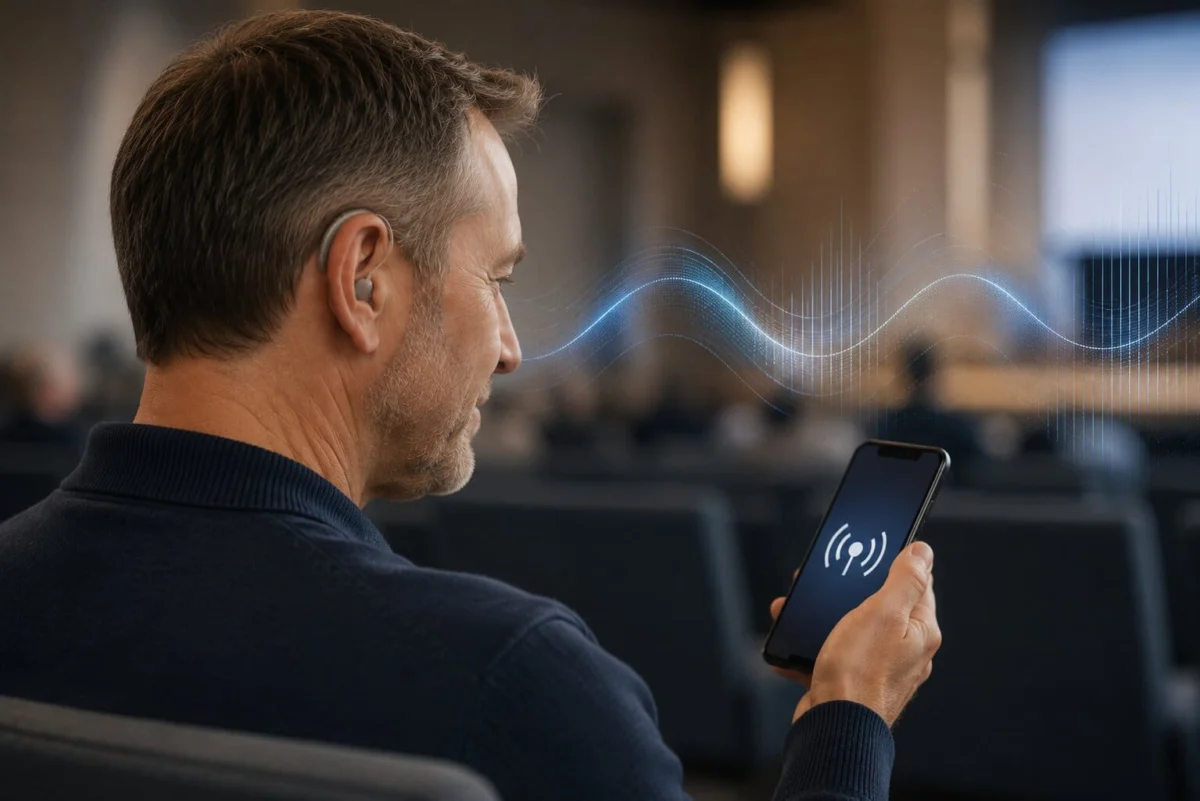
The user experience with Auracast is designed to be intuitive and unobtrusive. Upon entering an Auracast-enabled venue, individuals with compatible hearing aids or earbuds can typically scan for available broadcasts directly from their devices, much like connecting to Wi-Fi. Many newer Auracast-enabled hearing aids feature a built-in broadcast scanning capability, simplifying the process to a few taps or even automatic detection. For other compatible earbuds or older Auracast-enabled hearing aids, a smartphone application might serve as an intermediary, allowing users to browse and select available audio streams. This flexibility ensures a broad range of connectivity options.
The benefits for the user are immediate and profound. By connecting directly to the venue’s audio source, individuals experience crystal-clear sound, free from the distortions of room acoustics, echoes, and background noise that often plague public spaces. This direct audio feed significantly improves speech intelligibility, making it easier to follow conversations, enjoy performances, and understand critical announcements. The ability to personalize volume and other audio settings on their own devices further enhances the listening experience, providing a level of control and comfort previously unavailable with many traditional ALTs.
In conclusion, the deployment of Auracast in Albuquerque at Grace Lutheran Church and Albuquerque Hearing and Balance is more than just a local news story; it is a microcosm of a global movement towards universal audio accessibility. By embracing this cutting-edge Bluetooth technology, Albuquerque is demonstrating leadership in creating more inclusive environments for individuals with hearing loss. As Auracast continues its global expansion and integration into mainstream consumer electronics, its potential to transform public spaces, foster greater participation, and improve the quality of life for millions of people worldwide is undeniable, marking a significant milestone in the journey towards true audio equity.