A New Era of Adaptive Hearing: The Genesis of Allure AI
The launch of the Widex Allure AI RIC hearing aids marks a pivotal moment in the company’s continuous pursuit of innovation within the audiology sector. For years, Widex has differentiated itself by prioritizing the preservation of the natural soundscape, believing that hearing aids should augment, rather than heavily alter, the wearer’s perception of sound. This philosophy is deeply embedded in features like ZeroDelay technology and the PureSound program, which minimize processing latency to prevent unnatural auditory artifacts, particularly critical for open-fit hearing aid users where direct and amplified sound can interact.
The original Allure platform, introduced in 2025, represented a substantial leap forward, incorporating the powerful W1 processing chip, refined speech enhancement capabilities, and a streamlined fitting experience for hearing care professionals. It set a new benchmark for natural sound reproduction and user comfort. However, the pervasive challenge of speech understanding in cacophonous settings—such as bustling restaurants, crowded social gatherings, or noisy public transport—remained a complex frontier for all hearing aid manufacturers. Recognizing this critical need, Widex embarked on developing a solution that would provide targeted support without abandoning its core principles. The result is the Allure AI, a sophisticated device that layers advanced AI capabilities onto an already robust platform, offering users an unprecedented degree of control over their listening environment. The integration of artificial intelligence into premium hearing aids has been a growing trend across the industry, with competitors often deploying AI for continuous, automatic soundscape analysis and adjustment. Widex, with the Allure AI, adopts a more nuanced and user-centric approach, empowering wearers to engage the AI’s power precisely when and where it is needed most.
Dual-Chip Architecture: Marrying Natural Sound with Intelligent Clarity
At the heart of the Widex Allure AI RIC’s innovation lies its unique dual-chip architecture. Unlike systems that may rely solely on AI processing for all environmental adjustments, Widex has engineered a system that allows its established W1 chip to continue managing the hearing aid’s primary sound processing, including the renowned Universal and PureSound programs. This ensures the foundational natural sound quality and ultra-low latency that Widex users expect remain uncompromised during everyday listening.
Complementing the W1 chip is a newly integrated, dedicated artificial intelligence processor. This secondary chip, built around a third-generation linear recurrent neural network, is specifically tasked with providing additional noise management through the innovative Clarity Boost program. Recurrent neural networks are particularly adept at analyzing information that changes over time, making them highly effective in audio processing scenarios where distinguishing dynamic speech patterns from fluctuating background noise is paramount. This sophisticated AI can process the temporal characteristics of incoming signals, allowing for more precise and effective separation of desired speech from competing sounds.
According to Sonnie Harris, Senior Commercial Audiology Manager at Widex/WSA, this dual-chip strategy is deliberate: "With AI RIC, we are layering in dual-chip architecture to provide additional on-demand clarity for noisy situations where users need just a little bit of extra support." This statement underscores Widex’s commitment to user choice and its philosophy of enhancing, rather than overriding, the natural auditory experience. The architecture was meticulously developed to strike a delicate balance between powerful noise reduction, processing demands, battery consumption, and the overarching goal of preserving superior sound quality. This selective application of AI stands in contrast to approaches that might continuously apply heavy processing, potentially altering the natural nuances of sound. While continuous AI might offer a hands-off experience, Widex’s method caters to users who value control and a less processed sound for the majority of their day, reserving intensive AI intervention for genuinely challenging moments. However, this also implies a user responsibility to recognize such environments and activate Clarity Boost, a factor that individuals preferring fully automatic systems might need to consider.
Clarity Boost: A Targeted Solution for Challenging Environments

The cornerstone of the Allure AI’s enhanced capability is Clarity Boost, a feature specifically designed to provide robust noise reduction in the most demanding listening situations. For many hearing aid users, environments like bustling restaurants, vibrant social gatherings, or crowded public spaces with multiple overlapping conversations represent the ultimate test of their devices. Even advanced hearing aids can struggle when the signal-to-noise ratio is severely compromised.
The original Allure platform sought to mitigate these difficulties through updated speech enhancement and noise management algorithms that maintained situational awareness. Clarity Boost elevates this approach by engaging the dedicated AI processor to deliver a stronger, more focused noise reduction when the wearer requires additional support to understand speech. In research conducted by ORCA-US and described by Widex, Clarity Boost demonstrated a significant improvement, providing up to a 5 dB increase in output signal-to-noise ratio compared to the Universal program under evaluated conditions. While this is a substantial technical metric, it’s crucial to understand that a direct translation to an equivalent improvement in speech recognition for every listener is not guaranteed. Real-world performance is influenced by a myriad of individual factors, including the specific characteristics of the user’s hearing loss, the nature of the ambient noise, the acoustic coupling of the hearing aid, and the precision of the fitting adjustments.
The more pertinent question for everyday users is whether this additional processing translates into a more manageable and comfortable experience in difficult environments without introducing undesirable sound artifacts. Early impressions from hearing technology analyst Andrew Bellavia, who evaluated the Allure AI RIC extensively in challenging real-world settings after a Widex event in Copenhagen, offer encouraging insights. Bellavia, who had previously expressed interest in Widex’s natural sound philosophy but harbored reservations about its speech-in-noise performance, reported positive outcomes. He noted, "Speech in noise performance turned out to be much better than I expected as well. At the restaurant before the concert and at the hotel bar afterward, the sound levels and reflections were very challenging. Yet I found the Allure AI to be quite competent." These anecdotal reports, while not clinical trials, align with Widex’s stated technical goals and suggest a successful application of the AI for its intended purpose.
Preserving the Widex Listening Experience: PureSound and ZeroDelay
While Clarity Boost marks a significant new direction, Widex has meticulously ensured that the Allure AI RIC retains the core tenets of its acclaimed listening experience, particularly through PureSound and ZeroDelay processing. These technologies are integral to Widex’s philosophy of delivering an exceptionally natural sound, especially crucial for listeners utilizing open-fit hearing aids.

In open-fit configurations, where the ear canal is not fully occluded, some direct sound enters the ear naturally while amplified sound is simultaneously delivered by the hearing aid. If these two signals arrive at the eardrum with even slight temporal discrepancies, they can create comb-filtering effects, leading to an artificial, echoey, or distorted sound quality. Widex’s ZeroDelay technology masterfully minimizes this issue by processing sound with exceptionally low latency—near-zero delay—ensuring that the amplified sound arrives almost instantaneously, harmonizing seamlessly with the direct sound.
The original Allure platform had already expanded PureSound’s capabilities, making it suitable for a broader spectrum of listeners with mild-to-moderate hearing loss while maintaining its low-delay characteristics. The Allure AI RIC preserves this critical functionality, allowing users to benefit from the natural, high-fidelity sound that PureSound offers for the majority of their daily listening. The beauty of the dual-chip architecture is that it provides the option of AI-based noise reduction for demanding situations without forcing users to sacrifice the PureSound experience during ordinary listening.
It is important to note a trade-off: activating Clarity Boost does introduce a slight increase in processing delay. Widex indicates that the average delay in AI mode is approximately 10 milliseconds. While this remains well within the range generally considered acceptable for hearing aid processing and is often imperceptible to many users, it is discernibly higher than the near-zero delay of PureSound. For most listeners, the benefit of improved noise management will outweigh this minimal increase in delay. However, individuals with heightened sensitivity to sound quality, particularly musicians or audio professionals, might opt to prioritize the lower-delay PureSound programs for music appreciation or less challenging everyday environments. This flexibility, offering a choice between natural sound fidelity and enhanced clarity, is a hallmark of the Allure AI’s design.
Music Performance: A Continuing Pillar of Excellence
Music reproduction has historically been a distinct strength and a significant area of focus for Widex, attracting users who prioritize tonal accuracy, rich high-frequency detail, and a less processed auditory experience. Music presents a unique set of challenges for hearing aids, often featuring a wider dynamic range, intricate harmonic content, and sustained notes that can be detrimentally affected by overly aggressive noise reduction or compression algorithms.

Widex’s long-standing emphasis on low-delay processing and natural sound has resonated deeply with musicians and dedicated music enthusiasts. With the Allure AI, the company has meticulously ensured that these cherished characteristics are preserved, even while introducing sophisticated new noise management capabilities for exceptionally challenging environments. The hearing aids feature a dedicated music program, allowing users to optimize for musical fidelity without engaging the more intensive processing associated with Clarity Boost. This flexibility is particularly valuable for listeners who wish to immerse themselves in musical detail and dynamics while retaining the option for additional speech enhancement when transitioning to noisy conversational settings.
Andrew Bellavia, the hearing technology analyst, further corroborated this strength during his evaluation, reporting highly favorable impressions of the Allure AI RIC’s tonal balance, high-frequency reproduction, and overall clarity during several live music performances. He remarked, "In music mode, the treble was perfectly balanced with about as much extension as I’ve ever heard in a hearing aid." While musical preferences are inherently subjective and depend on individual hearing profiles and listening conditions, these observations suggest that the Allure AI successfully builds upon one of Widex’s most established and celebrated attributes. The combination of low-delay processing, specialized music settings, and optional AI-based noise management offers users unparalleled flexibility, ensuring that a single processing approach is not mandated for every diverse listening situation.
Design, Comfort, and Advanced Power Management
The Widex Allure AI RIC maintains the sleek and discreet receiver-in-canal (RIC) design established by the original Allure. This form factor features a compact, ergonomically designed housing that rests comfortably behind the ear, connected by a thin wire to a receiver placed in the ear canal. A notable engineering achievement is the successful integration of the additional AI processor without requiring a substantial increase in the device’s physical size, preserving the familiar and aesthetically pleasing form factor.
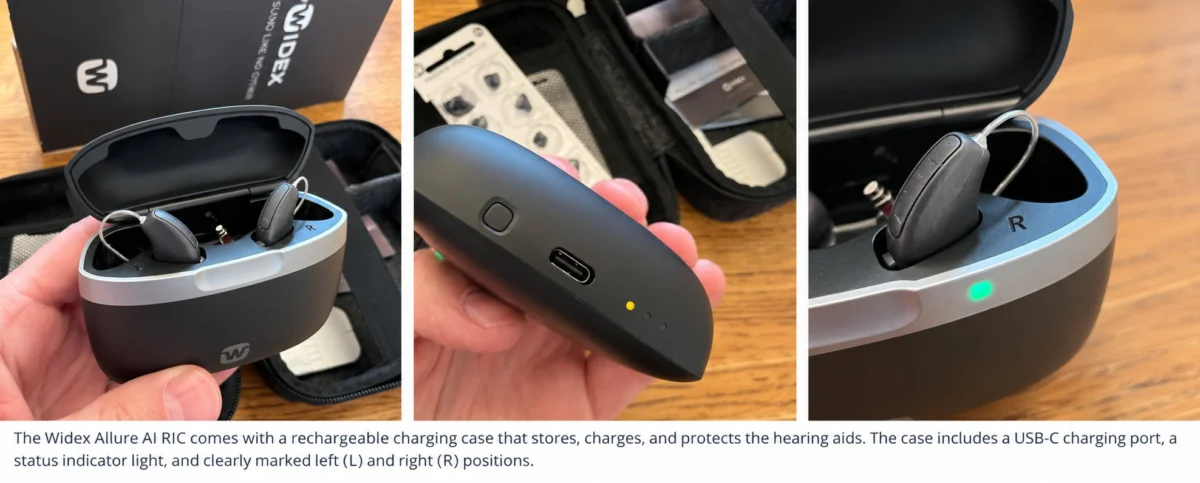
Powering this advanced technology is a robust rechargeable battery system designed to support a full day of typical use. Widex specifies impressive battery life figures: up to 36 hours of operation without audio streaming and up to 32 hours with five hours of streaming under standard conditions. However, the advanced processing capabilities of the Clarity Boost feature do impact battery consumption. When the AI processor is operating continuously, the battery life can decrease to approximately 15 hours. This is an important consideration for individuals who anticipate frequent or prolonged use of Clarity Boost throughout their day. For those who activate the feature only during occasional, brief challenging situations, the impact on daily battery life will be considerably less pronounced. Widex offers a range of charging solutions, including compact portable chargers, home charging stations, and options that integrate cleaning functionalities, allowing users to select a system that seamlessly fits into their daily routines and travel needs.

Widex Allure App: Empowering Personalized Control
The Allure AI RIC seamlessly integrates with the existing Widex Allure smartphone application, initially introduced with the original Allure platform in 2025. While a completely redesigned app was not necessary, Widex has consistently expanded its functionality, empowering users with greater, intuitive control over their listening experience. Through the app, wearers can effortlessly adjust volume levels, switch between various listening programs, monitor battery status, and fine-tune sound settings using an integrated equalizer. A particularly innovative feature is Widex’s AI Sound Assistant, which guides users in exploring different sound profiles and settings based on their individual listening preferences and real-world feedback, facilitating a truly personalized auditory experience.
For Allure AI users, direct and convenient access to Clarity Boost is a primary benefit. The program can be activated with a simple tap within the app when additional noise reduction is desired in demanding environments. For added convenience, users also have the option to activate Clarity Boost directly via a physical button on the hearing aid itself, offering an alternative for situations where reaching for a smartphone might be impractical or undesirable. Recent updates to the app have further refined the user experience, introducing additional streaming controls, including dedicated Music and Speech audio profiles, and the ability to customize program names for enhanced personalization. These refinements underscore Widex’s commitment to continuous improvement and user-centric design, providing both granular control for tech-savvy users and straightforward options for those who prefer minimal interaction.
Advanced Connectivity: Bluetooth LE Audio and Auracast Readiness
Connectivity is another area where the Allure platform, and now the Allure AI RIC, has made significant advancements. The hearing aids support direct audio streaming from a wide range of compatible iPhones and Android smartphones, leveraging both ASHA (Audio Streaming for Hearing Aids) and the newer Bluetooth LE Audio protocols. This ensures broad compatibility and a high-quality streaming experience for calls, music, and other media. Furthermore, hands-free calling is supported with compatible devices, enhancing communication convenience.

The inclusion of Bluetooth LE Audio is particularly forward-looking, as it lays the groundwork for next-generation wireless audio capabilities, most notably Auracast broadcast audio. Auracast is poised to revolutionize public sound accessibility by enabling compatible transmitters to broadcast audio to an unlimited number of receiving devices. This technology holds immense potential for expanding access to clear audio in various public spaces, including theaters, lecture halls, transportation hubs, gyms, and places of worship, transforming them into more inclusive environments for individuals with hearing aids. Widex has positioned the Allure AI RIC as "Auracast ready," with access to compatible broadcasts currently facilitated through supported smartphones, such as specific Samsung and Google Pixel models. However, the full realization of Auracast functionality remains dependent on the widespread adoption of compatible devices, comprehensive software support, and the deployment of Auracast transmitters in public venues. Users are advised to confirm specific compatibility details with their hearing care professional and device manufacturers. For individuals who continue to rely on established assistive listening technologies, the Allure AI RIC also thoughtfully includes telecoil functionality, ensuring continued access to hearing loop systems.
Compass Cloud 2.0: Empowering Professional Fitting and Personalization
Concurrent with the launch of the Allure AI RIC, Widex has introduced Compass Cloud 2.0, a significant update to its cloud-based professional fitting software. The original Compass Cloud platform, which debuted alongside the Allure in 2025, represented a paradigm shift by migrating core fitting functions to a browser-based environment, enhancing accessibility and flexibility for hearing care professionals (HCPs). The updated version builds on this robust foundation, incorporating a suite of new tools and refinements directly informed by extensive feedback from HCPs.
Among the key additions in Compass Cloud 2.0 are enhanced data logging capabilities, offering professionals more granular insights into how patients utilize their hearing aids in real-world settings. This data can inform more precise and personalized adjustments. Improvements in remote support functionalities allow HCPs to provide convenient, real-time assistance to patients outside the clinic, improving continuity of care. The platform also introduces new reporting features, streamlining the documentation and analysis of patient progress. Widex has committed to more frequent software updates for Compass Cloud, with development cycles aiming to deliver new functionality approximately every two months. These continuous enhancements are particularly valuable for HCPs seeking greater fine-tuning flexibility and deeper understanding of patient usage patterns. For patients, the ultimate benefit is a more individualized and responsive fitting experience, where adjustments are not only based on clinical measurements but also informed by invaluable real-world data and usage trends. The effectiveness of these sophisticated tools, however, remains contingent on the expertise of the HCP, encompassing thorough assessment, precise verification, comprehensive counseling, and diligent follow-up care.
Conclusion: A Versatile Path to Enhanced Hearing

The Widex Allure AI RIC represents a compelling and strategically sound evolution of the company’s hearing aid platform. Rather than fundamentally altering the widely acclaimed Widex sound philosophy, the company has intelligently augmented it with a dedicated AI processor designed to deliver targeted speech clarity and noise reduction in the most challenging listening environments. Clarity Boost stands as the most significant addition, offering powerful, on-demand noise management. Crucially, the dual-chip architecture allows Widex to maintain its established low-delay processing approach, ensuring that listeners who prioritize natural sound quality—especially during everyday conversations and music listening—do not have to compromise.
Collectively, these capabilities position the Allure AI as a remarkably versatile option, seamlessly blending the natural sound characteristics for which Widex is renowned with sophisticated, on-demand processing support for noisy situations. Further enhancements to connectivity, the user-friendly app functionality, and the professional fitting software (Compass Cloud 2.0) collectively strengthen the overall user and professional experience.
However, prospective users should consider a few practical aspects. The user-activated nature of Clarity Boost means that wearers must consciously engage the feature when needed, which may require a slight adjustment for those accustomed to fully automatic systems. Additionally, while overall battery life is excellent, continuous operation of the AI processor can notably reduce daily usage time, a factor to weigh against individual listening needs. Finally, the full benefits of advanced wireless features like Auracast readiness depend on the broader ecosystem of compatible devices and infrastructure.
Ultimately, the profound appeal of the Allure AI lies in its inherent flexibility and the choice it offers. It empowers listeners to navigate their auditory world by selecting between a truly natural, low-delay listening experience and powerful, AI-based noise management, tailored precisely to the demands of the moment. For individuals who deeply value natural sound quality but also require robust additional support in challenging listening situations, the Widex Allure AI RIC stands as a highly compelling option worthy of consideration as part of a professionally guided hearing aid evaluation. This device is not merely an upgrade; it is a testament to Widex’s evolving understanding of user needs, delivering a balanced and adaptive solution for a complex world.