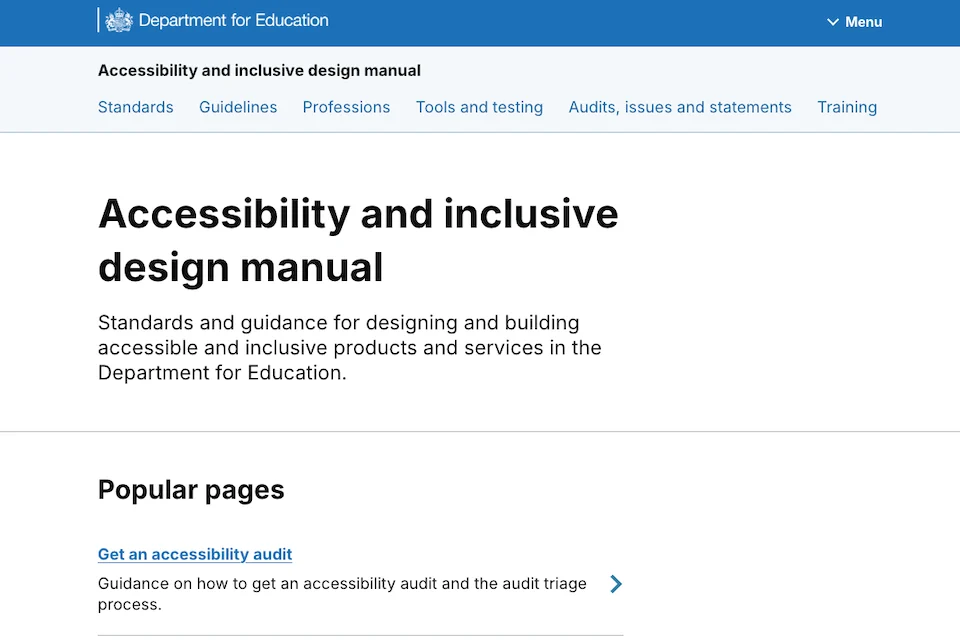
While the original manual was well-received, internal data and qualitative feedback indicated that users often struggled with information architecture and the practical application of the guidance. To address these hurdles, the DfE’s digital team conducted extensive research with professionals in design, product management, and delivery roles. The result is a streamlined, task-oriented resource intended to serve not only the DfE’s internal workforce but also the wider global community of developers and designers committed to digital equity.
Chronology of Development and Iteration
The journey toward the current iteration of the manual began in late 2023, as the DfE recognized a growing gap between high-level accessibility requirements and the day-to-day needs of its agile delivery teams. By the time the first version was published in September 2024, it served as a centralized repository for accessibility standards. However, as usage increased throughout the winter of 2024 and the spring of 2025, it became clear that a "knowledge-first" approach was less effective than a "task-first" approach.
In early 2025, the DfE accessibility team launched a deep-dive research phase. This involved moderated usability testing, search query analysis, and role-specific workshops. The goal was to identify where the manual was failing to provide immediate value. Researchers focused on three primary areas: content discoverability, the utility of the tools guidance, and the overall cognitive load of the user interface. By May 2025, the team had developed a roadmap for the "July Update," which sought to dismantle the siloed "Knowledge Hub" and integrate its contents into the natural workflow of a digital project life cycle.
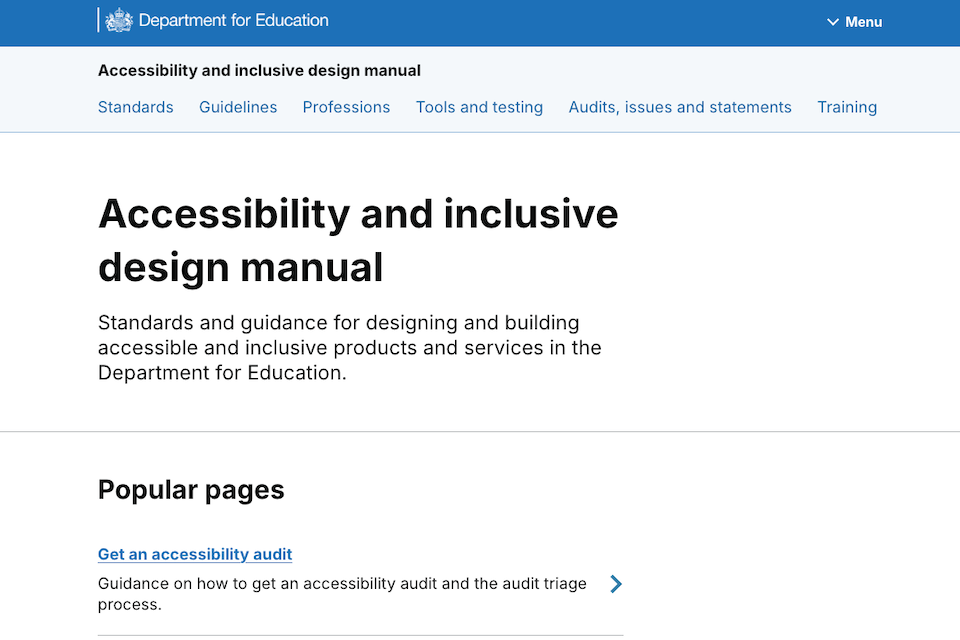
The final phase of development occurred in June 2025, involving rigorous accessibility audits of the manual itself—ensuring that the guide for accessibility was, in fact, a gold standard of the practice. The updated manual was officially deployed on July 21, 2025, featuring a simplified homepage and a reorganized content structure.
Strategic Reorganization: Moving Beyond the Knowledge Hub
One of the most significant changes in the July 2025 update was the total removal of the section formerly known as the "Knowledge Hub." While the hub contained technically accurate and valuable information, user feedback characterized it as a "dumping ground" that was difficult to navigate. The primary issue was that the content was organized by its format (e.g., articles, papers, or technical specs) rather than by the user’s intent.
The DfE team responded by decentralizing this content and moving it into sections that align with the user journey. For example, technical guidance on ARIA (Accessible Rich Internet Applications) labels was moved directly into the development and testing sections, rather than being sequestered in a general knowledge area. This change reflects a modern understanding of information architecture, where information is delivered at the "point of need."
By reorganizing content based on how people think and search, the DfE has reduced the "time to insight" for its employees. Designers no longer have to sift through theoretical documents to find practical color contrast ratios; instead, they find those requirements integrated into the design-phase guidance. This shift from a library-style organization to a workflow-integrated organization is expected to increase the adoption of inclusive design practices across all DfE digital products.
Enhancing Tool Guidance for Practical Application
In previous versions of the manual, the guidance regarding accessibility tools was largely descriptive, focusing on what the tools were and how to install them. However, user research revealed that delivery teams were less concerned with installation and more concerned with the "how" and "why" of tool selection. Professionals wanted to know which tools were most effective for specific tasks—such as automated versus manual testing—and how to interpret the results they produced.
The July 2025 update transformed the tools section into a needs-based directory. The revised guidance now clarifies:
- Which tools are best suited for specific roles (e.g., Axe for developers vs. screen readers for testers).
- The limitations of automated tools, emphasizing that they typically only catch 30% to 40% of accessibility issues.
- Step-by-step instructions on how to use these tools to perform meaningful audits.
This refinement is critical for maintaining high standards of quality assurance. By focusing on the human application of technology, the DfE ensures that its teams are not just "ticking boxes" with automated software but are actively understanding the barriers that users with disabilities might face.
User Interface and Homepage Simplification
The visual and structural overhaul of the manual’s homepage was driven by the need to reduce cognitive load. The original 2024 interface was noted for being "busy," featuring an abundance of icons, images, and a long-scrolling layout that could be overwhelming for users, particularly those with neurodivergent conditions. Furthermore, the top navigation was found to be ambiguous, leading to frequent "back-button" usage.
The redesign implemented several key UX (User Experience) improvements:
- Streamlined Navigation: The top-level menu was refined to use clear, unambiguous language that aligns with the GDS (Government Digital Service) design system.
- Visual Hierarchy: Superfluous icons and images were removed to create a cleaner, more focused aesthetic. This ensures that the content remains the primary focus.
- Reduced Verticality: The "long scroll" was replaced with a more modular, "hub-and-spoke" layout, allowing users to jump directly to the relevant sections without excessive scrolling.
These changes were not merely aesthetic. In the context of an accessibility manual, a simplified UI serves as a functional demonstration of the principles the manual advocates. By prioritizing clarity and ease of use, the DfE has created a more inclusive experience for the very people tasked with building inclusive services.
Supporting Data and User Research Methodology
The DfE’s decision to overhaul the manual was backed by compelling data. During the initial six months of the manual’s life (September 2024 – March 2025), analytics showed high traffic volumes, but a relatively high "bounce rate" on the Knowledge Hub pages. This indicated that while users were looking for information, they were not finding what they needed or were finding the presentation of that information discouraging.
Qualitative research involving 50 participants across various DfE "product families" confirmed these findings. Key metrics from the research phase included:
- Task Success Rate: Only 55% of users could find specific technical guidance within three clicks in the old Knowledge Hub.
- User Sentiment: 70% of respondents described the old homepage as "distracting" or "cluttered."
- Role Relevancy: Product managers reported that the manual felt "too developer-focused," leading to the creation of more role-specific pathways in the 2025 update.
Since the update went live in July 2025, preliminary data suggests a 40% improvement in task completion times and a significant increase in the use of the "Tools" section, particularly the guidance on manual testing procedures.
Broader Impact and Implications for Digital Governance
The DfE Accessibility and Inclusive Design Manual is more than just an internal handbook; it is a public-facing resource that sets a benchmark for other government departments and private sector organizations. By making the manual open to the public, the DfE contributes to a collective repository of knowledge that benefits the entire UK digital economy.
The implications of this update are three-fold:
- Legal Compliance and Risk Mitigation: By providing clearer guidance, the DfE reduces the risk of its services falling short of legal accessibility requirements, thereby avoiding potential litigation and the need for costly retroactive fixes.
- Efficiency in Service Delivery: When accessibility is "baked in" from the start—aided by a task-oriented manual—projects move through the "Alpha" and "Beta" phases more smoothly, saving taxpayer money and accelerating the delivery of vital educational services.
- Cultural Shift: The manual helps foster a culture where accessibility is seen as a creative challenge and a fundamental right, rather than a technical hurdle. It empowers every member of a delivery team, from the product owner to the junior developer, to take ownership of the user experience.
As digital services become the primary way citizens interact with the state, the importance of inclusive design cannot be overstated. The DfE’s iterative approach to its manual demonstrates a commitment to continuous improvement, acknowledging that as technology evolves, so too must the guidance that governs its use. The July 2025 update stands as a model for how government departments can listen to their users and transform a static document into a living, breathing tool for social inclusion.