The Challenge of Diagnosing Pediatric Laryngeal Clefts
Pediatric laryngeal clefts, a congenital anomaly where a gap exists between the arytenoid cartilages at the back of the larynx, present a complex diagnostic challenge. The variability in current assessment techniques has been a long-standing issue, leading to discrepancies in how these conditions are identified and classified. This inconsistency was underscored by the 2017 consensus guidelines from the International Pediatric Otolaryngology Group (IPOG) concerning Type I laryngeal clefts (T1C). Many IPOG members reported relying solely on visual inspection for diagnosing deep interarytenoid notches (DINs), while others adopted a more specific definition, involving a notch height of less than 3mm but still above the true vocal folds. Such differing interpretations can significantly influence treatment decisions, particularly regarding surgical intervention, making a standardized approach imperative.
The ability to accurately differentiate between a normal larynx, a deep interarytenoid notch, and a Type I laryngeal cleft is crucial. These distinctions are not merely academic; they directly inform whether a child requires surgical intervention to address potential functional sequelae, such as aspiration, recurrent pneumonia, or stridor. Without a unified method of evaluation, children with similar anatomical presentations might receive vastly different care pathways, potentially impacting long-term outcomes.
Development and Validation of the IAAP
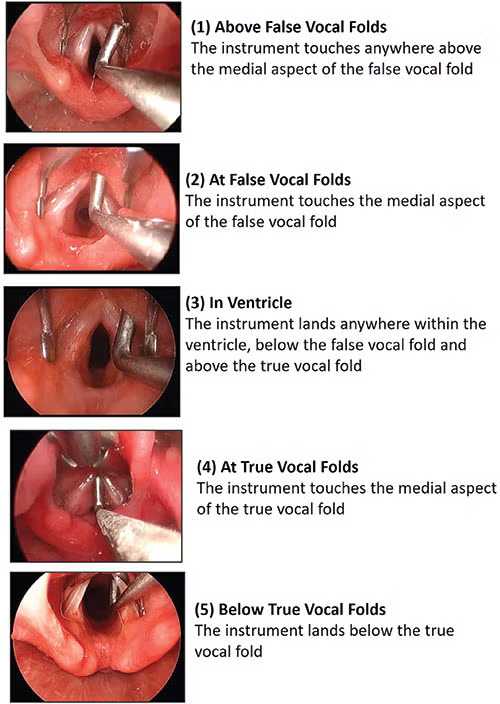
In response to this diagnostic variability, the Interarytenoid Assessment Protocol (IAAP) was developed. This protocol provides a structured approach to describing the interarytenoid mucosal height (IAMH). It involves a multi-step process during microlaryngoscopy: first, the patient is placed in suspension, and laryngeal distending forceps are used to optimize visualization. Second, the interarytenoid musculature is palpated to assess subjective qualities. Third, a right-angle microlaryngeal probe is employed to systematically measure the IAMH by swinging it from the anterolateral interarytenoid mucosa towards the laryngeal anatomy. The point of initial mucosal contact is designated as the IAMH, which is then categorized into one of five levels relative to the false vocal folds, ventricle, and true vocal folds.
While a previous single-institution validation study indicated promising inter- and intra-rater reliability for the IAAP, a critical gap remained: the lack of multi-institutional validation. This new study sought to address this by performing a comprehensive validation across multiple centers, a crucial step in establishing the protocol’s robustness and generalizability.
Methodology: A Rigorous Multi-Institutional Approach

The research team embarked on a retrospective review of 30 endoscopic videos from the Seattle Children’s Hospital Otolaryngology Database. Each video documented an IAAP procedure performed by either an attending pediatric otolaryngologist or a supervised resident/fellow at that institution. Institutional Review Board (IRB) approval was secured from Seattle Children’s Hospital (IRB No. STUDY00000815) for this retrospective data analysis.
Sample Selection and Video Review Process
The study meticulously selected videos that clearly depicted each step of the IAAP. The inclusion criteria emphasized sufficient quality to visualize the procedure, ensuring the integrity of the assessment. Out of an initial review of 115 records, 32 videos were excluded due to inadequate visualization of IAAP steps, eight for poor overall quality, and 45 were set aside to ensure a balanced representation across different IAMH categories.
A key element of the study’s design was the involvement of ten fellowship-trained pediatric otolaryngologists from ten distinct institutions. Each of these external raters was tasked with evaluating 30 de-identified endoscopic videos. Crucially, all videos were recorded at a single institution (Seattle Children’s Hospital), while the raters were from external centers, thus simulating a real-world multi-institutional assessment scenario.
To ensure objectivity and minimize bias, the raters were blinded to any identifying information about the patients or the number of videos assigned to each IAMH category. They were provided with the IAAP Scoring Sheet, which included illustrative examples of the right-angle probe’s position at different IAMH levels. The raters were specifically instructed to focus solely on evaluating the anatomy based on the contact point of the microlaryngeal probe as demonstrated by the surgeon in the video, refraining from making independent judgments about the surgical technique itself. The videos were edited to exclusively showcase the IAAP procedure, excluding any concurrent surgical steps.
To rigorously assess reliability, each video was scored by the raters at two separate time points, with a three-month interval between assessments. This dual evaluation of the same video by the same rater allowed for the measurement of intra-rater reliability. The order of video presentation was randomized for both review sessions, and raters were intentionally blinded to their initial assessment when reviewing the same video a second time, further enhancing the reliability of the findings. This meticulous approach resulted in a total of 500 separate video reviews (30 videos x 10 raters x 2 time points).
Statistical Analysis
The reliability of the IAAP was quantitatively assessed using intra-class correlation (ICC) coefficients calculated with two-way random effects models. These coefficients are a standard measure for evaluating the agreement between raters. The degree of agreement was categorized according to established benchmarks: 0.00–0.20 for slight agreement, 0.21–0.40 for fair agreement, 0.41–0.60 for moderate agreement, 0.61–0.80 for strong agreement, and 0.81–1.00 for near-complete agreement. All statistical analyses were performed using R Project for Statistical Computing, with a significance level set at P < 0.05.
Results: Demonstrating Strong Reliability

The multi-institutional validation study yielded compelling results, underscoring the reliability of the IAAP. The 30 endoscopic videos analyzed represented patients with a median age of 4.9 years (interquartile range: 59 months; range: one month to 20 years). The cohort comprised 30% females (median age seven years; range: 3.2 months to 20 years) and 70% males (median age four years; range: 1.1 months to 13.2 years).
The ten participating fellowship-trained pediatric otolaryngologists, hailing from ten different institutions, demonstrated strong agreement in their assessments. Both the first and second video assessments, conducted two months apart, revealed robust inter-rater reliability. In the initial assessment (Part 1), the inter-rater reliability was recorded at 0.74 (95% confidence interval [CI] 0.63 to 0.84), and in the subsequent assessment (Part 2), it was 0.75 (95% CI 0.63 to 0.85). These figures fall within the "strong agreement" category.
Furthermore, the intra-rater reliability, which measures the consistency of an individual rater’s assessments over time, was also highly encouraging. It ranged from 0.49 to 0.89, with an overall test-retest reliability of 0.75 (95% CI 0.69 to 0.79). This indicates a strong level of consistency among the raters when evaluating the same videos on different occasions.
Analysis of the specific classifications revealed that in seven instances (23%), all ten participants achieved 100% agreement on the IAAP classification for a given video. These unanimous agreements were distributed across different categories: three for "above FVF," one for "at FVF," two for "in ventricle," and one for "at TVF." Notably, in nearly half of the cases (14 instances, or 46.6%), raters selected IAAP classification levels that were within one level of each other, indicating a high degree of concordance. However, in nine cases (30%), there was a spread of two or more levels in IAAP classification among the ten raters, highlighting areas where further refinement or additional training might be beneficial.
Implications and Future Directions
The findings of this multi-institutional validation study carry significant implications for the field of pediatric otolaryngology. The IAAP has demonstrated its potential as a standardized tool for assessing interarytenoid mucosal height. Its strong inter- and intra-rater reliability, as evidenced by the pictorial analysis, suggests that it can provide a more consistent and reproducible method for evaluating laryngeal clefts across different clinical settings.
The study authors emphasize that while the observed reliability is a reflection of visual interpretation, the protocol’s overall effectiveness is also contingent upon the precision of the surgical technique employed during the procedure. Therefore, they recommend further research to explore how variations in surgical technique might influence the IAAP’s reliability, thereby providing a more comprehensive understanding of its clinical utility.
Broader Impact on Pediatric Care
The successful validation of the IAAP represents a crucial step toward standardizing anatomical evaluations in the pediatric larynx. This standardization is not only vital for accurate diagnosis of laryngeal clefts but also holds the potential to improve the reliability of outcomes studies related to pediatric pharyngeal dysphagia. By ensuring that initial assessments are more consistent, researchers can gain a clearer picture of the effectiveness of various interventions and surgical approaches. This, in turn, can lead to more evidence-based treatment guidelines and ultimately, better patient care for children affected by these complex laryngeal conditions. The ability to consistently identify and classify laryngeal clefts with tools like the IAAP can help to bridge diagnostic divides between institutions, fostering a more collaborative and effective approach to managing these challenging pediatric airway and swallowing disorders. The long-term goal is to ensure that every child receives the most appropriate and timely intervention, regardless of where they receive their care.