A Legacy of Advocacy: From Milan to the Modern Era
To understand the weight of the NAD’s current mandate, one must look back to the organization’s origins. Founded in 1880, the NAD was established in direct response to the Second International Congress on Education of the Deaf, held in Milan that same year. The "Milan Conference" resulted in a series of resolutions that effectively banned the use of sign language in schools, championing oralism—the practice of teaching Deaf students to speak and lip-read—as the only acceptable pedagogical method. The impact was catastrophic, leading to the widespread suppression of American Sign Language (ASL) and the displacement of Deaf educators.
The NAD was formed as a defensive bulwark against these assimilationist policies. For over 146 years, the organization has functioned as the primary representative for the American Deaf community, consistently arguing that sign language is the natural, accessible, and vital language of the community. In the current era of CRISPR-Cas9 and other gene-editing technologies, the NAD posits that the 19th-century push for oralism has been replaced by a 21st-century push for genetic correction. The organization asserts that the underlying goal remains the same: the erasure of Deaf culture through the pathologization of human difference.
The Rise of Genetic Medicine: A New Frontier
The rapid acceleration of gene therapy development has fundamentally changed the landscape of hearing healthcare. According to data from the National Institutes of Health (NIH), there are currently over 15 clinical trials globally investigating genetic therapies for various forms of hereditary hearing loss, particularly those caused by mutations in genes such as OTOF (otoferlin). These treatments often involve viral vectors that deliver a functional copy of a gene into the inner ear, aiming to restore auditory function.
While the medical community frames these advancements as life-saving interventions—particularly for conditions that cause progressive sensory loss—the NAD warns that the framing of "restoration" inherently devalues the lives of those who do not hear. Proponents of these therapies often cite the "quality of life" metrics associated with sensory access, but critics point out that these metrics are often developed without the input of the Deaf community. The NAD argues that when science is guided solely by the desire to "fix" biological deviations, it inevitably results in policies that marginalize the very people it claims to serve.
Chronology of Conflict and Engagement
The debate over genetic intervention is not new, but it has gained intensity over the last decade as technical barriers to gene editing have fallen.
- 1880: The Milan Conference mandates oralism, sparking the creation of the NAD to protect the linguistic rights of Deaf citizens.
- 1990: The Americans with Disabilities Act (ADA) establishes a legal framework for the inclusion of Deaf individuals in public life, reinforcing the social model of disability.
- 2012: The discovery of CRISPR-Cas9 technology makes precise gene editing a viable reality, shifting the conversation from theoretical bioethics to imminent clinical application.
- 2020–2024: Multiple international biotechnology firms announce early-stage successes in using gene therapy to restore hearing in children with specific genetic mutations.
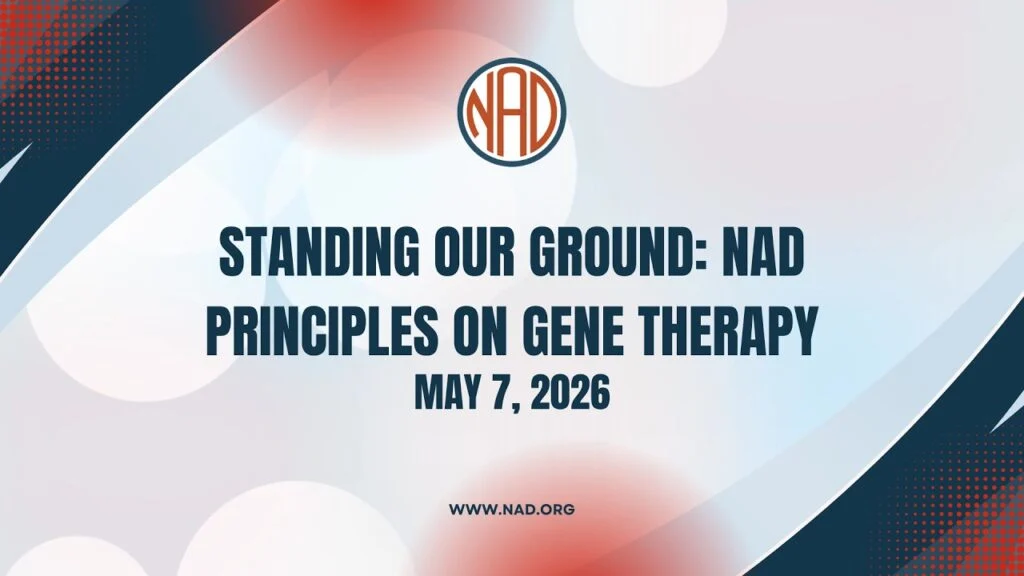
- May 2026: The NAD releases its comprehensive "Principles on Gene Therapy," formalizing the organization’s ethical boundaries and calling for a shift in research priorities.
The Principles of Ethical Engagement
The NAD’s 2026 declaration outlines specific ethical requirements for researchers and institutions. Central to these is the demand that no genetic intervention should be pursued with the objective of eliminating Deafness as a demographic or cultural trait. The organization asserts that:
- Informed Consent and Agency: Medical professionals must ensure that families and individuals are presented with information that reflects the reality of a full, healthy life as a Deaf person, rather than a narrative of tragedy or deficiency.
- Community Representation: Any institutional review board (IRB) or ethics committee evaluating research on hearing-related genetic modification must include members of the Deaf community to provide oversight.
- Prioritization of Health over Identity: If gene therapy is to be used, it should be reserved for life-threatening medical conditions rather than for the alteration of non-pathological sensory states.
Fact-Based Analysis: The Implications of Medical Hegemony
The societal implications of these advancements are profound. If society moves toward a future where "auditory normalcy" is a genetic mandate, the resources allocated to accessibility—such as ASL interpretation, captioned media, and inclusive educational environments—could be severely diminished. This creates a feedback loop: as the number of Deaf individuals decreases due to genetic intervention, the societal commitment to accessibility for those who remain Deaf or choose not to undergo therapy may weaken.
Economically, the cost-benefit analysis of gene therapy is also under scrutiny. These treatments often cost millions of dollars per patient. The NAD suggests that if even a fraction of this funding were redirected toward improving early childhood sign language acquisition, educational resources, and technological infrastructure, the systemic barriers facing the Deaf community would be significantly reduced without the need for medical intervention.
Responses from the Scientific and Medical Communities
The scientific community’s response to the NAD’s position has been varied. Many geneticists argue that the primary goal of their research is "patient autonomy," providing options to parents who may wish to mitigate hearing loss in their children. However, bioethicists are increasingly recognizing the validity of the NAD’s concerns.
Dr. Elena Rossi, a researcher in pediatric genetics, noted in a recent symposium, "The NAD’s call for inclusion is not an anti-science stance; it is a human rights stance. We must distinguish between treating a systemic disease and altering a biological characteristic that constitutes a person’s identity."
Conversely, some medical advocacy groups have emphasized that for many parents, the sudden onset of deafness in a child can be a source of trauma, and they view gene therapy as a legitimate medical solution to reduce that perceived burden. The NAD counters this by arguing that the trauma is not caused by the deafness itself, but by a society that fails to provide the necessary support, language, and culture for a Deaf child to thrive.
A Call to Action: Defining the Future
The NAD’s call to action is directed at both federal agencies, such as the Food and Drug Administration (FDA) and the National Institutes of Health (NIH), and the global scientific community. The organization is demanding a formal seat at the table in the regulation of genetic technologies. They propose:
- Mandatory Diversity in Ethics Boards: All research programs receiving federal funding for hearing-related gene therapy must demonstrate active consultation with Deaf advocacy groups.
- Public Education Reform: NIH-funded clinical education programs should include curriculum modules on the history of the Deaf community and the social model of disability to ensure that clinicians are culturally competent.
- Longitudinal Studies on Social Outcomes: Future research should not only track biological "success" but also the psychological and social well-being of individuals who undergo—or choose not to undergo—such interventions.
Conclusion: A Vital Part of Humanity
The NAD’s position is clear: the history of the Deaf community is one of resilience and self-determination. By standing against the erasure of their identity, the organization is not merely protecting a legacy but asserting a vision of the future where human diversity is embraced rather than engineered. As the scientific community continues to push the boundaries of what is possible, the NAD has positioned itself as the ethical conscience of the field.
The task force established by the NAD to monitor these developments will be responsible for sustained engagement with policymakers and researchers. Their mandate is to ensure that as society navigates the complexities of the 21st century, it does not repeat the mistakes of the 19th. The message from the Deaf community is unequivocal: they are not a problem to be solved, but a vital, vibrant, and permanent component of the human experience. As the world stands on the precipice of a new era in genetic science, the NAD’s declaration serves as a reminder that technological progress must always be subservient to the fundamental rights and dignity of all people.