
Navigating the Complex Landscape of Difficult Airway Management
The management of difficult airways represents one of the most critical and high-stakes scenarios encountered in modern medicine. These situations demand a confluence of expertise, meticulous planning, and seamless interdisciplinary collaboration. While advancements in medical technology and surgical techniques have significantly improved patient outcomes, numerous pitfalls persist, often stemming from communication breakdowns, underestimation of patient vulnerabilities, and a lack of proactive engagement from specialized teams. Leading otolaryngologists (ENT surgeons) have recently highlighted ten common errors that can jeopardize patient safety and recovery, offering insights into how to mitigate these risks and elevate the standard of care.
1. Communication Breakdowns: The Foundation of Airway Safety
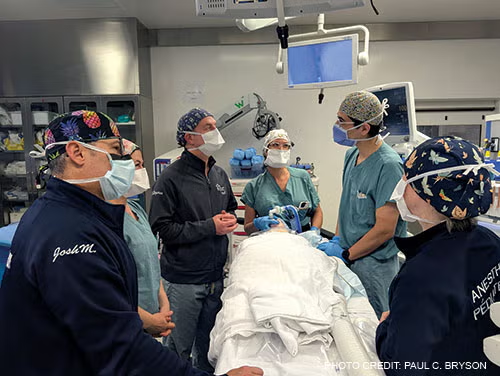
A recurring theme among experts is the critical importance of robust communication within multidisciplinary airway management teams. Paul C. Bryson, MD, director of the Cleveland Clinic Voice Center, emphasized that with numerous specialists involved – including anesthesiologists, intensivists, and ENT surgeons – preparation and clear dialogue are paramount.
"Failure to review a patient’s prior airway management event, such as a previously challenging intubation, and not sharing that information with anesthesia colleagues, is a lost opportunity for being better prepared if those challenges recur," Dr. Bryson stated. He further stressed the value of advanced imaging modalities. "Not performing CT scans and video laryngoscopy to visualize key anatomical structures in the patient’s airway before a procedure is another miss. These exams provide incredibly useful conversation points in terms of what the upper airway looks like before you initiate airway care. They don’t prevent or fix every difficulty, but you will be far better prepared when a routine case deteriorates and emergency interventions are needed."
Dr. Bryson also advocated for a comprehensive approach to team assembly. "Managing the difficult airway is a team sport. You’re the ENT airway specialist, but you’re also the coach, and you’re responsible for having all the right players in place to ensure the best outcomes," he explained, citing the collaborative relationship with interventional pulmonologists for their expertise in rigid bronchoscopy.
Mathieu Bergeron, MD, FRCSC, a pediatric otolaryngologist at CHU Sainte-Justine Hospital in Montreal, echoed this sentiment, detailing his team’s routine practice of reviewing key difficult airway case details with nursing, anesthesia, ENT, and OR technicians. "This ensures we are all on the same page and builds trust and rapport," Dr. Bergeron noted. His philosophy is preventative: "I often say the best airway rescue is the one that you never have to use because you anticipated the problems before even starting the case."
To formalize this proactive approach, Taher Valika, MD, medical director of the aerodigestive program at Ann & Robert H. Lurie Children’s Hospital of Chicago, and his team implement daily focused ENT/anesthesia airway huddles. "We review which patients may be difficult to intubate, which are likely manageable with mask ventilation, what size equipment and airway devices should be available, and whether the safest plan involves spontaneous ventilation or paralysis," Dr. Valika explained. "We also discuss the intra-operative plan, backup options, and post-operative airway strategy." This level of pre-operative diligence is crucial, as studies have shown that communication failures are a leading cause of adverse events in surgical settings.
2. Underestimating Pediatric Airway Fragility
A particularly perilous pitfall highlighted by experts is the underestimation of the fragility of younger patients’ airways. Dr. Valika cautioned that children with difficult airways "can appear stable until they suddenly are not." The narrow margin for error in pediatric anatomy means that a seemingly controlled airway situation can rapidly devolve into a life-threatening emergency.
"These patients’ very limited airway reserve is the main challenge that can sometimes be overlooked," he observed. Dr. Valika recalled a recent case at Lurie Children’s involving a child who initially presented with what sounded like humming but was later found to have biphasic stridor, indicating a critically narrowed airway. "When we evaluated him, this child had a pinpoint airway. At that point, he could not safely go home. It was a reminder that severe airway obstruction can be deceptively subtle, and that some children are compensating right up until the moment they no longer have a functioning airway." This underscores the need for vigilant assessment, even in seemingly stable pediatric patients.
3. Ignoring the Impact of Pre-Existing Medical Conditions
The presence of pre-existing medical conditions can transform a routine airway management into a complex, high-risk endeavor. Jonathan M. Bock, MD, FACS, a professor at the Medical College of Wisconsin, pointed to cancer patients who have undergone radiation therapy as a specific challenge. The resulting airway fibrosis can make visualization and intubation exceedingly difficult. Dr. Bock described his technique of probing the airway with a large-bore IV catheter or needle filled with saline, "pulling back until you get air. By leaving the needle in place, you can dissect down to the airway to localize it even in a bed of scar tissue."
Congenital disorders also present significant challenges, especially in pediatric populations. Dr. Bergeron cited children with complete tracheal rings (CTR) as a prime example. These patients have a rigid, cylinder-type airway that is "very unforgiving." Any swelling or secretion can lead to rapid obstruction, rendering safe intubation impossible. He has witnessed teams unfamiliar with CTR repeatedly attempting intubation, exacerbating edema and worsening the airway. Dr. Bergeron advocates for alternative strategies such as high-flow nasal cannulas with heliox (a helium-oxygen mixture that reduces turbulence in narrowed airways) or extracorporeal membrane oxygenation (ECMO) in severe cases.

Tyler Crosby, MD, from the University of California, San Francisco, highlighted that congenital airway anomalies are not exclusive to pediatric patients, as many survive into adulthood. Conditions like micrognathia and macroglossia can complicate both mask ventilation and tracheal intubation. These adult patients often exhibit hypotonia and do not emerge from anesthesia as well, making them inherently challenging cases.
4. Hesitation in Recommending and Managing Tracheostomies
A shift in approach towards earlier consideration of tracheostomies for safety has been noted by some experts. Dr. Bryson expressed increased willingness to suggest a tracheostomy for patients with difficult airways, allowing for a planned approach to removal. This strategy is particularly beneficial for patients with airway scarring, bilateral vocal cord paralysis, or multi-level airway obstruction. "We can still meet their functional needs – they can still work and live with the tracheostomy," he said. Furthermore, a surgically created airway can be lifesaving for patients residing far from specialized medical centers.
Dr. Bock raised a related concern: the reluctance of some ENT physicians to engage in the long-term care of tracheostomy patients. "As otolaryngologists, we are masters of the upper airway," he asserted. "We have more experience managing these structures and sequelae than almost anyone else in the hospital." He argues that this expertise comes with a responsibility to provide comprehensive care, rather than viewing such requests as an imposition.
5. Overlooking the Benefits of Awake Intubation
The strategy of awake intubation, performed with minimal sedation, is an effective but sometimes underutilized method for managing difficult airways. Dr. Bock emphasized that this approach should not be overlooked, as a patient’s own respiratory drive can be the sole factor preventing rapid deterioration. Guidelines from the Difficult Airway Society underscore the benefits of awake tracheal intubation in adults, including the preservation of spontaneous ventilation and airway tone, while maintaining patient cooperation and protective reflexes.
Dr. Bryson concurred, citing patients with upper airway tumors, obstructions, or post-radiation changes as prime candidates for awake intubation. "In the awake setting, you can navigate around that anatomy, while avoiding the complications that can occur during anesthesia, such as excessive relaxation of the upper airway resulting in obstruction." This technique allows for direct visualization and manipulation of the airway, minimizing the risk of catastrophic events during induction of anesthesia.
6. Delays in Bringing ENT Surgeons onto a Case
A critical pitfall is the delayed involvement of ENT surgeons in the management of difficult airways. Dr. Bryson noted that his team is often called in as a "surgical airway team of last resort, when a patient is already in grave trouble." He advocates for earlier consultation: "Bring us in early so we can help with a more thorough assessment and anticipate and avoid problems before they occur."
Dr. Crosby shared an anecdote of a cancer patient scheduled for an interventional radiology procedure. His team received a "heads-up" call, but upon assessing the patient’s neck, found it to be "hard as a rock from previous radiation, with no palpable landmarks." They informed the radiology team that an emergent surgical airway would have been "highly challenging to manage, even in an ideal care setting and with prior knowledge of, and planning for, the patient." Dr. Crosby cautioned against the misconception that ENT specialists are simply available for emergent rescues. "That’s not a viable management plan. We need to be consulted far earlier to ensure optimal outcomes." This highlights the need for proactive risk stratification and early specialist involvement.
7. Not Trusting Junior Clinicians’ Expertise
Related to communication breakdowns is the issue of not fully leveraging the expertise of junior clinicians, particularly residents. Dr. Bock described situations where residents, highly experienced in procedures like awake intubations due to frequent clinic exposure, are sidelined during emergencies. He has personally intervened by encouraging a resident to proceed, resulting in successful airway securing. "Making sure your residents are respected and relied upon is thus key," he stressed. This not only empowers trainees but also ensures that valuable skillsets are utilized to their fullest potential during critical events.
8. Poor Equipment Planning and Selection
The consequences of inadequate equipment planning and the use of incorrect equipment can be severe and long-lasting. Dr. Crosby has observed numerous patients suffering from long-term sequelae due to intubation with the wrong-sized endotracheal tube, leading to severe laryngeal injuries and stenosis requiring lifelong tracheostomies. He emphasizes the need for critical care colleagues to be "really thoughtful about the size tube you’re using, how long you’re leaving it in, and the damage it could cause while still in place."
A common misconception, Dr. Crosby explained, is the assumption that morbidly obese patients require larger tubes for positive air pressure. However, he clarified that "a patient’s height determines how big their airway is, not their weight." He has treated short, very heavy patients who were intubated with tubes two sizes too large, resulting in significant airway complications.
Institutions like Lurie Children’s have developed specialized Rapid Difficult Airway Response (RaDAR) teams, equipped with dedicated instrument carts containing essential pediatric airway equipment. These carts ensure that specialized personnel and necessary devices are immediately available. The RaDAR team’s approach follows a structured algorithm: optimize oxygenation, deploy supraglottic rescue, default to video laryngoscopy, escalate to fiberoptic techniques, and prepare for front-of-neck access.

Dr. Bergeron recounted a personal experience where a miscommunication regarding tracheostomy tube size led to the use of a tube that was "four times too large," reinforcing the lesson to "never take difficult airway equipment and planning for granted." He recommends video laryngoscopes or rigid endoscopes like the Hopkins rod for direct visualization of tube placement in infants, allowing for rapid confirmation and prompt initiation of alternative interventions if needed. Dr. Crosby advises mentally rehearsing the surgical plan and contingencies, ensuring all necessary equipment is present and functional before the patient enters the operating room. The absence of critical equipment, such as a working light source, suction, or a dilator, during a time-critical phase can be disastrous.
9. Transferring Patients Without Adequate ENT Workup
A significant pitfall identified by Dr. Crosby is the transfer of patients for ENT management without a prior airway assessment. The assumption that a stable-appearing patient is safe for transfer can be misleading. "We need to perform at least a foundational airway assessment before sending a patient elsewhere. Even a simple bedside flexible scope can provide valuable information," he stated. This proactive assessment is crucial to prevent unexpected complications during transit or upon arrival at the receiving facility.
10. Poor Patient Positioning for Airway Access
Even experienced airway teams can fall prey to poor patient positioning during emergency intubations. Dr. Bock has frequently observed anesthesiologists attempting procedures with patients lying flat. He advocates for moving the patient forward into a more upright position, similar to how patients are positioned for clinic laryngoscopies. "When we scope people in the clinic, for example, we have them sitting forward, and that makes a huge difference when viewing the airway," he explained. This simple adjustment can significantly improve visualization and facilitate successful airway management.
Enhancing Airway Preparedness Through Training and Education
The consistent identification of these pitfalls underscores the critical need for ongoing training and education in difficult airway management. Two prominent ENT surgeons shared their innovative approaches to ensuring their multidisciplinary teams are exceptionally well-prepared.
The Chicago Advanced Airway Course: Simulation for Real-World Challenges
Taher Valika, MD, and his colleagues at Ann & Robert H. Lurie Children’s Hospital of Chicago have been presenting the Chicago Advanced Airway Course annually for six years. This intensive program brings together trainees and faculty from anesthesiology, pediatric surgery, and otolaryngology across the Midwest. Through advanced simulation models and realistic board-style emergency scenarios, participants hone both their technical skills and their ability to make critical decisions under pressure.
"We deliberately model high-stress, worst-case airway scenarios because that is what trainees need to be prepared for," Dr. Valika explained. Participants practice deploying rigid bronchoscopes, utilizing laryngeal mask airways as rescue devices, and escalating through a difficult airway algorithm in real-time. He noted that while most trainees may not encounter a high volume of true pediatric difficult airway emergencies, "when these cases happen, they happen fast." Simulation provides a safe environment to experience stress, refine decision-making, and build the "muscle memory" essential for high-pressure situations.
"ENT! 911!" Lecture Series: Mental Preparedness for Chaos
Jonathan M. Bock, MD, employs a distinct approach through his annual "ENT! 911!" lecture, designed for residents and medical students. This session heavily emphasizes emergency airway management and the psychological aspects of handling chaotic situations. "The chaos of these situations can trip up even relatively experienced surgeons," Dr. Bock observed. He advises trainees to mentally approach a critical case as if the patient has already passed, not out of callousness, but to alleviate the overwhelming pressure of feeling solely responsible for the outcome. "I tell them to remember that this patient’s life is not all on your shoulders; you’re just one component of the surgical team."
Dr. Bock also advocates for a brief moment of self-calm: "I suggest that his trainees ‘take their own pulse at the bedside before they even consider intervening.’" This practice aims to foster a state of calm sufficient to enable rational, step-by-step decision-making, a crucial element in successfully navigating high-acuity, low-frequency airway emergencies.
The collective insights from these leading ENT surgeons provide a comprehensive roadmap for improving difficult airway management. By prioritizing clear communication, recognizing patient-specific vulnerabilities, embracing advanced techniques, ensuring proper equipment and team readiness, and investing in robust training, the medical community can significantly reduce the incidence of avoidable complications and enhance patient safety in these critical clinical scenarios.