

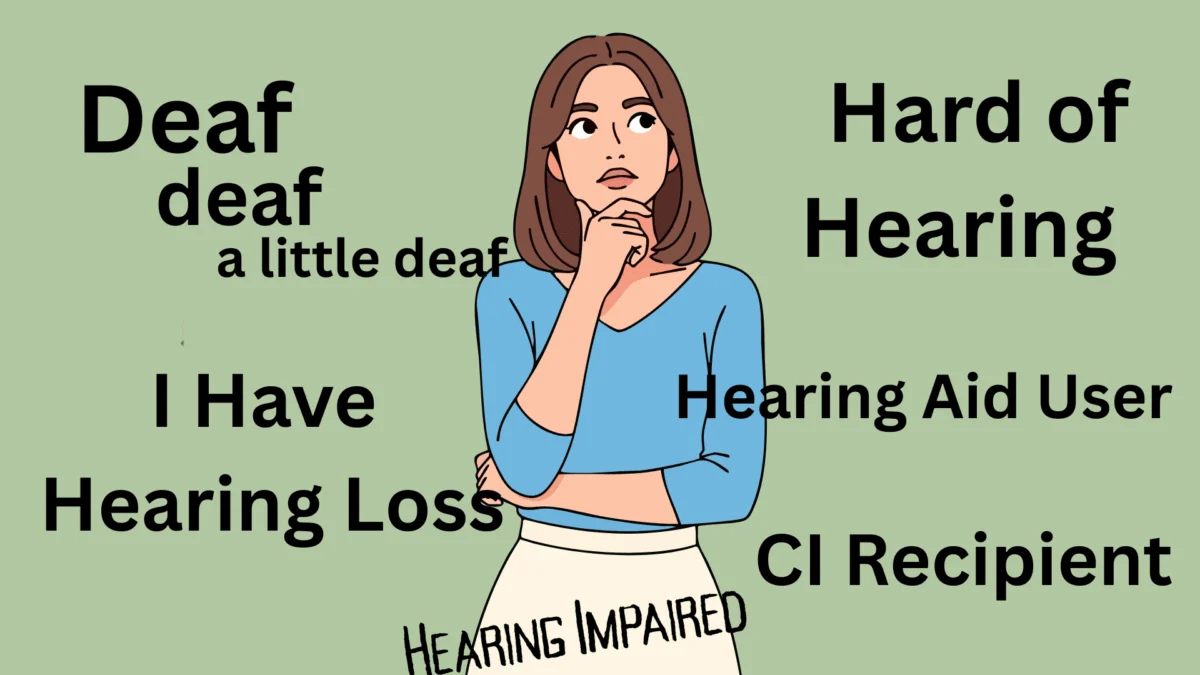
The crux of the matter lies in the assertion that some individuals, despite their lived experience with hearing loss, may lack the comprehensive understanding or the authority to prescribe how others should define their own journey. This often manifests as rigid pronouncements such as, "You can’t call yourself THAT! Because you’re NOT that! I am THAT! You’re THIS, because I say so (based on my own limited knowledge of the full spectrum of deafness!)." Such sentiments underscore a fundamental misunderstanding of identity as a personal and evolving construct, rather than a fixed medical diagnosis or a communal decree. The debate over "what do we call ourselves?" is not merely semantic; it touches upon profound aspects of individual autonomy, cultural affiliation, and the practicalities of daily communication.
The Spectrum of Hearing and Identity: A Deeper Dive
To understand the intensity of these discussions, it is crucial to recognize the vast spectrum of hearing abilities and the diverse ways individuals experience and relate to their hearing loss. Hearing loss is not a monolithic condition; it encompasses a range from mild to profound, can be congenital or acquired, and may affect one or both ears. The World Health Organization (WHO) estimates that over 1.5 billion people globally experience some degree of hearing loss, with approximately 430 million having disabling hearing loss. This sheer number underscores the diversity of experiences and the inadequacy of a one-size-fits-all approach to identity.
Historically, terms used to describe individuals with reduced hearing have evolved significantly, reflecting shifting societal attitudes and medical understanding. Early terminology often carried negative connotations, focusing on deficits. The mid-20th century saw the rise of "hearing impaired," a term that, while intended to be neutral, has since fallen out of favor with many within the community who perceive it as emphasizing impairment over identity and capability.
The distinction between "deaf" (lowercase ‘d’) and "Deaf" (uppercase ‘D’) is central to these identity debates. "Deaf" (lowercase ‘d’) typically refers to the audiological condition of profound hearing loss. In contrast, "Deaf" (uppercase ‘D’) refers to a cultural identity associated with a shared language (such as American Sign Language or British Sign Language), traditions, values, and community. Individuals who identify as Deaf often view themselves as part of a linguistic minority rather than as individuals with a disability that needs to be "fixed." This cultural perspective often emphasizes the richness and vibrancy of Deaf culture.
Within the "hard of hearing" category, individuals experience varying degrees of hearing loss, from mild to severe, and often use a combination of hearing aids, assistive listening devices, lip-reading, and spoken language for communication. Many hard of hearing individuals navigate a liminal space, feeling not fully part of the hearing world nor fully integrated into the Deaf cultural community, leading to unique identity challenges. Other terms that appear in discussions include:
- Late-Deafened: Individuals who become deaf later in life, often after acquiring spoken language, presenting a distinct set of challenges related to adaptation and identity formation.
- Oral Deaf: Individuals who are deaf but primarily communicate using spoken language, often through intensive speech therapy and hearing technologies like cochlear implants or powerful hearing aids.
- Cochlear Implant User: While not an identity in itself, it describes individuals who use this specific technology, which often sparks debates about hearing restoration versus embracing deafness.
- Hearing Ally/Friend: Terms used by hearing individuals who actively support the Deaf and hard-of-hearing communities.
The sheer variety of these descriptors highlights why self-identification is so deeply personal. Each term carries different implications regarding communication methods, cultural affiliation, and individual experience.
The Rise of Online Forums and the Double-Edged Sword of Community
Social media platforms and dedicated online forums have revolutionized how individuals with hearing loss connect, share experiences, and seek advice. These digital spaces provide a vital sense of community, breaking down geographical barriers and offering support that may not be available locally. Individuals can ask for advice on new technologies, share coping strategies, or simply find solace in connecting with others who understand their daily challenges.
However, the anonymity and immediacy of online interactions also present significant challenges. Without the nuances of face-to-face communication, well-meaning advice can easily be misinterpreted as judgmental, and strong opinions can quickly escalate into shaming. The very platforms designed to foster connection can, inadvertently, become arenas for identity policing. This often occurs when individuals with a particular lived experience — for instance, a culturally Deaf individual — confront someone identifying as "deaf" but using spoken language or a cochlear implant, questioning their "authenticity." Conversely, hard of hearing individuals may face skepticism from those with profound deafness regarding the severity of their challenges.
This dynamic creates an environment where individuals, particularly those new to their hearing loss journey or exploring their identity, may feel pressured to conform to certain labels or risk being ostracized. This gatekeeping behavior, while sometimes stemming from a desire to protect cultural identity or community boundaries, ultimately undermines the principle of individual autonomy and inhibits open dialogue.
Implications of Identity Policing and the Call for Inclusivity
The practice of identity policing carries significant negative implications for individuals and the broader community. For those on the receiving end, it can lead to:
- Alienation and Isolation: Feeling unwelcome or judged can deter individuals from seeking support, leading to increased isolation and mental health struggles.
- Delayed Identity Formation: Individuals may struggle to find a comfortable and authentic self-description if external pressures dictate their choices.
- Internalized Shame: Being told one’s identity is "wrong" can foster feelings of shame and inadequacy, hindering self-acceptance.
- Community Fragmentation: Constant infighting over labels detracts from addressing larger systemic issues, such as accessibility, advocacy for communication rights, and combating discrimination.
Professional organizations and disability advocates consistently emphasize the importance of person-first language (e.g., "person with hearing loss" rather than "hearing-impaired person," although community preferences vary) and respect for individual self-identification. The National Association of the Deaf (NAD) in the United States, for example, advocates for respecting the diverse experiences within the deaf and hard of hearing communities, recognizing that identity is complex and personal. Audiologists and speech-language pathologists also play a crucial role in counseling individuals about communication strategies and technology options, while respecting their personal choices regarding identity.
Sociologically, the debates reflect broader discussions within disability studies about the social model of disability, which posits that disability is created by societal barriers and attitudes rather than by an individual’s impairment. From this perspective, identity becomes a powerful tool for self-definition and challenging societal norms, making the act of policing another’s identity particularly problematic as it can inadvertently reinforce oppressive structures.
Moving Forward: Fostering Respect and Functional Communication
The resolution to these online conflicts does not lie in establishing a universal lexicon for self-identification, but rather in cultivating an environment of mutual respect and understanding. The primary objective should shift from policing labels to facilitating effective communication and mutual support.
The fundamental principle is straightforward: individuals have the right to call themselves whatever they choose. This is "Step One" in their journey of self-definition. "Step Two," which is arguably more critical for interaction, involves communicating effectively what is needed from others to ensure a satisfying or at least functional conversation. This practical approach transcends the often-divisive debate over terminology and focuses on tangible actions.
Examples of such clear communication include:
- "Please stand on this side, my better ear."
- "Speak up, I’m having trouble hearing you."
- "Face me so I can read your lips."
- "Let’s move to a quieter spot; it’s too noisy here."
- "It’s too dark for me to read your facial expressions clearly."
- "Thank you, that’s much better."
These simple, direct requests empower the individual with hearing loss to advocate for their communication needs without needing to justify their chosen identity. They shift the focus from what one is to what one needs in a given interaction, thereby fostering understanding and bridging communication gaps.
Ultimately, the goal of any community, whether online or offline, should be to uplift its members. While passionate discussions about identity are natural and can be constructive, they cross a line when they devolve into shaming and exclusion. The emphasis should always remain on inclusivity, empathy, and the shared human experience of navigating the world with hearing loss. Respecting individual autonomy in self-identification is not merely an act of politeness; it is a foundational pillar for building strong, supportive, and truly representative communities. In a world striving for greater diversity and inclusion, the ability for each person to define their own truth, especially concerning deeply personal aspects like identity, must be upheld.


