
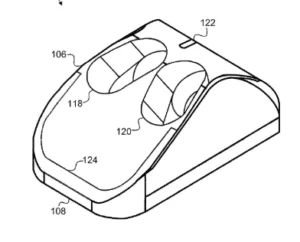
The Innovative Convergence: Earbuds Meet Mouse
At its heart, Spackman’s patent addresses a common user pain point: the proliferation of devices and the associated challenges of management, charging, and potential misplacement. By integrating a wireless earbud charging and storage case directly into a computer mouse, the design seeks to reduce cognitive load and enhance convenience. The practical design considerations, as outlined in the patent, span ergonomics, internal component layout, and dual-purpose usability. The intent is not merely to combine two items but to create a unified object where each function complements the other without compromise. This thoughtful integration aims to maximize user behavior efficiency by presenting a single, readily accessible solution for both audio and navigation needs.
The concept of convergence in consumer electronics is not novel, yet Spackman’s approach distinguishes itself through a focus on intuitive user interaction. Early examples of convergence include smartphones integrating cameras, music players, and personal digital assistant functions. More recently, smartwatches have merged timekeeping with health monitoring and communication. In the realm of computer peripherals, the drive towards multi-functionality has seen keyboards with integrated USB hubs or mice with customizable macro buttons. However, the direct amalgamation of a primary input device with a distinct audio accessory, particularly in a manner that improves, rather than complicates, user access and storage, marks a significant step. The design philosophy underpinning this patent prioritizes a fluid user experience, ensuring that the act of retrieving earbuds or using the mouse remains natural and unimpeded.
A Design Philosophy Reimagined: "Form Follows Function"
The principle "form follows function," first articulated by architect Louis Sullivan in the late 19th century, posits that the shape of an object should primarily be determined by its intended purpose. In industrial design, this has often translated to minimalist aesthetics and highly efficient engineering. Spackman’s patent illustrates this principle by designing the earbud case as the mouse, rather than an attachment. The physical contours and internal architecture are meticulously planned to facilitate both ergonomic mouse operation and secure, convenient earbud storage and charging. This suggests an iterative design process where the functional requirements of both components dictated the final unified form, aiming for an optimal balance between comfort, utility, and aesthetic appeal.
This approach contrasts with less integrated designs, where additional functionalities might be bolted on, leading to bulky or awkward devices. The successful physical execution of Spackman’s design would necessitate careful engineering to ensure the combined weight and dimensions remain within comfortable parameters for mouse usage, while simultaneously providing robust protection and efficient charging for the earbuds. Factors such as the material composition, tactile feedback, button placement, and the mechanism for opening and closing the earbud compartment would all play critical roles in realizing the "form follows function" ideal. A well-executed design would feel intuitive and natural, allowing users to switch between tasks—from navigating a digital interface to listening to audio—with minimal friction.
Addressing the Shortcomings of Prior Art
The patent documentation itself highlights previous attempts at similar multi-tasking mouse designs, while also clearly articulating the perceived disadvantages of these earlier iterations. Spackman notes: "others have developed computer mouse peripherals with earbud chambers at the bottom of the mouse… to store earbuds and charge them. Other attempts include computer mouse peripherals with a compartment on the side that can house retractable or wireless earbuds."
While acknowledging that these examples aimed to reduce the number of devices users needed to track, Spackman’s patent critically points out their ergonomic flaws. Storing earbuds on the bottom of a mouse, for instance, creates difficulty for retrieval, requiring the user to flip the mouse over or manipulate it awkwardly. Similarly, side compartments might improve access but could add bulk or interfere with the natural grip and movement of the mouse. These design choices, according to the patent, introduce "additional disadvantages," undermining the very convenience they sought to provide.
Spackman’s innovation seeks to overcome these practical hurdles by integrating the earbud case in a manner that does not impede the primary function of the mouse, nor the accessibility of the earbuds. The implied superior design would likely feature a top-loading or easily accessible compartment that allows for quick retrieval and replacement of earbuds without significant disruption to workflow or uncomfortable handling of the device. This focus on seamless user interaction and ergonomic efficiency positions the patent as an advancement that learns from and refines previous attempts at device convergence.
The Broader Landscape of Audio and Hearing Health Innovation (March 2026 Patents)
Nathan Spackman’s patent is not an isolated instance of innovation but rather part of a vibrant ecosystem of technological development, particularly evident in the field of audio and hearing health during March 2026. A review of patents issued during this month reveals a concerted global effort to advance various aspects of auditory technology, from fundamental communication methods to sophisticated hearing aids and diagnostic tools. This period saw numerous patents granted to major international players, indicating significant research and development investments across the sector.
Wireless Connectivity and Communication Breakthroughs:
Several patents highlight the ongoing push for enhanced wireless communication in audio devices. Huawei Technologies Co Ltd (Shenzhen, CN) secured patent #12568325 for a "Communication method applied to binaural wireless headset, and apparatus" on March 3, 2026. This indicates a focus on optimizing the wireless link between two ear-worn devices, crucial for immersive stereo sound and advanced signal processing. Later in the month, GN Hearing A/S (Ballerup, DK) received #12574692 for a "Wirelessly rechargeable hearing device and charger for same," emphasizing the growing importance of seamless power solutions. Sonova AG (Staefa, CH) received multiple patents including #12592219 for "Hearing device user communicating with a wireless communication device," and Starkey Laboratories Inc (Eden Prairie, MN) patented "Antenna designs for hearing instruments" (#12592478), underscoring the critical role of robust wireless connectivity and efficient antenna systems in modern hearing solutions. Intel Corporation (Santa Clara, CA) also entered this space with "Communication device and hearing aid system" (#12593182), suggesting a broader integration of hearing technology into general computing and communication platforms. Sony Group Corporation (Tokyo, JP) contributed with "Hearing aid listening test presets" (#12593184), and Sonos (Goleta, CA) with "Broadcast audio for synchronized playback by wearables" (#12593264), further illustrating the expansion of wireless audio ecosystems.
Advanced Noise Reduction and Auditory Enhancement:
A significant number of patents address the perennial challenge of noise in audio environments. Bose Corporation (Framingham, MA) was granted #12573365 for "Acoustic noise reduction audio system having tap control" on March 10, 2026, showcasing innovation in user-controlled noise management. Earlens Corporation (Menlo Park, CA) focused on "Environmental noise estimation and reduction based on a constructed noise reference from a multi-microphone input" (#12574687). Oticon A/S (Smorum, DK) secured #12574689 for a "Hearing device comprising a noise reduction system" and later #12581248 for a "Hearing aid comprising a combined feedback and active noise cancellation system," highlighting advancements in integrating multiple noise management strategies. Meta Platforms Technologies LLC (Menlo Park, CA) patented "Active noise cancellation using remote sensing for open-ear headset" (#12579965), indicating a drive for noise cancellation in less occlusive ear-worn devices. Starkey Laboratories Inc (Eden Prairie, MN) further contributed with "Ear-wearable device with active noise cancellation system that uses internal and external microphones" (#12581226). Fortell Research Inc (New York, NY) received two patents related to neural networks for noise reduction, including #12574691 for "Method, apparatus and system for neural network hearing aid" and #12581250 for "Ear-worn device with neural network for noise reduction and/or spatial focusing using multiple input audio signals," signaling the increasing adoption of AI and machine learning for sophisticated auditory processing.
The Evolution of Hearing Aids and Implants:
Traditional hearing assistance devices are also seeing substantial innovation. Starkey Laboratories Inc (Eden Prairie, MN) was particularly active, with patents like #12568326 for "Mechanism for external multi-functional cable retention for a hearing device" and #12568339 for "Curved acoustic path for hearing instruments" on March 3, 2026. They also patented "Person-to-person voice communication via ear-wearable devices" (#12574693) and "Hearing assistance devices with control of other devices" (#12581253), indicating a trend towards smart, connected hearing aids that interact with other electronics. Cochlear Limited (Macquarie University, AU) focused on implants with "Ear canal microphone utilizing communications with hearing implant" (#12574694) and "Convertibility of a bone conduction device" (#12581254). Sivantos Pte Ltd (Singapore, SG) patented multiple advancements, including "Charging coil for a hearing aid charger, hearing aid charger and wireless charging system" (#12574672), "Method for operating a hearing instrument and hearing system with such a hearing instrument" (#12574688), and "Method for operating a hearing system and hearing system" (#12587797). Widex A/S (Lynge, DK) patented a "Method of operating a hearing aid system and a hearing aid system" (#12574690). Sonova AG (Staefa, CH) secured patents for "Facilitating hearing device fitting" (#12581247), "Hearing device with optical sensor for determining a tissue property" (#12582355), and "Method of optimizing audio processing in a hearing device" (#12587796), demonstrating a holistic approach to improving hearing aid functionality and personalization. Even specialized devices like "Neonatal hearing protection device" (#D1119095) by Neotech Products LLC (New York, NY) highlight diverse applications.
Diagnostic Tools and Personalized Hearing Solutions:
The development of more accurate and accessible hearing diagnostics and personalized audio experiences is another strong theme. Bragi GmbH (Munich, DE) patented an "Earpiece for audiograms" (#12574669), suggesting integration of diagnostic capabilities directly into consumer-grade earbuds. Mimi Hearing Technologies GmbH (Berlin, DE) focused on "Systems and methods for assessing hearing health based on perceptual processing" (#12581255), indicating a move towards more sophisticated, user-friendly hearing assessment. University of South Carolina (Columbia, SC) patented a "Display screen with animated graphical user interface for a hearing testing training device" (#D1119915), showing innovation in training and education for hearing professionals. Alex Lau and Pui Tong Paul Lee (Hong Kong, HK) patented "Headphones with sound-enhancement and integrated self-administered hearing test" (#12587798), representing a significant step towards empowering users with at-home hearing assessment and personalized sound profiles.
Market Implications and the Future of Integrated Peripherals
The surge of patents in March 2026, particularly Spackman’s integrated mouse and earbud case, paints a clear picture of an industry striving for greater convenience, enhanced functionality, and deeper integration of technology into daily life. The implications of these innovations are far-reaching. For consumers, this trend promises a reduction in device clutter, streamlined workflows, and potentially more affordable multi-functional gadgets. The emphasis on user-centric design, as seen in Spackman’s patent, suggests a maturing market where ease of use and ergonomic comfort are paramount.
From an industry perspective, this patent activity signals intense competition and a robust investment in R&D. Companies are not just improving existing products but are actively seeking to redefine product categories and create new market segments. Spackman’s "Wireless earbud case with mouse functionalities" could be a precursor to a new generation of smart peripherals that combine multiple daily functions into intuitive, consolidated forms. Such devices could appeal to remote workers, digital nomads, and anyone seeking to simplify their tech arsenal without sacrificing capability.
The potential for licensing opportunities for Spackman’s patent is considerable, as major peripheral manufacturers or even earbud companies might seek to incorporate this functionality. Furthermore, its success would hinge on meticulous execution in manufacturing, ensuring that the combined device is not only functional but also durable, aesthetically pleasing, and competitively priced.
Ultimately, the collective patents from March 2026 underscore a broader technological narrative: the continuous evolution of personal electronics towards more intelligent, interconnected, and human-centric designs. From advanced hearing aids that leverage AI to sophisticated noise cancellation and innovative multi-device integrations like Spackman’s, the future of audio and computing peripherals is clearly moving towards a more seamless and integrated user experience. This period of innovation reflects a strategic response to evolving consumer demands for simplicity, efficiency, and powerful technology that discreetly enhances their lives.