A New Paradigm in Live Audio Accessibility
The evening of April 8, 2026, marked a pivotal moment for concertgoers at David Geffen Hall. As the New York Philharmonic commenced its performance, attendees equipped with Auracast-enabled devices or specialized receivers were treated to an astonishingly clear and detailed soundscape. Listeners reported an experience akin to having the orchestra performing directly in their personal library, complete with the subtle nuances of page turns and the distinct placement of orchestral sections across the stage. This remarkable clarity and spatial fidelity were achieved not through a high-resolution recording, but via a live broadcast of the ongoing rehearsal, transmitted directly to individual devices, irrespective of the listener’s physical distance from the stage.
Andrew Bellavia, founder of AuraFuturity and a prominent advocate for hearing care innovation, was among those who experienced this transformative technology firsthand. "Phone in hand, I pressed the start button. After a moment of silence, my ears were caressed by a gentle passage performed by the New York Philharmonic," Bellavia recounted, highlighting the immediate and profound impact of the Auracast stream. This level of immersion, achieved from the farthest seat in the hall, underscores the revolutionary potential of Auracast in democratizing access to high-quality live audio.
The Genesis of an Inclusive Vision at Lincoln Center

The journey to this technological milestone at Lincoln Center for the Performing Arts has been a long and collaborative one, rooted in a deep commitment to accessibility. Miranda Hoffner, Director of Accessibility at Lincoln Center, emphasized the institution’s dedication to ensuring equitable access to the arts for everyone. For years, organizations like the Hearing Loss Association of America (HLAA) New York City chapter, alongside influential figures such as composer Richard Einhorn, have advised Lincoln Center on addressing hearing issues, training staff, and exploring advanced assistive listening technologies.
Richard Einhorn’s work played a crucial role even before Auracast’s commercial availability. His composition was featured in GN Hearing’s initial Auracast trial in November 2024. At that time, commercial Auracast equipment was nascent, and the ReSound app was still in beta. Despite these early stages, the potential of Auracast to dramatically enhance the concert-going experience for individuals with hearing loss was unequivocally evident. This early promise spurred Hoffner and her team to delve deeper into Auracast’s capabilities and implementation requirements.
The drive for superior audio accessibility was also fueled by the inherent limitations of existing technologies. Rudy Rodriguez, Technical Director for Lincoln Center’s event production team, had spent years optimizing their traditional hearing loop system. Despite his diligent efforts, he recognized its fundamental constraints. "I think there’s ways we can make [the loop] incrementally better, but in terms of it sounding crisp and clear, it’s never going to be that way. The hearing loop technology is just not that," Rodriguez candidly admitted to Hoffner. This acknowledgment underscored the urgent need for a next-generation solution that could deliver true high-fidelity audio, a need that Auracast appeared poised to meet.
Auracast: A Deeper Dive into the Technology
Auracast broadcast audio is a new capability within Bluetooth LE Audio, designed to allow an audio source device to broadcast audio to an unlimited number of nearby Bluetooth receivers. This technology represents a paradigm shift from traditional point-to-point Bluetooth connections, enabling public broadcast of high-quality audio. Unlike older assistive listening systems, which often rely on dedicated hardware, complex installations, or suffer from interference and bandwidth limitations, Auracast leverages the ubiquitous Bluetooth standard, making it highly scalable and adaptable.
Key advantages of Auracast include:

- High-Fidelity Stereo Audio: Unlike many legacy systems that transmit in mono, Auracast supports stereo sound, offering a richer, more spatial listening experience crucial for appreciating the nuances of classical music.
- Low Latency: Essential for live events, Auracast minimizes delay between the live performance and the transmitted audio, ensuring synchronization.
- Broad Compatibility: As a Bluetooth standard, Auracast is designed to be compatible with a wide range of devices, including future hearing aids, earbuds, and smartphones, reducing the need for specialized, venue-specific equipment.
- Enhanced Clarity and Reduced Interference: Operating on the Bluetooth Low Energy standard, Auracast offers superior signal integrity and is less susceptible to electromagnetic interference often plaguing induction loops.
Globally, over 1.5 billion people live with some degree of hearing loss, a number projected to rise to 2.5 billion by 2050, according to the World Health Organization. This demographic faces significant barriers to fully participating in public life, including cultural events. Traditional assistive listening devices (ALDs) have attempted to bridge this gap, but often fall short in delivering a truly equitable experience. Induction hearing loops, while beneficial for some, frequently struggle with sound quality, signal dropout, and the inherent limitations of mono transmission and frequency response. FM and IR systems require specialized receivers that can be cumbersome and often carry hygiene concerns. Auracast promises to overcome these longstanding challenges by integrating high-quality audio directly into personal devices, providing a seamless and discreet solution.
Seamless Integration: The David Geffen Hall Pilot
The practical implementation of Auracast at David Geffen Hall was a collaborative effort involving Lincoln Center, GN Hearing, and Listen Technologies. In March 2026, a professional installation trial commenced, with Jill Mecklenburger and Megan Quilter of GN leading discussions with Lincoln Center staff. Andrew Bellavia was invited to bring his Listen Tech Auri demo kit for this crucial pro-level trial.
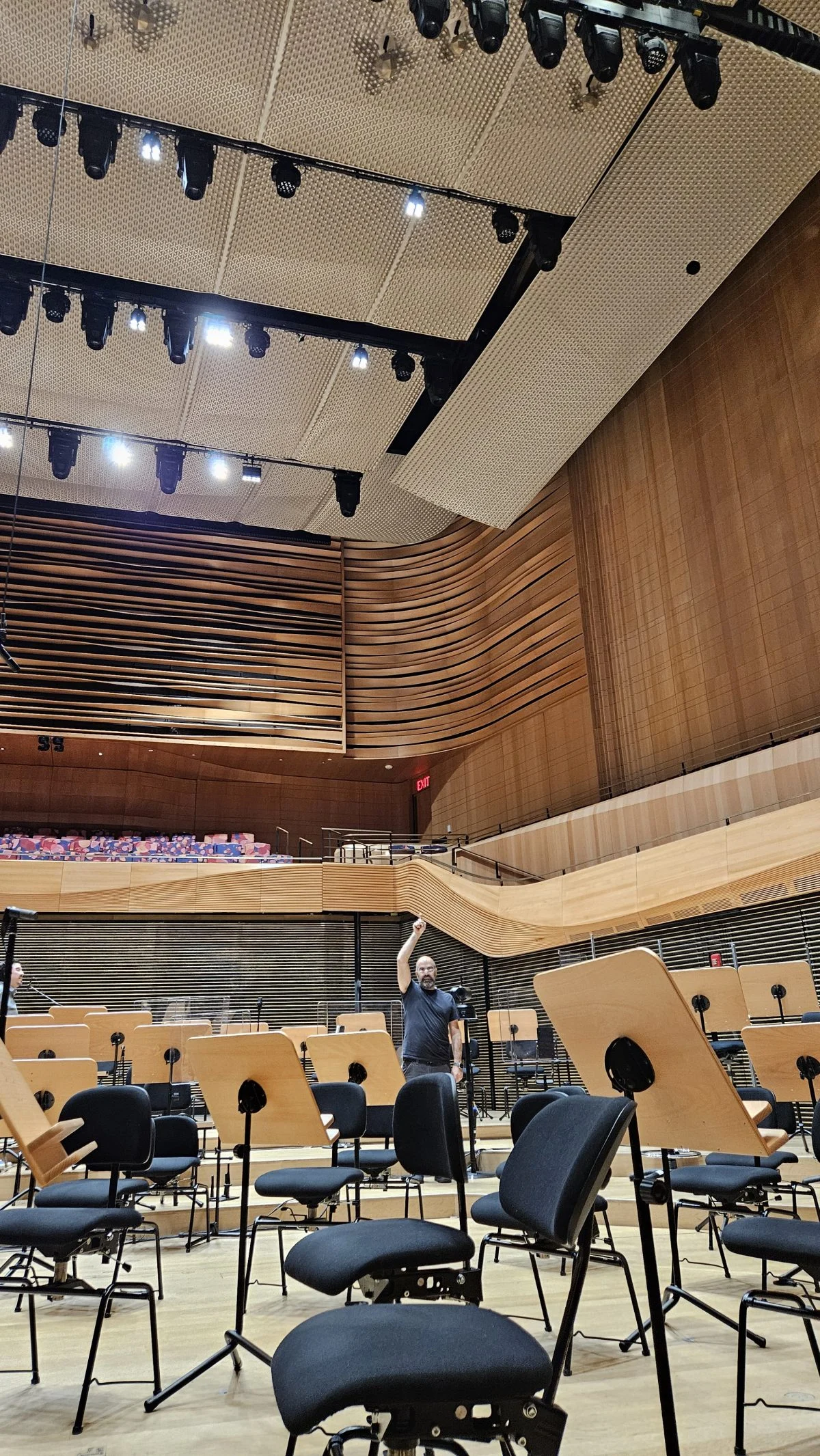
The technical team, including Rudy Rodriguez, quickly identified a strategic location for the Auracast transmitter: behind the acoustic panels in the ceiling above the stage. This spot was ideal as it already housed existing audio feeds and network infrastructure, simplifying the installation process. Although a more central location might have offered marginally better signal distribution, the chosen spot provided excellent coverage and minimized logistical challenges for the trial.
The installation proved remarkably straightforward, a testament to the efficient planning and the expertise of Rodriguez and the stagehands. "We were set up in like 30 minutes, 45 minutes, and we had blocked out four hours just in case anything went wrong," Rodriguez later noted, expressing surprise at the speed. Bellavia was able to configure the transmitter’s power, audio input levels, and, crucially, block out channels used by the venue’s existing Wi-Fi system to prevent interference. This meticulous approach ensured a clean, robust signal throughout the hall. Preliminary tests with pre-recorded music confirmed excellent sound and signal quality, with even the weakest signal points registering as "good" to "fair."
The Critical Dress Rehearsal: Fine-Tuning for Perfection

With the initial setup successful, plans were finalized for the live concert experience on April 8, 2026. Given the purely acoustic nature of Philharmonic concerts, which eschew amplification or speakers, the Auracast sound calibration was scheduled for the dress rehearsal that morning. This presented a high-stakes scenario, allowing minimal time for error correction.
A significant advantage for the Auracast system was the existing array of high-quality overhead microphones positioned above the stage. These microphones typically serve various purposes, including providing sound for the lobby’s free listening area, recording concerts for commercial release, and feeding the traditional hearing loop. Their professional placement and fidelity proved invaluable for capturing the subtle nuances and dynamic range of classical music, a critical factor when there’s no live mixer or amplifier to compensate for imbalances.
The calibration process, overseen by Bellavia, took approximately 30 minutes to achieve optimal audio levels. This involved carefully adjusting the volume to ensure even the softest passages were perceptible, while engaging automatic gain control (AGC) to prevent overloading the system during the loudest musical climaxes. Gregoire Yeche, an R&D Audiologist at GN and a part-time recording engineer, played a crucial role, providing real-time feedback from different seating areas via text messages while Bellavia made adjustments at the computer. This collaborative, iterative process was essential to achieve the desired balance and clarity.
The impact of this meticulous tuning was immediately apparent. Unbeknownst to Bellavia initially, several members of the production and technical staff were also monitoring the Auracast feed through Auri receivers. Their reactions were overwhelmingly positive. Rudy Rodriguez shared that his colleagues were "teams-ing me like, ‘This sounds awesome!’" Miranda Hoffner articulated the profound shift in experience: "I forgot that I was listening to an assistive tech receiver. It felt as though I was very much in the room listening to the music, which is really cool." Rodriguez further elaborated on the immersive quality, stating, "it felt like you were not only in the room 100%, but it almost feels like you’re on stage with the musicians, as opposed to just in a chair." These sentiments underscored the system’s ability to transcend the typical limitations of assistive listening and deliver a truly engaging, high-fidelity experience.
Showtime: An Equitable Experience for All
For the evening concert, Lincoln Center and GN Hearing set up a welcoming station for invited guests. Many attendees were local hearing aid wearers, some fitted with ReSound Vivia devices, which are Auracast-capable. For those without compatible personal hearing technology, Auri receivers were provided, along with Sennheiser earbuds, courtesy of the Bluetooth SIG. The event drew key opinion leaders, members of the media, and notable advocates like Richard Einhorn.

Among the guests was Holly Cohen, former President of HLAA’s NYC chapter, a passionate hearing health advocate, and Executive Producer of the documentary We Hear You. Her reaction encapsulated the success of the Auracast implementation. "Just from the get-go, it was just so enjoyable. It was really enjoyable. And again, like I said, very crisp," Cohen enthusiastically shared after the concert. Having experienced numerous assistive listening systems over the years, Cohen was particularly struck by Auracast’s performance and ease of use. "So simple. It just immediately connected, and there I was, and just hearing so well," she remarked, concluding with profound satisfaction, "I’m not sure how much more I could say, just to be so thrilled about it. Just thrilled with this new technology."
The stark contrast with traditional systems was evident. Bellavia also tested the existing hearing loop during the performance. While functional for its intended purpose, it presented a low-level hiss during quiet passages. Crucially, the loop’s bandwidth limitations meant that the upper registers of the music were compromised, diminishing the overall quality. Furthermore, as a mono transmission, the stereo width and spatial impression of the live orchestra collapsed, reducing the sense of being present at a live performance. For regular users of the loop, it offered some benefit, but the Auracast system clearly demonstrated its superiority, transforming the listening experience from merely "adequate" to "exceptional." The profound implication was clear: with Auracast, any patron, regardless of their hearing ability or seating location, could experience the concert with the intimacy and detail previously reserved for those in the most acoustically privileged seats.
Striving for Excellence: Lincoln Center’s Enduring Commitment
Lincoln Center’s pioneering adoption of Auracast is a testament to its broader commitment to universal accessibility and excellence in cultural programming. The institution already offers a range of inclusive experiences, from free listening areas in the main lobby to "choose what you pay" programs and audio-described performances. The integration of Auracast aligns perfectly with their overarching mission: to ensure that everyone can enjoy the arts to the greatest extent possible.
"We want people with hearing loss to be able to sit next to people that they love that don’t have hearing loss and have an equitable experience. So we really deeply care about everyone being able to access the arts," Miranda Hoffner articulated, underscoring the philosophical foundation behind their technological embrace. Rudy Rodriguez echoed this sentiment, emphasizing his professional responsibility to "make use of a growing number of technological options that are accommodating people who perceive the world differently."
With Auracast, Lincoln Center’s ambitious goals for inclusivity are more attainable than ever. This successful deployment at David Geffen Hall serves as a powerful proof of concept, demonstrating how cutting-edge technology can break down barriers and enrich the cultural experience for millions. The implications extend far beyond concert halls, promising a future where high-quality, personalized audio is seamlessly available in diverse public spaces, from airports and museums to conference centers and sports arenas, fundamentally reshaping how individuals interact with their environment and access information. The April 8, 2026, concert at David Geffen Hall was not just a performance; it was a glimpse into the future of truly accessible public audio.