This overhaul is part of a broader initiative within the Civil Service to ensure that digital services meet the stringent requirements of the Public Sector Bodies (Websites and Mobile Applications) (No. 2) Accessibility Regulations 2018. By focusing on the practical application of inclusive design principles, the DfE aims to bridge the gap between theoretical compliance and the delivery of truly accessible services for millions of students, parents, and educators.
The Context of Digital Accessibility in Government
The DfE’s decision to refine its accessibility manual comes at a time when digital transformation in the public sector is under intense scrutiny. Accessibility is no longer viewed as an optional "add-on" but as a fundamental requirement of service design. According to data from the UK’s Family Resources Survey, approximately 16 million people in the UK reported having a disability in the 2022-23 period, representing 24% of the population. This demographic includes individuals with visual, auditory, motor, and cognitive impairments, all of whom rely on government digital services for essential education-related tasks.
The original manual, launched in late 2024, was designed to centralize the DfE’s guidance on Web Content Accessibility Guidelines (WCAG) 2.2. While the initial reception was positive and usage data indicated high engagement, the department recognized that accessibility standards are evolving. Feedback from internal design and delivery teams suggested that while the content was valuable, the information architecture occasionally hindered efficiency. This prompted a research-led redesign aimed at optimizing how information is consumed and applied during the product development lifecycle.
Chronology of the Update: From Feedback to Implementation
The journey toward the July 2025 update began shortly after the manual’s first iteration was deployed. The DfE digital team initiated a discovery phase to monitor how different roles—specifically designers, product owners, and delivery leads—interacted with the platform.
In early 2025, the department conducted a series of user research sessions. These sessions were designed to identify "pain points" in the existing navigation and content structure. The research focused on three primary areas: the discoverability of specific guidance, the utility of the existing "knowledge hub," and the effectiveness of the tools section.
By the second quarter of 2025, the research findings were synthesized into a development roadmap. The team identified that users were often overwhelmed by the volume of information and felt that the "knowledge hub" acted more as a repository for miscellaneous data rather than a functional guide. Between April and June 2025, the content was systematically reorganized to align with the "user journey"—the logical steps a professional takes when building or testing a service. The final version was rigorously tested for its own accessibility before being published in late July.
Structural Overhaul: Moving Beyond the ‘Knowledge Hub’
One of the most significant changes in the updated manual is the complete removal of the "knowledge hub" section. In the previous version, this section served as a centralized location for various articles, research papers, and deep dives into accessibility topics. However, user feedback indicated that it felt "cluttered" and was perceived as a "dumping ground" for information that did not fit elsewhere.
To address this, the DfE team adopted a "task-based" information architecture. Rather than forcing users to browse a separate hub, the department integrated the content directly into the manual’s primary sections. This ensures that information is presented exactly when a user needs it. For example, guidance on cognitive accessibility is now located within the design patterns section, allowing a designer to access relevant research while they are actively working on an interface.
This reorganization reflects a sophisticated understanding of cognitive load. By reducing the number of clicks required to find information and placing data in a contextually relevant environment, the DfE has made the manual a more efficient tool for high-pressure delivery environments.
Refining Tools Guidance for Practical Application
The 2025 update also saw a paradigm shift in how the manual approaches accessibility tools. Previously, the "tools" section was primarily a directory—a list of software and browser extensions with instructions on how to install them. Research showed that while users knew what tools were available, they were often unsure when to use them or how to interpret the results.
The updated manual now focuses on the "why" and "how" of tool usage. The guidance has been restructured to answer specific user questions, such as:
- Which tool is most appropriate for a specific stage of the development cycle?
- What are the limitations of automated testing tools?
- How should a team integrate manual testing with screen readers alongside automated checks?
By providing clearer, person-focused guidance, the DfE is encouraging a "shift-left" approach to accessibility. This methodology involves testing for accessibility as early as possible in the development process, rather than waiting for a final audit. This not only improves the quality of the end product but also significantly reduces the cost and time associated with fixing accessibility bugs late in the project.
Simplifying the User Interface and Homepage
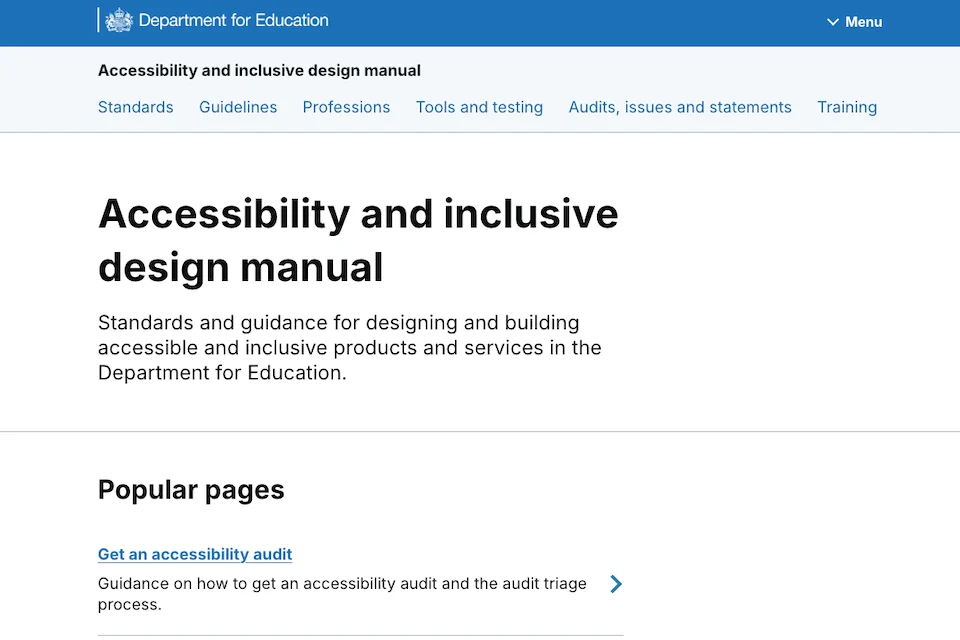
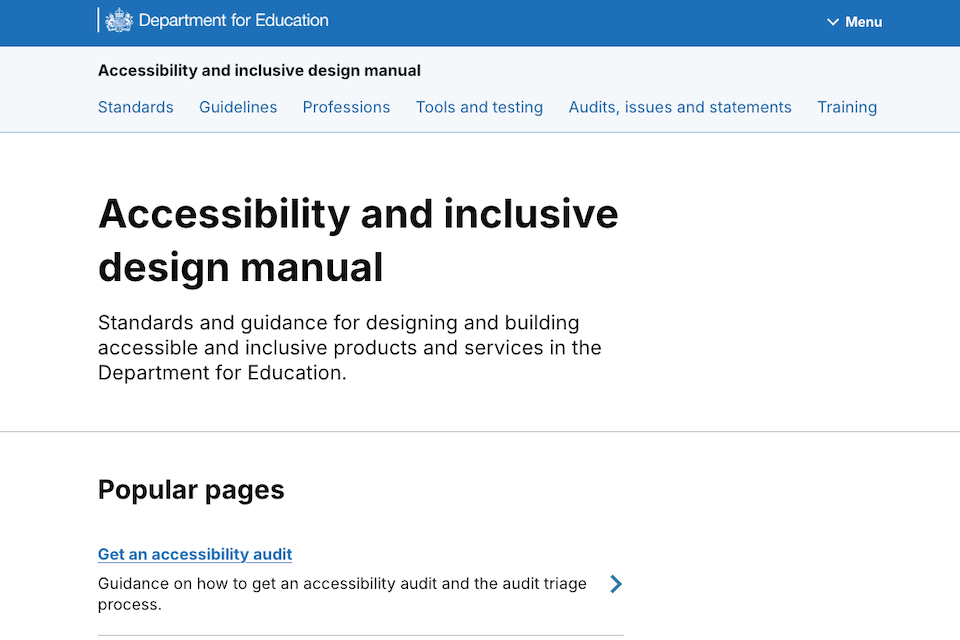
The visual and functional design of the manual’s homepage was another major area of focus. The department noted that the original homepage was overly complex, featuring numerous icons, heavy imagery, and an extensive "long scroll" that could be disorienting for users. Furthermore, the top-level navigation was deemed unclear, making it difficult for new users to understand the scope of the manual.
The 2025 redesign prioritized simplicity and clarity. Key changes included:
- Streamlined Navigation: The menu structure was simplified to highlight core sections such as "Design," "Content," and "Development."
- Reduced Visual Noise: Excessive icons and images were removed to focus the user’s attention on the text and search functionality.
- Improved Searchability: The search interface was enhanced to provide more accurate results, reflecting the department’s data-driven approach to how users look for specific WCAG criteria.
These changes are not merely aesthetic; they are functional improvements that make the manual more accessible to the very people who use it—including those who may be using assistive technologies themselves to navigate the site.
Official Perspective and Strategic Implications
While the DfE has not released individual statements, the department’s digital blog emphasizes that the manual is a living document. The iterative nature of this update suggests a commitment to continuous improvement. Officials within the DfE’s digital transformation unit have indicated that the manual’s success is measured by its adoption rate and the subsequent improvement in the accessibility scores of DfE services.
The implications of this update extend beyond the Department for Education. Although the manual was built specifically for DfE teams, it is hosted on a public-facing platform, making it a resource for the entire public sector, local authorities, and even private-sector organizations. By setting a high bar for documentation, the DfE is influencing the broader standard of inclusive design across the UK.
Industry analysts suggest that this type of "open-source" guidance is crucial for systemic change. When a major department like the DfE provides clear, actionable, and research-backed instructions, it reduces the barrier to entry for smaller organizations that may not have the resources to conduct their own extensive user research on accessibility.
Broader Impact: The Future of Inclusive Design
The July 2025 update to the DfE Accessibility and Inclusive Design Manual arrives at a critical juncture for digital rights. As more public services move to "digital by default" models, the risk of excluding citizens becomes higher. The DfE’s focus on the "human" aspect of tools and the "user journey" of information highlights a maturing approach to digital governance.
Furthermore, the update aligns with the recent introduction of WCAG 2.2 standards, which include new criteria regarding focus appearance, dragging movements, and target sizes. By integrating these complex technical requirements into a simplified, task-oriented manual, the DfE is ensuring that its staff can meet legal obligations without being overwhelmed by technical jargon.
As the department looks toward the future, the manual is expected to evolve alongside emerging technologies. With the rise of Artificial Intelligence (AI) in service delivery, the DfE’s inclusive design framework will likely need to address new challenges, such as algorithmic bias and the accessibility of AI-driven interfaces. For now, the 2025 update stands as a robust foundation for building a more equitable digital landscape in the UK education sector.
The updated manual is currently available to the public, serving as both a practical toolkit for developers and a blueprint for other government departments seeking to enhance their own digital accessibility strategies. Through this initiative, the DfE reinforces the principle that in a modern democracy, digital access is a right, not a privilege.