
The Evolution of Wearable Health Technology
The landscape of personal health monitoring has undergone a profound transformation over the past decade, driven by rapid advancements in sensor technology, miniaturization, and data processing capabilities. What began with simple pedometers has evolved into a sophisticated ecosystem of smartwatches, fitness trackers, and specialized medical devices capable of tracking a myriad of physiological parameters. This shift reflects a growing consumer demand for proactive health management, preventive care, and personalized wellness insights seamlessly integrated into daily life.
Traditional methods for cardiovascular monitoring have ranged from clinical electrocardiograms (ECGs) to consumer-grade photoplethysmography (PPG) sensors found in smartwatches. While highly effective, these methods often come with limitations. Clinical ECGs require dedicated equipment and trained personnel, making continuous, casual monitoring impractical. PPG, which measures volumetric changes in blood flow, is widely used in wrist-worn devices but can be susceptible to motion artifacts and skin tone variations, potentially affecting accuracy during strenuous activity or for certain user demographics. The ongoing challenge for innovators is to develop monitoring solutions that are highly accurate, non-invasive, comfortable for continuous wear, and discreet. STMicroelectronics’ patent directly addresses this challenge by proposing an entirely new form factor and measurement technique for cardiac monitoring.
Deciphering Forcecardiography (FCG) and its Potential
At the heart of STMicroelectronics’ innovation is the application of forcecardiography (FCG). Unlike electrocardiography (ECG), which measures the electrical activity of the heart, or photoplethysmography (PPG), which detects changes in blood volume, FCG is a technique that measures the mechanical vibrations generated by the heart’s contraction and relaxation. These vibrations propagate through the body and can be detected at various points on the skin surface. FCG offers a unique window into the mechanical efficiency and performance of the cardiovascular system.
The principle behind FCG involves using highly sensitive accelerometers or force sensors to detect the subtle, rhythmic movements caused by the heartbeat. These mechanical signals are directly related to ventricular wall motion, valve opening and closing, and blood flow dynamics. Because FCG directly assesses mechanical vibrations, it can potentially offer different or complementary insights compared to electrical (ECG) or optical (PPG) methods. For instance, FCG might be less susceptible to certain types of electrical interference or optical noise, and could potentially provide richer information about cardiac contractility and hemodynamics.
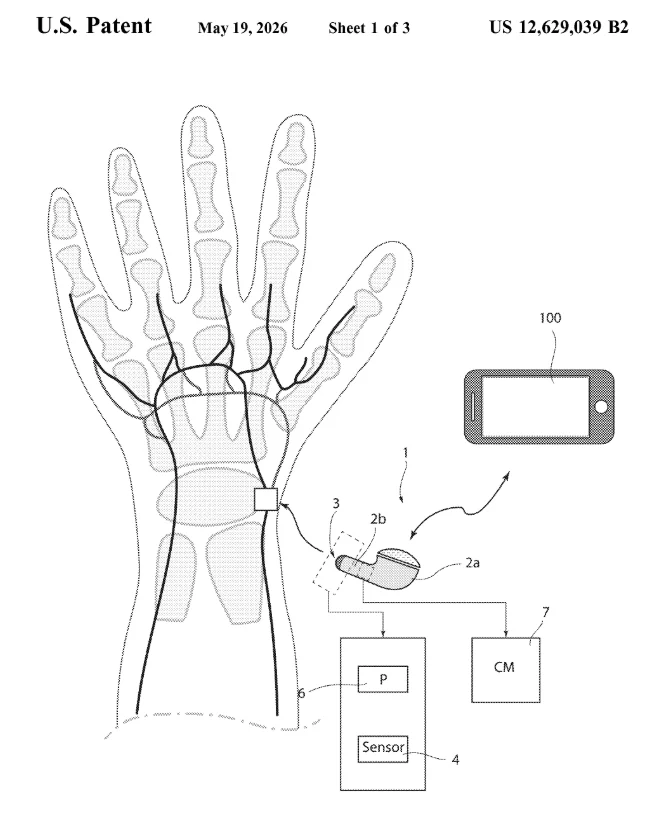
The novelty of STMicroelectronics’ patent lies not just in the use of FCG, but in its proposed application: integrating the FCG sensor into an earbud and using it to measure from an "out-of-ear" location like the wrist. This departure from conventional wrist-worn or chest-worn sensors for cardiac monitoring represents a significant conceptual leap. The earbud, already a ubiquitous personal electronic device, is repurposed to leverage its processing power and connectivity for advanced physiological sensing. By positioning the earbud as the data acquisition and processing hub, and then using its embedded sensors to detect vibrations from the wrist’s radial artery, STMicroelectronics aims to create a highly versatile and potentially more accurate monitoring system. The radial artery, being superficial and a common site for pulse palpation, offers a clear pathway for detecting arterial pulsations and, by extension, the mechanical signals originating from the heart.
The Strategic Rationale: Why Out-of-Ear?
The decision to implement out-of-ear measurements from an earbud raises several strategic and functional questions. Why would an earbud be used to measure from the wrist, rather than simply placing a sensor directly on the wrist? The answer likely lies in a combination of factors related to user convenience, sensor integration, and signal quality.
Firstly, ear-worn devices are already intimately connected to the user, offering a discreet and stable platform for integrated electronics. Modern earbuds are packed with sophisticated microcontrollers, Bluetooth radios, batteries, and often multiple sensors (accelerometers, gyroscopes for head tracking, microphones for ANC). Leveraging this existing computational and power infrastructure for health monitoring, even from a remote site, is a logical extension.
Secondly, the "out-of-ear" concept could offer advantages in scenarios where continuous wrist-worn devices are inconvenient or impractical. For example, athletes might find a wrist-worn device cumbersome during certain sports, or individuals might prefer not to wear a smartwatch continuously. An earbud, already worn for audio, could provide passive monitoring during these times. The patent’s illustration of a "clawing hand" reaching out suggests a scenario where the earbud is temporarily held or placed against the wrist to take a reading, rather than being a permanent fixture. This might imply an on-demand measurement capability, similar to how some smartwatches offer on-demand ECGs.
Thirdly, the specific physiological signals available at different body locations vary. While the ear canal and surrounding areas can provide valuable health data (e.g., temperature, oxygen saturation), the radial artery at the wrist is a well-established site for pulse measurement and arterial stiffness assessment. By combining the processing power of an earbud with the specific physiological access point of the wrist, STMicroelectronics could be aiming for a more comprehensive or specific set of cardiac metrics than might be achievable from the ear alone.
A Snapshot of Innovation: The Broader Patent Landscape
The STMicroelectronics patent, issued on May 19, 2026, is not an isolated development but rather part of a larger wave of innovation in ear-worn and hearing-related technologies. A review of patents issued around the same period, specifically throughout May 2026, reveals a vibrant and competitive landscape, with major players investing heavily in R&D. These patents underscore a clear trend: the convergence of audio, communication, hearing assistance, and health monitoring into increasingly sophisticated and integrated ear-worn devices.
The majority of patents in this timeframe focus on hearing implants and aids, reflecting the significant advancements in assistive listening technology. Companies like MED-EL Elektromedizinische Geraete GmbH (e.g., "Patient specific frequency mapping procedure for hearing implant electrode arrays," #12616838), Oticon Medical A/S (e.g., "Drill bit, drill kit and method for drilling a cavity or a recess into a skull," #12616485; "Method of detecting a sudden change in a feedback/echo path of a hearing aid," #12621613), Cochlear Limited (e.g., "Self-locking fixation system for medical implant," #12616842; "Musical perception of a recipient of an auditory device," #12621617; "Determining impedance-related phenomena in vibrating actuator," #12634638; "Electroporation shield for implantable electrodes," #12636491), GN Hearing A/S (e.g., "Hearing device with acceleration-based beamforming," #12620402), Widex A/S ("Method of operating a hearing aid system and a hearing aid system using speech forecasting," #12621616), Sivantos Pte Ltd (e.g., "Method for customizing a hearing apparatus," #12634639; "Method for determining an aging condition of a battery cell," #12638515), Starkey Laboratories Inc (e.g., "Reducing comb filtering for hearing devices," #12634641; "Swappable rechargeable battery cartridge for hearing aid," #12634643), and Fortell Research Inc (e.g., "Method, apparatus and system for neural network hearing aid," #12634642; "Binaural data sharing in ear-worn devices using neural networks," #12640133) are pushing the boundaries in areas like personalization, sound processing, surgical techniques, and power management for hearing prostheses. These innovations aim to improve sound quality, user comfort, and the overall efficacy of hearing solutions.
Another substantial category involves general ear-worn devices and audio processing, with a strong emphasis on user experience and advanced audio features. Bose Corporation, a prolific innovator in this space, secured multiple patents (e.g., "Wearable control system and method to control an ear-worn device," #12619306; "Ear worn device," #12621596; "Dynamic voice nullformer," #12626713; "Recovery of voice audio quality using a deep learning model," #12626714; "Wearable hearing assist device with sound pressure level shifting," #12641378). These patents highlight efforts in active noise cancellation (ANC), voice processing, and user control systems. Knowles Electronics LLC ("Low latency audio processing system having active noise cancellation for ear-worn hearing device," #12620385) also contributes to ANC technology. Other companies like Sony Group Corporation ("Sound processing device, sound processing method, and hearing aid device," #12621615), Panasonic Intellectual Property Management Co Ltd ("Ear-worn device and reproduction method," #12626684), LG Electronics Inc ("Wireless earbud," D1125126), and Amazon Technologies Inc ("Wingtip portion of an earbud," D1127774) are developing new form factors, audio reproduction methods, and integrated features for earbuds.
Crucially, several patents, including STMicroelectronics’, indicate a growing interest in health monitoring and advanced sensing beyond pure audio. While STMicroelectronics focuses on FCG from the wrist, Chang Gung Memorial Hospital and Chang Gung University have patented an "Array measuring method and interpretation device for ultrasonic detection of middle ear effusion" (#12629129), suggesting diagnostic capabilities for ear health. Legato Audio Inc’s "Open ear system using artificial intelligence (AI) driven audio signal processing" (#12627937) hints at AI-powered processing that could extend to health applications. Audioptics Medical Inc’s "Ear imaging system" (#12635883) points towards visual diagnostics. These developments collectively signify a broader trend where ear-worn devices are evolving into sophisticated diagnostic and monitoring tools, moving beyond their traditional roles.
The concentration of these patents, all issued within a single month of May 2026, underscores the intense research and development activity across the globe in this domain. It signifies a strategic push by both established players and emerging innovators to capture market share in the rapidly expanding segments of hearing health, advanced audio, and integrated physiological monitoring.
Implications and Future Outlook
The STMicroelectronics patent for a sensorized earphone device capable of out-of-ear FCG measurements carries significant implications across several sectors:
1. Healthcare and Wellness: This technology could pave the way for more ubiquitous and less intrusive cardiac monitoring. For individuals at risk of cardiovascular disease, athletes monitoring their heart performance, or those simply seeking to understand their physiological responses better, an earbud capable of providing FCG data offers a compelling solution. The discreet nature of an earbud, combined with its potential for on-demand measurements from the wrist, could enhance adherence to monitoring protocols and provide real-time insights into heart health without the need for additional, dedicated medical devices. This could facilitate early detection of anomalies, personalized health management, and improved overall wellness.
2. Consumer Electronics and Wearables: The patent exemplifies the ongoing convergence of consumer electronics with medical and wellness technology. Earbuds, traditionally audio devices, are rapidly transforming into multi-functional health hubs. This development could intensify competition among tech giants, traditional audio companies, and specialized medical device manufacturers. Companies will increasingly differentiate their products not just on audio quality or battery life, but on the breadth and accuracy of integrated health sensors. The success of such devices will depend on seamlessly integrating complex sensing capabilities without compromising core audio functionality or user comfort.
3. Technological Advancements: Realizing this vision requires significant advancements in miniaturization, power efficiency, sensor fusion, and on-device data processing. The earbud must be capable of accurately capturing subtle mechanical vibrations from a remote location, transmitting data reliably, and processing it efficiently, all within a compact and low-power form factor. STMicroelectronics, with its core expertise in semiconductors and sensor technologies, is well-positioned to drive these engineering innovations. The development will also likely push the boundaries of AI and machine learning for interpreting FCG data, filtering noise, and providing actionable health insights.
4. Regulatory Landscape: As consumer devices increasingly incorporate medical-grade sensing capabilities, the regulatory landscape will become more complex. Devices that claim to diagnose, treat, or monitor medical conditions may fall under stricter regulations (e.g., FDA in the US, CE Mark in Europe). Companies entering this space will need to navigate these regulatory pathways carefully, balancing innovation with compliance to ensure product safety and efficacy.
In conclusion, STMicroelectronics’ patent #12629039 represents a forward-thinking step in the evolution of wearable health technology. By leveraging the ubiquitous earbud as a sophisticated physiological monitoring platform, capable of performing forcecardiography from an out-of-ear location like the wrist, the company is exploring new paradigms for discreet and integrated health management. This innovation, alongside a flurry of other ear-worn device patents from leading global innovators, signals a clear future where our personal audio devices will become increasingly intelligent companions, providing not just entertainment and communication, but also vital insights into our health and well-being. The journey from patent to product will undoubtedly involve significant engineering challenges and strategic decisions, but the potential impact on personalized health monitoring is profound.