

The Enduring Challenge of Hearing Loss in a Noisy World
For millions globally, hearing loss is not merely an absence of sound but a profound impediment to communication, social interaction, and overall quality of life. While modern hearing aids have made remarkable strides in amplifying sound and offering basic noise reduction, the holy grail of hearing technology has always been the ability to isolate and clarify desired speech amidst a cacophony of competing sounds. Environments such as bustling restaurants, lively cafes, crowded public transport, or even a family gathering with multiple conversations simultaneously, pose immense challenges. The human brain naturally excels at this "cocktail party effect," but replicating this complex auditory processing artificially has historically been a formidable hurdle for engineers and audiologists.
Traditional hearing aids often struggle in these scenarios, sometimes amplifying all sounds indiscriminately, leading to an overwhelming and fatiguing listening experience. Early digital hearing aids introduced directional microphones and basic noise reduction algorithms, which offered some improvement, but often at the cost of environmental awareness or natural sound quality. The advent of artificial intelligence, particularly machine learning and neural networks, has opened new frontiers, allowing devices to learn, adapt, and process sound in ways that mimic the brain’s own sophisticated mechanisms. Fortell’s initial foray into AI-powered hearing aids in December 2025 was a testament to this paradigm shift, laying the groundwork for the advanced capabilities now seen in AI 2.0.
Fortell’s AI Journey: Building on a Foundation of Innovation
The launch of Fortell’s first generation of AI hearing aids in late 2025 was met with considerable anticipation, introducing an AI processing platform that promised a new era of personalized and intelligent sound management. These initial devices were designed to learn from a user’s acoustic environment, adapting sound processing to enhance speech and reduce unwanted noise. The core innovation lay in their ability to dynamically adjust settings based on real-time environmental analysis, moving beyond static programs to offer a more fluid and responsive listening experience.
However, Fortell recognized that the journey of AI development is iterative, driven by continuous data collection and algorithmic refinement. The development of AI 2.0 is a direct result of this philosophy, building upon the robust foundation established by its predecessor. Rather than necessitating a hardware upgrade, which can be costly and inconvenient for consumers, Fortell chose a software-centric approach. This strategy leverages the existing powerful processors within their hearing aids, demonstrating a forward-thinking commitment to long-term value for their customer base. The decision to deliver AI 2.0 as a free over-the-air update is a significant boon for current users, ensuring they benefit from the latest technological advancements without additional investment, setting a high standard for ongoing product support in the industry.

The Technological Leap: Data-Driven Intelligence and Algorithmic Refinement
The core of AI 2.0’s enhanced performance lies in two critical areas: an expanded set of real-world training data and sophisticated updates to its underlying signal-processing algorithms. Fortell’s team embarked on an intensive data collection initiative, meticulously gathering audio samples from a diverse array of environments known to be particularly challenging for hearing aid users. This included the din of restaurants and cafes, the clatter of construction sites, the rumble of trains and buses, the ambient noise of car interiors, and the reverberant acoustics of offices and living spaces. The emphasis on "real-world" data is paramount; synthetic or laboratory-generated noise often fails to capture the intricate, unpredictable complexities of actual acoustic environments. By exposing its neural network to this rich, varied dataset, Fortell aimed to imbue AI 2.0 with a more nuanced understanding of how to differentiate speech from a wide spectrum of distracting sounds.
Following this extensive data collection, Fortell’s neural network was rigorously retrained. This process involves feeding the network vast amounts of annotated audio, allowing it to identify patterns, learn to suppress irrelevant noise, and intelligently prioritize speech signals. Concurrently, the company’s engineers refined several signal-processing algorithms. While specific details of these proprietary algorithms are not fully disclosed, they likely involve advancements in areas such as beamforming (to focus on sound sources from specific directions), noise reduction, feedback cancellation, and speech enhancement techniques. The synergy between a more robust training dataset and optimized algorithms enables AI 2.0 to execute a more precise and effective separation of speech from background noise, ultimately delivering clearer and more natural-sounding conversations.
Rigorous Validation: Objective Measures Confirm Significant Gains
To objectively quantify the improvements brought by AI 2.0, Fortell conducted comprehensive laboratory testing, comparing its performance against the original AI model, now referred to as AI 1.0. This rigorous evaluation utilized identical acoustic scenes and the same physical pair of Fortell AI Hearing Aids, ensuring that any observed differences were solely attributable to the software update.
The testing protocol involved a KEMAR acoustic manikin, a standardized head and torso simulator used in audiological research, fitted with the hearing aids. A total of 80 challenging speech-in-noise scenes were created. Forty of these incorporated background noise meticulously recorded from real-world environments like cafes and train stations, simulating everyday distractions. The other 40 scenes presented an even greater challenge, featuring three competing talkers strategically positioned around the listener, mimicking the complexity of multi-person conversations.
Both AI versions were evaluated using identical hearing aid settings across Fortell’s two primary AI listening programs: "All Voices" (designed to enhance all speech signals within the environment) and "Front Voices" (focused on speech originating from in front of the listener). Researchers employed a suite of four objective measures widely accepted in audiology and speech processing to assess performance:
- Signal-to-Noise Ratio (SNR): A fundamental measure indicating the level of the desired signal (speech) relative to the level of background noise. Higher SNR generally correlates with better speech intelligibility.
- Hearing-Aid Speech Perception Index version 2 (HASPI v2): A perceptual model designed to predict speech intelligibility and quality for hearing aid users, taking into account audibility and distortion.
- Perceptual Evaluation of Speech Quality (PESQ): An objective measure that predicts the subjective quality of speech, often used in telecommunications, providing a score that correlates with human perception of speech quality.
- Short-Time Objective Intelligibility (STOI): An objective measure that predicts the intelligibility of speech in the presence of noise, designed to correlate well with subjective intelligibility scores.
Breakthrough Results: Enhanced Clarity Across the Board
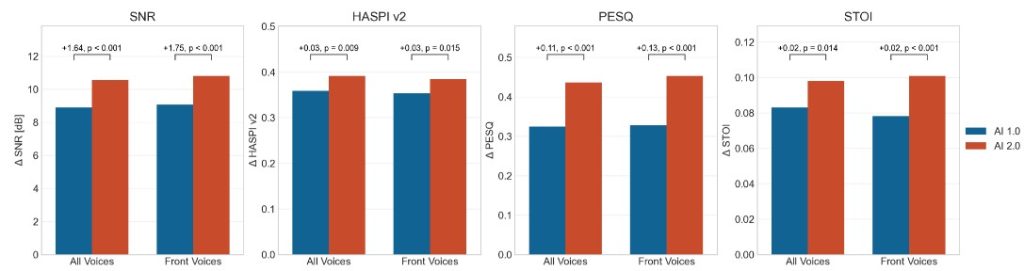
Fortell’s analysis of the testing results revealed a consistent and statistically significant improvement across nearly all evaluated parameters. AI 2.0 demonstrated an improvement over AI 1.0 in the mean result for all 16 combinations of listening program, acoustic condition, and objective metric. Crucially, fifteen of these 16 comparisons achieved statistical significance, underscoring the robustness of the update’s performance gains.
Across both listening modes (All Voices and Front Voices) and noise conditions (background noise and competing talkers), Fortell reported an impressive average 2.13 dB improvement in SNR benefit with AI 2.0 compared with AI 1.0. To put this in perspective, even a 1 dB improvement in SNR can lead to a noticeable difference in speech understanding, especially for individuals with hearing loss. A 2.13 dB gain represents a substantial enhancement in the ability to separate speech from noise.
The most dramatic improvement was observed in the "All Voices" mode during competing-talker conditions. In this particularly challenging scenario, the SNR benefit surged from 1.9 dB with AI 1.0 to a remarkable 5.9 dB with AI 2.0, representing a significant 4.1 dB improvement. This specific gain is highly impactful as multi-talker environments are often cited as the most difficult for hearing aid users. The ability to enhance all voices, not just those directly in front, while still improving clarity in complex speech-heavy environments, signifies a major step forward.
In scenes dominated by general background noise, the output SNR benefit also saw notable increases. In "All Voices" mode, it rose from 8.9 dB to 10.6 dB, and in "Front Voices" mode, from 9.1 dB to 10.8 dB. These represent per-scene improvements of 1.6 dB and 1.7 dB, respectively. Furthermore, the objective measures of PESQ, HASPI v2, and STOI also showed consistent improvements in both programs under background noise conditions, indicating better perceived speech quality and intelligibility.
Even in competing-talker conditions, where "Front Voices" mode achieved an 11.0 dB output SNR benefit with AI 2.0, representing a 1.0 dB improvement over AI 1.0. As noted, "All Voices" mode showed an even larger change, demonstrating the versatility and power of the update. The only comparison that did not reach statistical significance was STOI for "Front Voices" in competing-talker scenes, a minor exception in an otherwise overwhelmingly positive outcome. While these findings are based on objective laboratory measures rather than a full clinical trial comparing wearer outcomes, the consistent improvements across multiple validated metrics strongly suggest a tangible benefit for users. Fortell has transparently published its methodology, statistical analysis, and complete results in an accompanying technical white paper, inviting scrutiny and further validation from the scientific community.
Broader Implications: A New Horizon for Hearing Healthcare
The release of Fortell AI 2.0 carries significant implications, not only for current and future users but also for the broader hearing healthcare industry.
For Users: The most immediate and profound impact will be on the daily lives of individuals with hearing loss. Improved speech clarity in noisy and multi-talker environments translates directly into reduced listening effort, less fatigue, increased confidence in social settings, and ultimately, a richer, more connected life. The ability to engage more fully in conversations at work, with family, or in public spaces can dramatically enhance mental well-being and combat social isolation, a common consequence of unaddressed hearing loss. The fact that this is a free, software-only update democratizes access to cutting-edge technology, ensuring that existing customers benefit from Fortell’s ongoing research and development without needing to purchase new devices.
For the Industry: Fortell’s AI 2.0 update sets a new benchmark for performance in challenging listening conditions, particularly through software-driven enhancements. This could spur other hearing aid manufacturers to accelerate their own AI development and focus more intensely on iterative software improvements. The trend towards "hearables" and integrated smart technology is already strong, and Fortell’s approach reinforces the idea that hearing aids are evolving into sophisticated, adaptable personal audio devices rather than mere amplifiers. It highlights the competitive advantage of robust AI platforms capable of continuous learning and improvement. The emphasis on objective, published data also encourages greater transparency and scientific rigor within the industry.
For Fortell: This update solidifies Fortell’s position as an innovator and leader in the AI-powered hearing technology space. By delivering substantial improvements via software, they demonstrate a commitment to user satisfaction and a long-term vision for their product ecosystem. This strategy could foster greater brand loyalty and attract new customers who value continuous innovation and a future-proof investment in their hearing health. The company’s unique blend of scientific expertise, engineering prowess, and human-centered design principles positions it well for continued growth and impact.
The Future of Hearing Technology: A Continuum of Innovation
Fortell’s AI 2.0 is more than just an update; it’s a testament to the dynamic potential of artificial intelligence in healthcare. As AI models become more sophisticated, fueled by even larger and more diverse datasets, the capabilities of hearing aids will continue to expand. Future iterations might include even greater personalization, predictive sound processing based on user habits and environments, seamless integration with other smart devices, and perhaps even real-time language translation. The trajectory of this technology suggests a future where hearing aids are not just assistive devices, but intelligent companions that proactively enhance auditory perception and facilitate communication in an increasingly complex world.
Fortell, a company driven by scientists, engineers, audiologists, and designers, remains at the forefront of this evolution. Their AI Hearing Aids are prescription devices available for adults with hearing loss in the United States, representing a blend of advanced artificial intelligence, custom hardware, and a profound commitment to human-centered hearing care. With AI 2.0, Fortell has not just improved a product; it has advanced the conversation around what is possible in the quest for clear, effortless hearing.