
The Historical Context of Advocacy
The NAD was established in 1880, a year etched into the collective memory of the Deaf community as a moment of existential crisis. The Second International Congress on Education of the Deaf, held in Milan, Italy, resulted in a global consensus—driven by hearing educators—to mandate oralism and prohibit the use of sign language in classrooms. This decision sought to assimilate Deaf individuals into the hearing world by force, effectively attempting to dismantle the linguistic foundations of Deaf culture.
The formation of the NAD was a direct response to this systemic suppression. Leaders recognized that without a unified national organization, the Deaf community risked losing its autonomy, language, and cultural legacy. Today, the NAD views contemporary genetic interventions with a similar lens of skepticism, drawing parallels between the 19th-century mandate to "fix" the Deaf body through oralism and the 21st-century drive to "repair" the genome through gene therapy.
The Evolution of Genetic Science and Deaf Identity
In recent years, the scientific community has seen breakthroughs in CRISPR-Cas9 and other gene-editing technologies. These tools offer unprecedented precision in altering DNA sequences. While these advancements hold promise for treating debilitating genetic disorders, they have also ignited a profound ethical debate regarding "enhancement" versus "therapy."
The medical model of disability categorizes deafness as a pathology—a sensory loss requiring correction. Conversely, the social and cultural model, championed by the NAD, frames deafness as a variation of human experience. From this perspective, the application of gene therapy to "correct" hearing status is viewed as an existential threat to a minority group whose members view themselves as whole and complete.
Chronology of Genetic Advancements and Community Response
The trajectory of the current debate can be traced through several key developments:
- 2012: The discovery of CRISPR-Cas9 technology provides the scientific community with a relatively accessible tool for permanent genomic modification.
- 2018: Early clinical trials for genetic deafness targeting specific mutations begin to gain international attention, prompting the first wave of internal discussions within disability advocacy groups.
- 2023-2025: Regulatory agencies, including the U.S. Food and Drug Administration (FDA), begin to see an increase in filings for gene therapy trials targeting various sensory conditions.
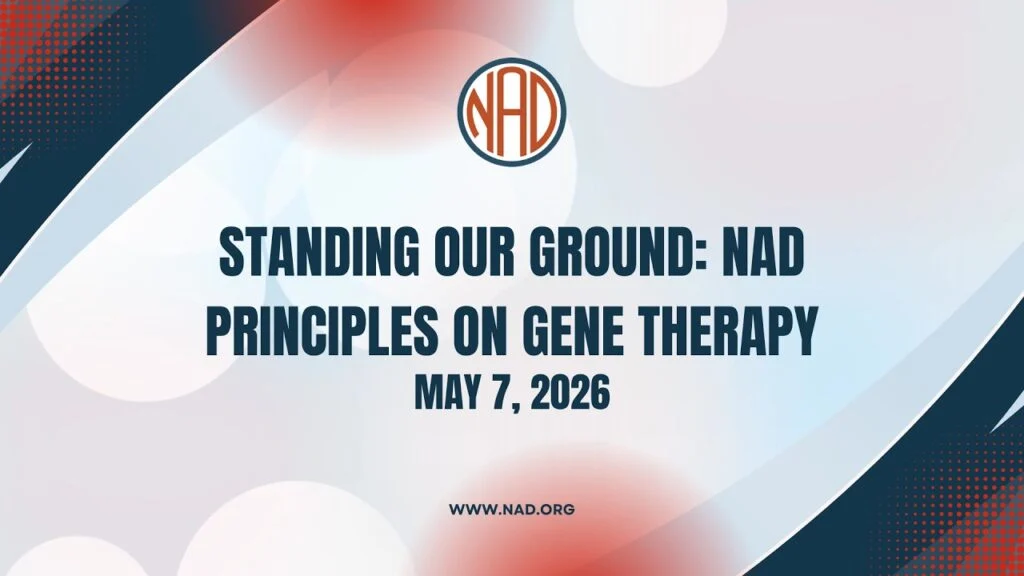
- May 2026: The NAD releases its comprehensive principles on gene therapy, signaling a move toward proactive policy engagement rather than reactive opposition.
Supporting Data and Scientific Perspectives
According to the National Institutes of Health (NIH), genetic factors contribute to approximately 50% to 60% of childhood deafness. Researchers argue that for many families, the prospect of restoring hearing is a deeply personal medical choice. However, the NAD emphasizes that the pursuit of these therapies is often fueled by societal pressure and the stigmatization of disability.
Critics of the medical-only approach point to the lack of "patient-centered" research. Data from health equity studies suggest that clinical research into genetic conditions often fails to include the voices of those who are actually living with the condition. The NAD argues that the absence of the Deaf community in the research design process constitutes a fundamental breach of ethical research practices. If researchers do not engage with the community they intend to "treat," they risk imposing a singular, hearing-centric worldview on a population that does not identify as "broken."
Official Responses and the Call to Action
The NAD’s 2026 mandate calls for a paradigm shift within the global scientific community. The organization has established a dedicated task force to monitor genetic research, provide resources to policymakers, and foster dialogue between geneticists and the Deaf community.
Key demands from the NAD include:
- Mandatory Community Representation: Researchers and grant-making bodies must include Deaf individuals in all stages of project development, from hypothesis generation to clinical trial design.
- Transparency in Informed Consent: Medical professionals must ensure that families are fully informed about the cultural and social realities of the Deaf community, rather than presenting deafness solely as a medical failure.
- Prioritization of True Health: Funding should be directed toward conditions that cause physical suffering or death, rather than interventions aimed at altering fundamental human characteristics like sensory identity.
"Any scientific advancement that proceeds without the leadership of the community it impacts is an act of exclusion," states the NAD. This sentiment is echoed by many bioethicists who argue that "technological capability" should not be the sole determinant of "social desirability."
Broader Implications for Human Diversity
The implications of this debate extend far beyond the Deaf community. If society adopts the principle that any biological variation—be it hearing, vision, or neurodivergence—is a target for eradication, the scope of human diversity will inevitably shrink. The NAD’s stance serves as a litmus test for how modern society views the concept of normalcy.
Sociologists note that the drive for genetic perfection often mirrors the eugenics movements of the early 20th century, even if the intent behind modern gene therapy is framed as individual choice. The concern is that as genetic editing becomes more common, the societal pressure to "normalize" children will intensify, effectively coercing parents into procedures they might not otherwise choose.
Furthermore, the economic implications are significant. As the cost of genetic therapies remains astronomical, public health systems must decide whether to prioritize these high-cost interventions or invest in the accessibility, education, and social inclusion of disabled individuals. The NAD argues that investing in inclusive environments—such as better sign language education and communication access—is a more ethical and effective use of resources than attempting to "cure" the individual.
Conclusion: A Legacy of Resilience
The mandate issued by the NAD in 2026 is a continuation of the resolve demonstrated in 1880. By asserting that the Deaf community is a vital, permanent, and valued part of humanity, the organization is challenging the scientific community to reconsider its definition of progress.
The path forward, as outlined by the NAD, requires sustained engagement and a commitment to human rights that transcends technological capability. Whether in the classroom or the laboratory, the message remains consistent: the Deaf community is not an object to be fixed. It is a culture to be respected. As the world stands on the precipice of a genetic revolution, the NAD’s call to action serves as a vital reminder that scientific innovation must be tempered by human dignity. True progress is measured not by how effectively we can edit our biology, but by how well we can embrace the full spectrum of the human experience. Through its new task force and ongoing advocacy, the NAD remains prepared to navigate this complex future, ensuring that the voice of the community is heard in the halls of science and the corridors of power.