Historical Context: The 1880 Mandate
The organization’s current stance is rooted in its foundational history. The NAD was established in Cincinnati, Ohio, during a climate of intense suppression of sign languages, most notably following the 1880 International Congress on Education of the Deaf in Milan. The "Milan Resolutions" essentially banned the use of sign language in classrooms, sparking a global movement to pathologize deafness and force assimilation into hearing society. For nearly 150 years, the NAD has operated under a mandate to preserve American Sign Language (ASL) and advocate for the autonomy of a community that views itself not as "broken," but as a distinct linguistic and cultural minority. By invoking this history, the NAD signals that the contemporary push for gene therapy is viewed by many in the community as a technological iteration of the same assimilationist pressures experienced in the late 19th century.
The Scientific Landscape and Current Developments
The field of genetic medicine has evolved at an unprecedented pace over the last decade. Since the first successful in vivo gene therapy trials for hereditary deafness began in the early 2020s, the scientific community has moved from theoretical possibilities to clinical realities. Researchers have targeted specific mutations—such as those involving the OTOF gene—which cause non-syndromic hearing loss. While these interventions offer restorative potential for some, the rapid pace of development has outstripped the inclusion of the affected community in ethical deliberations.
According to data from the National Institutes of Health (NIH), hundreds of gene therapy candidates are currently in pre-clinical or clinical stages globally. The economic pressure to bring these therapies to market is significant, with the global gene therapy market projected to reach valuations exceeding $40 billion by the end of the decade. However, the NAD argues that the "medical model" of disability, which focuses exclusively on "fixing" the biological deficit, fails to account for the social, cultural, and psychological impacts of erasing a community’s existence.
Principles of Ethical Engagement
The NAD’s newly released guidelines categorize the "Deaf experience" as a valid form of human variation. The organization is calling for a paradigm shift in the pharmaceutical and medical research sectors, emphasizing three core pillars:
- Community-Led Research: No research targeting deafness should proceed without the meaningful inclusion of Deaf, DeafBlind, and Hard of Hearing individuals at the governance and design levels of clinical trials.
- Informed Consent and Agency: The narrative of "curing" deafness must be replaced with a focus on informed, patient-centered care that respects the autonomy of the individual, particularly minors who cannot consent to permanent genetic alterations.
- Prioritization of Quality of Life: Research should prioritize the reduction of physical pain or secondary health complications rather than the wholesale eradication of the Deaf identity.
Chronology of Advocacy
- 1880: The NAD is founded in response to the Milan Conference and the suppression of sign language in education.
- 2010s: The advent of CRISPR-Cas9 technology sparks global debate regarding the ethics of germline and somatic cell editing.
- 2023: Initial clinical trials for gene-based hearing restoration show promising physiological results, triggering internal discussions within disability rights organizations regarding the potential for "cultural erasure."
- 2025: The NAD forms a specialized task force to draft a comprehensive position paper on the ethics of gene therapy.
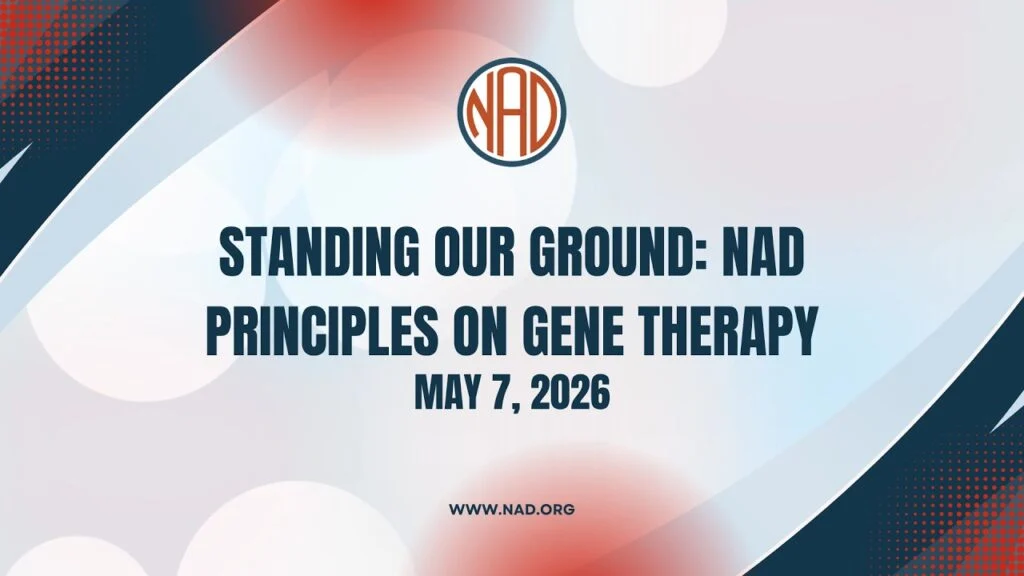
- May 7, 2026: The NAD formally adopts its "Standing Our Ground" principles, setting a clear policy boundary against the use of gene therapy as a tool to eliminate Deaf identity.
Broader Impact and Implications
The implications of the NAD’s stance extend well beyond the Deaf community. Bioethicists have long debated the "slippery slope" of human enhancement. By drawing a line between treating life-threatening syndromes and altering identity-forming traits, the NAD is joining a broader coalition of disability advocates—including those representing the neurodivergent and physical disability communities—who are challenging the assumption that the human genome should be "optimized" toward a narrow standard of functionality.
Dr. Elena Vance, a bioethicist specializing in genetic technology, notes that the NAD’s position is a critical challenge to the pharmaceutical industry. "When you commodify a ‘cure’ for a trait that is central to a person’s cultural identity, you are essentially creating a market for the removal of that identity. The NAD is forcing the scientific community to ask: just because we can do this, does it mean we should?"
Conversely, some in the medical establishment argue that the focus must remain on the individual’s right to access any available technology that might improve their daily life. "The challenge," says Dr. Marcus Thorne, a lead researcher in inner-ear gene therapies, "is finding the balance between respecting the cultural heritage of a community and fulfilling the Hippocratic duty to mitigate biological impairment when the patient desires such intervention."
Future Outlook and Policy Recommendations
The NAD has called upon federal agencies, including the FDA and the NIH, to mandate that any federally funded research regarding genetic modification of sensory organs includes an ethics board comprised of members of the affected community. Furthermore, the organization is pushing for a moratorium on research that seeks to "correct" hearing status in children without long-term longitudinal studies that assess the psychological and social impact on the child’s identity.
Looking forward, the NAD’s task force will serve as a permanent watchdog, monitoring scientific publications and patent filings that may threaten the sustainability of Deaf culture. The organization is also partnering with international human rights groups to lobby for a global declaration on genetic diversity, ensuring that the Deaf experience is recognized as a vital part of the human tapestry.
Conclusion: A Sustained Mandate
The NAD concludes its position paper with a firm assertion: the value of a human being is not determined by their ability to hear, but by their participation in the shared human experience. As gene therapy continues to advance, the organization insists that technological progress must not come at the expense of human diversity. By framing the conversation around ethical stewardship rather than Luddite opposition, the NAD has carved out a sophisticated, necessary space for the Deaf community in the high-stakes world of modern science. The fight for the right to exist, first articulated in 1880, has simply evolved to meet the challenges of the 21st century. The organization remains committed to a world where accessibility and inclusion are not dependent on medical conformity, but are recognized as fundamental human rights. Through its new task force, the NAD will continue to advocate for a future where technology serves the diversity of humanity, rather than attempting to homogenize it.