The revision of the manual marks a pivotal moment in the DfE’s digital strategy. Since its initial launch in September 2024, the manual has served as a foundational document for designers, product managers, and delivery leads. However, as the digital landscape evolved and user expectations shifted, the department recognized that providing information was not enough; the information had to be navigable, actionable, and aligned with the specific workflows of the professionals using it. The 2025 update represents a shift from a content-heavy "knowledge hub" model to a streamlined, journey-based approach that prioritizes the "how" and "why" of inclusive design.
Historical Context and the Drive for Digital Inclusivity
The journey toward the updated manual began shortly after the original version’s release in late 2024. While initial feedback from the civil service was largely positive, internal metrics indicated a discrepancy between content consumption and practical application. Data showed that while users were accessing the manual, they often struggled to find specific guidance during the high-pressure phases of product delivery. This prompted the DfE’s accessibility team to launch a deep-dive research phase involving practitioners across various disciplines, including user experience (UX) design, software engineering, and product management.
The context for this update is rooted in a broader national trend. In the United Kingdom, approximately 16 million people—nearly 24% of the population—live with a disability. For these individuals, digital accessibility is not a luxury but a fundamental requirement for accessing essential services, ranging from student finance applications to teacher training resources. The DfE, which manages a vast portfolio of digital services that impact millions of citizens daily, carries a significant responsibility to ensure no user is excluded due to poor design. By refining its internal manual, the DfE is effectively raising the floor for digital standards across its entire ecosystem.
A Chronology of Transformation: From Launch to Re-Launch
The timeline of the manual’s evolution reflects a disciplined approach to iterative design. In September 2024, the first iteration was published as a centralized guide for accessibility standards. By January 2025, the DfE began a four-month period of qualitative research, conducting usability testing and interviews with "power users" in design and delivery roles. These sessions revealed that the existing structure was unintentionally creating cognitive load, with users reporting that the "Knowledge Hub" felt disorganized.
By May 2025, the DfE accessibility team began the reorganization process, focusing on three core objectives: improving navigation, enhancing tool-based guidance, and simplifying the visual interface. This culminated in the July 21, 2025, release of the updated platform. This chronological progression mirrors the "Alpha, Beta, Live" lifecycle of government digital services, treating the manual itself as a product that requires constant maintenance and improvement based on evidence.
Structural Overhaul: Dismantling the Knowledge Hub
One of the most significant changes in the 2025 update was the total removal of the "Knowledge Hub" section. In the previous version, this section served as a catch-all for various articles, best practices, and research papers. User feedback characterized it as a "dumping ground," where valuable information was often buried under layers of non-intuitive categorization. Practitioners reported that they did not think in terms of "knowledge," but rather in terms of the tasks they were currently performing.
To rectify this, the DfE team migrated the content into parts of the manual that align with the user journey. For instance, guidance on how to write accessible content was moved directly into the sections focused on content design, while technical specifications for ARIA (Accessible Rich Internet Applications) labels were integrated into the development guidelines. This reorganization ensures that information is presented at the point of need. By mapping the manual to the way people actually think and search for information, the DfE has reduced the "time to find," an essential metric for busy product teams working under tight deadlines.
Enhancing Tools Guidance: Shifting from Installation to Implementation
The research phase highlighted a critical gap in how tools were presented. Previously, the manual featured a tools section that functioned primarily as a directory—a list of software and browser extensions with instructions on how to install them. However, users indicated that knowing how to install a tool like a screen reader or a contrast checker was secondary to knowing when and why to use it.
The updated manual addresses this by focusing on people’s needs rather than software specifications. Each tool listed is now accompanied by clear guidance on the specific problems it solves and the stage of the design process in which it is most effective. For example, instead of just providing a link to a color contrast analyzer, the manual now explains how to use that tool to meet WCAG 2.2 (Web Content Accessibility Guidelines) Level AA standards during the wireframing phase. This shift from technical instruction to pedagogical guidance helps build "accessibility literacy" among staff, moving the department away from a "checkbox" compliance culture toward a genuine understanding of inclusive outcomes.
User Interface and Experience: Simplifying the Homepage
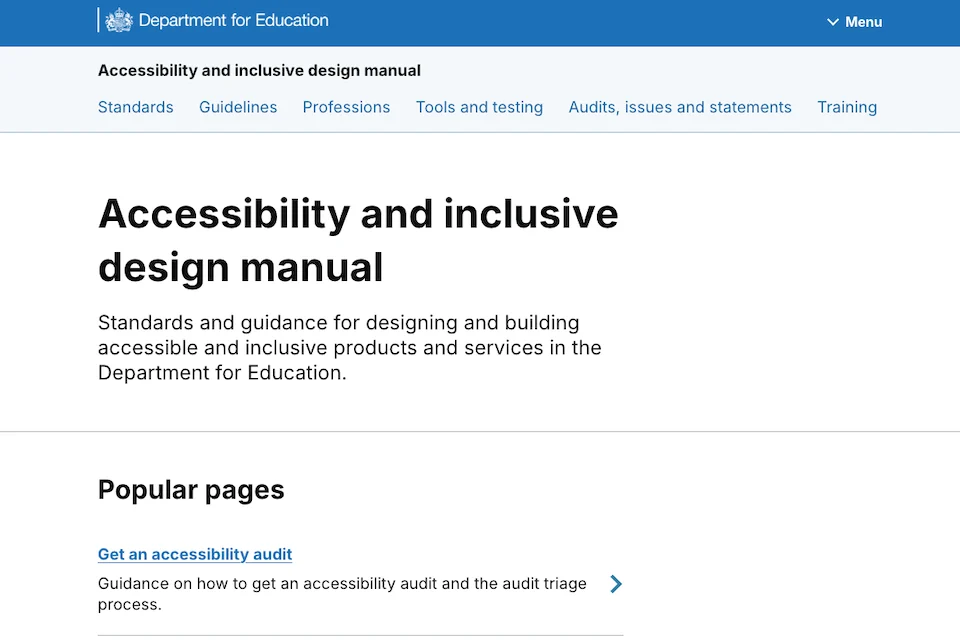
The visual and navigational architecture of the manual also underwent a dramatic simplification. The original homepage was identified as a barrier to entry; it featured a "busy" layout with excessive icons, decorative images, and a long-scroll format that overwhelmed users. Furthermore, the top-level navigation was criticized for being ambiguous, making it difficult for users to orient themselves within the site’s hierarchy.
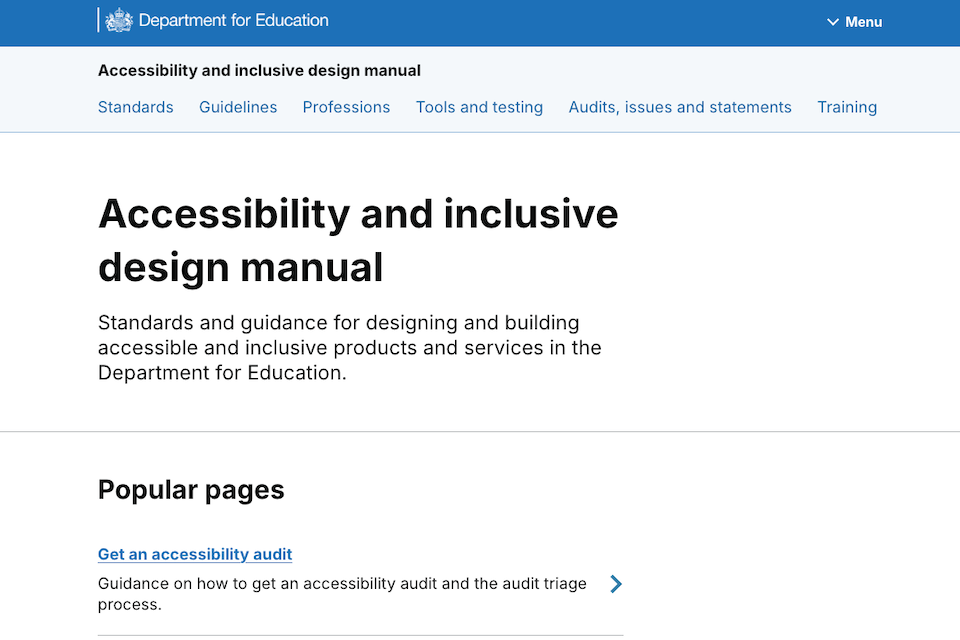
The July 2025 update introduced a minimalist design language that adheres closely to the GDS (Government Digital Service) Design System. The DfE removed unnecessary visual clutter, reduced the reliance on icons that did not add semantic value, and restructured the top navigation to reflect the primary user paths: "Guidance by Role," "Technical Standards," and "Testing Tools." This cleaner interface is not just an aesthetic choice; it is a functional one. A simpler homepage reduces the cognitive burden on the user, allowing them to focus on the content rather than the interface, which is a core tenet of accessibility in its own right.
Supporting Data and the Impact of Inclusive Design
The DfE’s decision to invest in these updates is supported by compelling data regarding the benefits of inclusive design. Research from the Cabinet Office has previously shown that services designed with accessibility at their core are 30% faster for all users to complete, not just those with disabilities. Furthermore, by providing clearer internal guidance, the DfE expects to reduce the amount of time spent on "remediation"—the costly process of fixing accessibility errors after a service has already been built.
Industry data suggests that it is up to 30 times more expensive to fix an accessibility issue in the post-production phase than it is to address it during the initial design phase. By equipping its teams with a more usable manual, the DfE is implementing a "shift left" strategy—moving accessibility considerations to the very beginning of the development lifecycle. This is expected to lead to significant cost savings and more robust digital services that are resilient to future regulatory changes.
Official Responses and Implications for the Public Sector
While official statements from the DfE emphasize the internal benefits of the update, the broader implications for the UK public sector are clear. The DfE’s willingness to iterate on its own standards sets a precedent for other departments, such as the Department for Work and Pensions (DWP) and the Ministry of Justice (MoJ), which manage similarly complex digital estates.
Accessibility advocates have praised the DfE for its transparency. By making the manual and the rationale behind its changes public, the department is contributing to a "shared language" of accessibility across the civil service. This collaborative approach is essential for achieving the goal of a truly inclusive "Digital Britain." Experts in the field of inclusive design have noted that the DfE’s focus on the "user journey" within the manual itself demonstrates a high level of maturity in digital practice, acknowledging that internal documentation is just as much a "user product" as a public-facing website.
Conclusion: A Living Resource for an Evolving Landscape
The updated Department for Education Accessibility and Inclusive Design Manual is more than just a document; it is a living resource that reflects the iterative nature of modern digital development. By listening to user feedback and analyzing how information is consumed, the DfE has transformed a static "knowledge hub" into a streamlined, effective tool for change.
As digital services continue to become the primary interface between the citizen and the state, the importance of inclusive design will only grow. The DfE’s proactive approach ensures that its teams are not just following the letter of the law, but are embracing the spirit of inclusivity. With the July 2025 update, the department has provided a blueprint for how large organizations can successfully manage the complex task of embedding accessibility into their DNA. The manual stands as a testament to the idea that in the world of digital government, the work of inclusion is never truly finished, but must be constantly refined to meet the needs of all people.