
The Persistent Challenge of Recurrent Laryngeal Nerve Injury
The recurrent laryngeal nerve (RLN), a critical structure responsible for vocal cord function, is inherently vulnerable to iatrogenic injury during thyroid surgery, whether performed through open or endoscopic approaches. Surgeons operating on the thyroid gland are acutely aware of the anatomical landmarks and potential pitfalls that can lead to inadvertent trauma to this nerve. While established techniques exist to minimize these risks, the introduction of minimally invasive endoscopic procedures presents unique challenges and necessitates a re-evaluation of safety protocols.
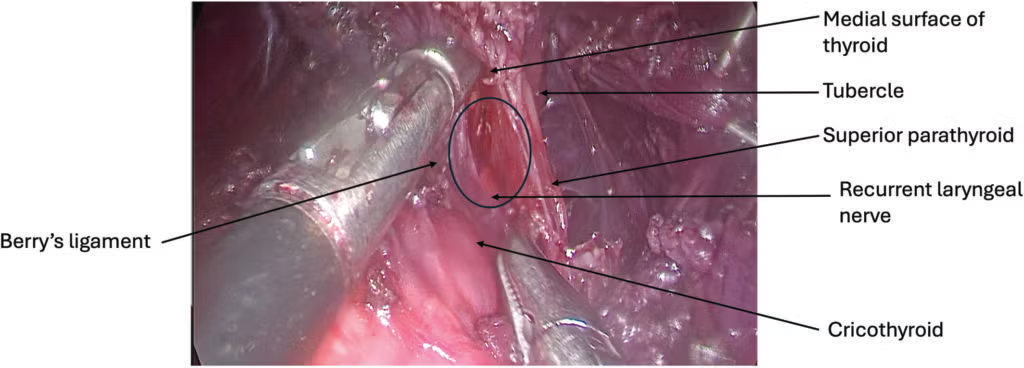
The standard lateral route endoscopic thyroidectomy has seen the application and description of CVS to safeguard the RLN. This article introduces and advocates for the application of this same rigorous visual standard to transoral endoscopic thyroidectomy by vestibular approach (TOETVA). The primary objective is to promote a standardized anatomical approach for the unambiguous visual identification of the RLN, offering a robust safety net for surgeons, especially in settings where advanced IONM systems may not be accessible or utilized.
Methodology: A Refined Approach to Anatomical Visualization
The surgical methodology employed in TOETVA, while adhering to standard principles, incorporates specific steps designed to achieve the critical view of safety for RLN identification. The procedure commences with the insertion of the telescope and working instruments, followed by the meticulous creation of a safe working space. A crucial early step involves the identification and division of the linea alba to expose the trachea and isthmus. Subsequently, the isthmus is divided, and dissection proceeds within the sternothyroid-laryngeal triangle.
A key maneuver involves the visualization of the external branch of the superior laryngeal nerve (EBSLN) and superior pole vessels after the division of the sternothyroid muscle. The dissection then progresses along the medial surface of the superior pole, separating it from the cricothyroid muscle to clearly delineate the medial and lateral thyroid spaces. By retracting the thyroid gland in a supero-lateral direction, the crucial vascular structures are exposed.
The EBSLN, which typically crosses the superior thyroid artery either superiorly or inferiorly, is meticulously safeguarded. The superior thyroid artery and its branches are then ligated using an ultrasonic device, a method known for its hemostatic efficiency and minimal thermal spread.
Achieving the Critical View of Safety in TOETVA
The creation of the critical view of safety in TOETVA involves a systematic, five-step process designed to provide an unimpeded and conclusive anatomical assessment. While the original article did not explicitly detail these five steps, a comprehensive understanding of the CVS principle in this context would entail:
- Exposing the Posterior Aspect of the Thyroid Lobe: This involves dissecting the gland away from the surrounding structures to reveal its posterior surface and its relationship with the RLN.
- Identifying the Entry Point of the RLN into the Larynx: Locating where the nerve enters the larynx is paramount to understanding its trajectory and avoiding accidental transection.
- Visualizing the Terminal Branches of the Superior Thyroid Artery: These vessels are often in close proximity to the RLN, and their clear identification and management are crucial.
- Confirming the Absence of Other Vital Structures: Ensuring that no other critical nerves (e.g., external branch of the superior laryngeal nerve) or parathyroid glands are obscured or at risk.
- Demonstrating the RLN in its Entirety from its Origin to its Laryngeal Entry: This final step ensures that the nerve has been traced comprehensively, leaving no ambiguity about its course and relationship to the surgical field.
Thyroid Lobectomy and Specimen Management
Following the establishment of the CVS and the meticulous management of vital structures, the thyroid lobectomy proceeds. The inferior pole of the lobe is dissected free from its attachments. Medial traction on the upper portion of the lobe facilitates visualization of the inferior parathyroid gland, a critical step in preserving parathyroid function. Lateral traction, conversely, aids in the identification of the inferior thyroid vein, situated just lateral to the trachea. This vein is then carefully sealed and divided.
Upon completion of the lobectomy, the specimen is removed, and the surgical cavity is thoroughly inspected for any signs of bleeding. A significant advantage of this endoscopic approach, as described, is the routine omission of drainage in the thyroid bed, contributing to a less invasive post-operative recovery.

Study Design and Patient Population
This study represents a retrospective analysis conducted within the endocrine surgery unit of a tertiary teaching hospital in Central India. The data collection period spanned from January 2022 to October 2023, encompassing a total of 36 patients who underwent TOETVA. Prior to the commencement of the study, approval was secured from the Institutional Ethics Committee, and written informed consent was obtained from all participating patients.
The cohort comprised 34 females and two males, with a median age of 32 years, ranging from 22 to 47 years. All patients presented with benign thyroid nodules, exhibiting a mean size of 4.2 cm, with a standard deviation of 1.8 cm. The surgical intervention performed on all patients was hemithyroidectomy. Notably, this cohort underwent TOETVA without the utilization of intraoperative nerve monitoring.
Results: Unambiguous RLN Identification and Functional Preservation
The application of the critical view of safety proved highly effective in the study population. In all 36 patients, the CVS allowed for clear visual identification of the recurrent laryngeal nerve. This anatomical clarity was achieved without the reliance on IONM, underscoring the power of a standardized visual approach.
Post-operatively, all patients underwent standard laryngoscopy assessment at 48 hours to evaluate vocal cord function. The results were exceptionally positive, with no instances of recurrent laryngeal nerve palsy reported among any of the patients. This outcome strongly suggests that the adopted CVS strategy effectively prevented iatrogenic injury to the RLN during transoral endoscopic thyroidectomy.
Analysis and Implications: A Paradigm Shift in Endoscopic Thyroid Surgery Safety
The findings of this study carry significant implications for the practice of endoscopic thyroid surgery, particularly for the TOETVA approach. The recurrent laryngeal nerve’s vulnerability has historically been a major concern, leading to the development of various intraoperative monitoring techniques. While IONM is an invaluable tool, its availability and cost can be prohibitive in certain healthcare settings. The success of this study, demonstrating successful RLN identification and preservation using a purely anatomical CVS approach in the absence of IONM, offers a compelling alternative.
The "critical view of safety" principle, originally established for gallbladder surgery, has proven its adaptability and efficacy in the complex anatomical landscape of the thyroid. By meticulously adhering to a defined set of dissection steps and achieving a specific visual endpoint, surgeons can gain a high degree of confidence in their ability to identify and avoid injury to the RLN. This standardized approach not only enhances patient safety but also contributes to a more predictable and reproducible surgical outcome.
The implications of this research extend to the training of new surgeons. A robust anatomical CVS can serve as a foundational element in their education, equipping them with the visual acuity and systematic approach necessary for safe thyroid surgery. Furthermore, in resource-limited settings, the ability to perform safe thyroidectomies without expensive monitoring equipment could significantly expand access to advanced surgical care.
Future Directions and Considerations
While this retrospective study presents encouraging results, further prospective research is warranted to validate these findings on a larger scale and across diverse patient populations. Long-term follow-up data would be beneficial to assess any delayed complications or functional changes. The development of detailed, step-by-step anatomical guides and visual aids for the TOETVA CVS could further facilitate its widespread adoption and standardize its application.
The integration of advanced imaging technologies, such as augmented reality, could potentially enhance the visualization of anatomical structures during endoscopic procedures, further refining the critical view of safety. However, the fundamental principle of meticulous dissection and clear anatomical identification, as advocated by the CVS, remains the cornerstone of safe surgical practice.
In conclusion, the successful application of the critical view of safety in transoral endoscopic thyroidectomy by vestibular approach, as demonstrated in this study, represents a significant advancement in minimizing the risk of recurrent laryngeal nerve injury. This anatomical approach offers a reliable and accessible method for ensuring surgical safety, particularly in scenarios where intraoperative nerve monitoring is not feasible, thereby enhancing patient outcomes and promoting a higher standard of care in minimally invasive thyroid surgery.