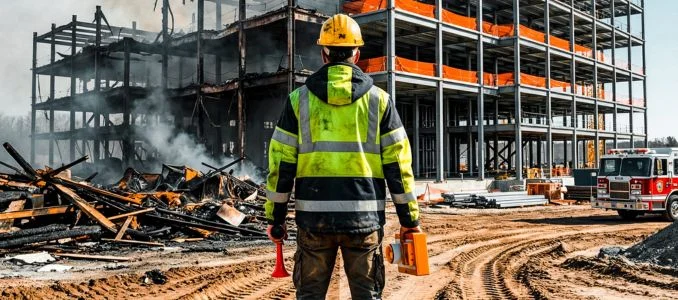
As project footprints expand and the complexity of building materials increases, the report asserts that the "minimum-code" mindset—where contractors do only what is legally required to pass inspection—is no longer sufficient to protect the lives of thousands of workers or the financial integrity of high-value developments.
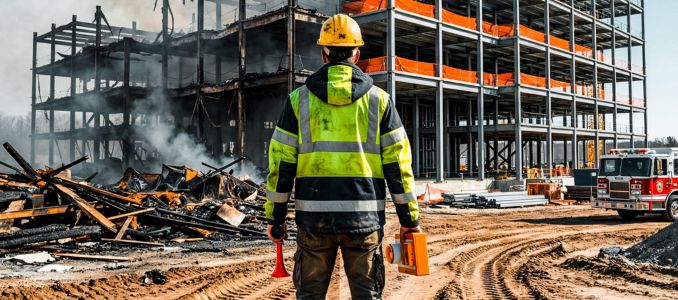
The Evolution of NFPA 241 and the Compliance Crisis
NFPA 241, the Standard for Safeguarding Construction, Alteration, and Demolition Operations, serves as the primary regulatory framework for fire prevention on active jobsites. Despite its importance, the report highlights a fragmented adoption landscape. Because NFPA codes are adopted at the state or local level, there is no uniform national enforcement. This lack of consistency means that a contractor working in one jurisdiction may face stringent, high-tech safety requirements, while a similar project across a state line operates under decades-old standards that fail to account for modern construction risks.
James Pecz, Ramtech’s North America lead and a member of the NFPA 72/241 Temporary Fire Alarm Task Group, emphasizes that this reliance on outdated editions of the code is a systemic failure. "Reliance on older editions or minimum-code compliance leaves sites exposed, especially as projects become larger and more complex," Pecz stated. "Wireless detection and notification systems can bridge these gaps."
The industry is currently bracing for the 2026 revision of NFPA 241, which is expected to introduce rigorous new standards. These anticipated changes include specific guidance for the increasing use of mass timber, a material that presents unique fire-loading profiles compared to traditional steel and concrete. Additionally, the revised code is expected to place a heavier emphasis on site security and provide a more granular definition of the Fire Prevention Program Manager (FPPM) role, ensuring that a single point of accountability exists on every project to oversee safety compliance.
The Complexity of Modern Jobsites
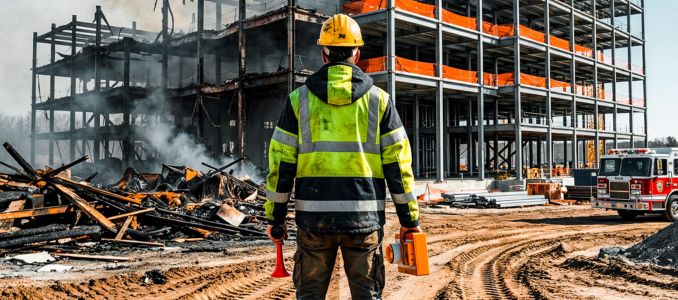
Modern mega-projects, such as the $1 billion Hudson’s Detroit development or the $1.3 billion resort project detailed in the report, represent a new class of risk. These sites often span dozens of floors, host hundreds of subcontractors simultaneously, and involve a constant rotation of materials and personnel. In such environments, traditional, hardwired fire alarm systems are frequently impractical or impossible to install during the early phases of construction.
Kyle Jarvenpaa, vice president of business development at Space Age Electronics, notes that the sheer scale of modern projects renders legacy communication methods obsolete. "The real test isn’t just knowing the code—it’s making sure every worker hears the alarm, every floor is cleared, and safety teams have real-time visibility," Jarvenpaa said.
When a fire ignites on a high-rise construction site, the primary obstacles to safety are the lack of finished egress routes, the presence of flammable debris, and the difficulty of communicating an evacuation order across a massive, noisy, and constantly shifting environment. Without a robust, site-wide wireless detection system, minutes can be lost—minutes that are often the difference between a minor incident and a total loss of life or property.

Technological Integration as a Safety Imperative
The Ramtech report underscores that wireless fire detection is no longer a luxury but a necessity. Authorities Having Jurisdiction (AHJs) are increasingly acknowledging this reality. When permanent life-safety systems—such as smoke detectors or sprinkler systems—are not yet operational, wireless temporary systems provide an immediate, reliable solution that can be moved as the building structure rises.
The case study involving a $1.3 billion California resort development serves as a prime example of this strategy. By deploying more than 350 wireless devices across the site, the construction team was able to achieve a level of coverage that would have been impossible with a traditional, wired setup. These systems allow for instantaneous, automated alerts that reach workers in remote corners of a site, ensuring that the evacuation process begins before smoke or fire becomes visible to the naked eye.
Anna Kahl, a project safety professional who worked on the Hudson’s Detroit development, emphasizes the psychological and logistical importance of these systems. "A coordinated alarm system that reached all workers at the same time was vital," Kahl noted. By removing the reliance on manual "fire watch" personnel—who are subject to human error, fatigue, and limited sightlines—wireless systems provide a consistent, technology-driven layer of protection that operates 24/7.

Implications for the Future of Construction Safety
The findings in the Ramtech report suggest that the construction industry is at a crossroads. As projects continue to trend toward greater verticality and increased complexity, the margin for error continues to shrink. The cost of a fire on a major construction site is not merely the loss of materials or the delay in the project schedule; it is the potential for catastrophic injury and the associated litigation, insurance premium hikes, and reputational damage that can cripple a construction firm.
Furthermore, the integration of technology into fire safety has broader implications for how insurance providers view construction risk. As data becomes more available, it is likely that insurers will begin to mandate, or at least heavily incentivize, the use of advanced wireless monitoring systems. Companies that continue to adhere to the bare minimum requirements may soon find themselves priced out of the market or unable to secure coverage for large-scale developments.
The upcoming 2026 NFPA 241 revision is expected to act as a catalyst for this transition. By clarifying the responsibilities of the Fire Prevention Program Manager and setting clearer standards for mass timber and high-rise safety, the updated code will likely force a industry-wide reckoning. Contractors who prioritize early adoption of these standards will be better positioned to navigate the evolving regulatory landscape and, more importantly, ensure the safety of their workforce.

A Call for Industry-Wide Standardization
The movement toward better fire safety is not just a technological challenge but a cultural one. The report highlights that "fragmented adoption" remains the primary barrier to progress. If state and local jurisdictions do not move in tandem to adopt the latest NFPA standards, the safety of workers will remain dependent on their geography rather than a universal standard of care.
For the construction industry, the message is clear: the era of reactive fire safety is coming to an end. The integration of proactive, wireless detection systems, paired with a commitment to exceeding minimum code requirements, represents the new standard for professional project management. As Ramtech continues to expand its footprint in the United States—marked by the recent opening of its North Carolina office—the firm and other technology leaders are signaling that the infrastructure for a safer industry is already here.
Ultimately, the goal of these advancements is to ensure that every worker on a site, regardless of the project’s size or the construction phase, has the same level of protection. By shifting from a culture of "minimum-code" compliance to one of proactive risk management, the construction sector can mitigate the dangers of an increasingly complex built environment. The data provided in the report, combined with the real-world experiences of professionals like Pecz, Jarvenpaa, and Kahl, provides a roadmap for that transformation. Whether the industry moves quickly enough to meet the challenges of 2026 and beyond remains to be seen, but the necessity for change has never been more apparent.