
The Escalating Threat of Magnetic Foreign Bodies in Children
The allure of magnetic jewelry, from decorative nose rings and earrings to educational "neodymium" magnet sets, has led to a concerning rise in pediatric ingestions and aspirations. These magnets, often small but exceptionally strong, pose a dual threat. When ingested, if multiple magnets are swallowed at different times, they can attract each other across intestinal lumens. This magnetic force can pinch, tear, and perforate the bowel wall, leading to a surgical emergency. When aspirated into the airway, their magnetic properties can cause them to adhere to each other and to surrounding tissues, complicating removal and increasing the risk of airway damage. Data from the Nationwide Children’s Hospital, for instance, has shown a dramatic increase in emergency department visits for magnetic foreign body ingestions, with a significant proportion involving children under the age of six, though this case highlights the continued risk in older pediatric populations. Between 2017 and 2021, there was a reported 50% increase in emergency department visits for magnetic ingestions nationwide, underscoring the public health relevance of this issue.
A Case of Unexpected Aspiration: The 13-Year-Old Patient
The patient, a 13-year-old female, presented to the emergency department experiencing chest discomfort following an accidental inhalation of the backing of her magnetic nose ring. Despite the discomfort, she reported no difficulty breathing or audible wheezing. Upon arrival, her vital signs were stable, and her oxygen saturation was within normal limits. Initial diagnostic imaging, including anteroposterior and lateral chest X-rays, revealed a 3mm x 4mm metallic foreign body located in the right lower lobe. Crucially, an expiratory film demonstrated the object to be approximately 0.5 cm from the diaphragm, indicating its deep intrabronchial placement. Given the precise location of the metallic foreign body deep within the lung’s bronchial tree, the medical team deemed operative intervention to be the most appropriate course of action.
The Chronology of Intervention: From Diagnosis to Novel Retrieval
The operative process commenced with the induction of general anesthesia. A thorough direct laryngoscopy was performed, confirming no foreign body was lodged in the oropharynx or hypopharynx. Following this, a 6.0 rigid bronchoscope was introduced into the trachea and carefully advanced into the distal trachea and segmental bronchi of both lungs.
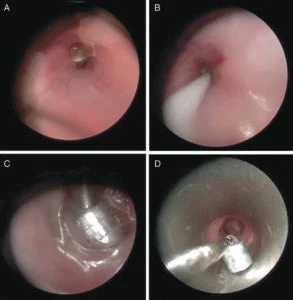
Upon examination of the right lung, a small metallic foreign body was visualized within a distal tertiary bronchus. The diminutive size of the bronchus and the precise location of the foreign body presented a significant challenge. Standard endoscopic instruments, including conventional graspers, proved ineffective due to the foreign body’s inaccessible position. Attempts to dislodge and retrieve the object using a salivary wire basket and a ureteral stone retrieval basket also failed to achieve engagement. Further complicating matters, an attempt to pass a 2 French Fogarty embolectomy catheter, a tool typically used for clearing vascular obstructions, was unsuccessful. The catheter’s diameter, even at its smallest, was too large to maneuver past the foreign body and into the tertiary bronchus.
The clinical team then pivoted to exploring alternative, less conventional retrieval methods. A thorough inspection of available flexible bronchoscopy equipment revealed a critical tool: ferromagnetic flexible rat tooth biopsy forceps. These specialized forceps are designed to be atraumatic and are capable of being magnetized. In a moment of innovative problem-solving, the ferromagnetic forceps were advanced through the rigid bronchoscope and into the tertiary bronchus. The inherent magnetic field of the aspirated nose ring backings was sufficient to attract and adhere to the ferromagnetic instrument. This magnetic attraction allowed for the safe and controlled retrieval of the foreign body.

Upon successful removal, the foreign body was identified as three small, interconnected magnetic nose ring backings. A subsequent repeat bronchoscopy was performed to ensure no residual foreign bodies remained and to assess for any iatrogenic injury to the airway. The examination confirmed a clear airway and no signs of trauma. The patient recovered uneventfully from the procedure and was discharged from the hospital postoperatively without any complications.
Analyzing the Implication: Beyond Traditional Methods
This case underscores the evolving landscape of foreign body aspiration in pediatrics. The increasing prevalence of magnetic jewelry necessitates a preparedness for the unique challenges these objects present. Traditional bronchoscopic techniques, while highly effective for many foreign bodies, can be rendered inadequate by the specific properties of magnets, particularly their ability to adhere to each other and to their surroundings. The distal location of the foreign body in this case, within a tertiary bronchus, further amplified the difficulty. Tertiary bronchi are small airways, making it challenging for rigid bronchoscopes and conventional grasping tools to reach and manipulate objects without causing damage.
The successful utilization of ferromagnetic flexible biopsy forceps represents a significant advancement in the interventional bronchoscopy toolkit for managing magnetic foreign bodies. This technique leverages the inherent properties of the foreign object itself to facilitate its removal, bypassing the limitations of purely mechanical grasping methods. The adaptability of flexible instruments to navigate the tortuous and delicate pathways of the smaller airways is also a key factor in their utility.
Expert Commentary and Broader Impact
While direct statements from the treating physicians are not available in the original report, the authors’ conclusion highlights their recognition of the case’s uniqueness and its implications for clinical practice. They emphasize that ferromagnetic flexible bronchoscopic instruments provided a safe and effective solution for retrieving these challenging foreign bodies. This approach offers a paradigm shift in how clinicians might approach similar cases in the future.
The implications of this case extend beyond the immediate medical intervention. It serves as a critical reminder for parents and caregivers about the potential dangers of magnetic jewelry and small, powerful magnets for young children and adolescents. Public health campaigns and educational initiatives aimed at raising awareness regarding safe storage and use of such items are crucial. Furthermore, this case may prompt further research and development into specialized retrieval devices tailored for magnetic foreign bodies, potentially including more advanced magnetic retrieval systems or bio-compatible, non-magnetic alternatives for jewelry.
The successful management of this 13-year-old patient highlights the critical importance of a prepared and adaptable medical team. The ability to recognize the limitations of standard procedures and to innovate with available technology is paramount in pediatric emergencies. As magnetic devices continue to permeate consumer products, the medical community must remain vigilant and equipped to address the associated risks, ensuring the safety and well-being of young patients. The story of the "Lord of the Magnetic Rings" is not just about a single successful retrieval, but about the ongoing evolution of pediatric airway management in the face of emerging technological and societal trends.