
The Widening Gap in Rural Otolaryngology Access
The core of the problem lies in the stark underrepresentation of otolaryngologists in rural settings. Projections paint a grim picture: by 2030, urban areas are expected to have approximately 2.9 otolaryngologists per 100,000 population. In stark contrast, rural areas are forecasted to see a decline, with the number of practicing rural otolaryngologists potentially dropping to as low as 0.2 to 0.7 per 100,000. This impending shortage threatens to widen the existing chasm in care access, leaving rural populations with even fewer options for essential ear, nose, and throat services.
The factors influencing an otolaryngologist’s decision to practice in a rural versus urban setting are multifaceted, encompassing clinical preferences, academic aspirations, financial considerations, personal life choices, regional opportunities, and the quality of their residency training. While many of these factors are beyond the direct control of residency programs, a crucial point of intervention lies in the recruitment of trainees who express a commitment to serving underserved rural areas. However, emerging concerns suggest that the current otolaryngology residency selection process, particularly through the Standardized Letter of Recommendation (SLOR), may inadvertently be a barrier to this critical recruitment.

The Standardized Letter of Recommendation: A Double-Edged Sword
Introduced in 2012 by the Otolaryngology Program Directors Organization, the SLOR was intended to streamline and objectify the competitive residency application review process. It features 12 questions, including 10 scale-based assessments and an open-ended commentary section, designed to evaluate an applicant’s knowledge, work ethic, interpersonal skills, research potential, and relationship with the recommender. While it has been shown to reduce review time and mitigate certain biases, such as gender bias, its utility in differentiating candidates has been questioned.
A significant point of contention is the question: "Commitment to Academic Medicine – Likelihood of pursuing a research/academic career after residency." This query, while seemingly aimed at identifying future leaders in research and education, may be inadvertently penalizing applicants who are passionate about providing comprehensive clinical care in rural communities. Comprehensive otolaryngologists are essential for rural settings, where they must diagnose, triage, and manage a broad spectrum of conditions, often with limited subspecialty support. Their clinical experience, while valuable, may not translate into the same volume of traditional academic research output as their urban counterparts, who are often embedded in larger academic institutions with dedicated research infrastructure and protected time.
Evidence of Potential Bias in SLOR Assessment
Studies evaluating the SLOR have yielded findings that raise concerns about its impact on applicant selection. One retrospective analysis of a single application cycle indicated that responses to scale-based questions were heavily skewed towards higher scores, making it difficult to distinguish between candidates. Another study found no correlation between a letter writer’s perception of an applicant’s commitment to academic medicine and objective measures such as test scores, research experience, or other academic achievements. These findings suggest that the SLOR, particularly the academic commitment question, may not be an accurate predictor of an applicant’s future success or suitability for a particular practice setting.

Furthermore, the clustering of "Commitment to Academic Medicine" scores around the 85th percentile on the SLOR suggests a potential pressure on applicants and letter writers to portray a strong inclination towards academic pursuits to enhance their chances of matching. This creates a scenario where individuals genuinely interested in comprehensive, community-based practice, particularly in rural areas, might feel compelled to emphasize academic interests they do not fully possess, or conversely, may be perceived as less desirable if their primary focus is on clinical service.
The implications of this potential bias are profound. If the SLOR is indeed favoring applicants with a perceived inclination towards academic medicine, it could be indirectly promoting the recruitment of fellowship-trained, urban-based otolaryngologists over the generalist practitioners that rural areas desperately need. This aligns with data from the 2022 Otolaryngology Workforce Study, which indicated that nearly all academic otolaryngologists practice in urban settings. The system, therefore, risks perpetuating and even amplifying the rural-urban divide in otolaryngology care.
The Need for Comprehensive Care in Rural Settings
Rural otolaryngologists are the backbone of care delivery in underserved regions. They are often the first point of contact for patients with a wide range of conditions, from common ear infections and hearing loss to more complex cases of head and neck cancer. Their role extends beyond simple diagnosis and treatment; they are crucial in triaging patients, managing chronic conditions, and providing essential surgical interventions. The unique challenges of rural practice, including the vast distances patients may need to travel and the limited availability of advanced diagnostic and treatment technologies, necessitate a highly adaptable and clinically adept physician.
While academic contributions are vital for the advancement of any medical specialty, the primary goal of graduate medical education should be to train physicians who can meet the diverse healthcare needs of the entire population. This includes ensuring an adequate supply of clinically oriented, comprehensive otolaryngologists who are prepared and willing to serve in rural and underserved areas. Overemphasis on academic metrics within the selection process risks overlooking the critical need for these community-focused practitioners.
Addressing the Rural Shortage: A Call for Reform
The potential for the SLOR to disadvantage applicants committed to rural practice presents a clear area for intervention. Experts suggest that removing the question concerning "Commitment to Academic Medicine" from the SLOR could be a significant step towards rebalancing the residency selection process. This change would allow the otolaryngology graduate medical education system to acknowledge and cater to a broader spectrum of career pathways and the diverse care needs across the United States.
Such a reform would signal a commitment to training a workforce that reflects the nation’s demographic and geographic diversity. By valuing all career aspirations – whether academic research, fellowship specialization, or comprehensive community-based practice – residency programs can better serve the entirety of the American population. The focus should shift towards identifying and nurturing individuals who are passionate about practicing otolaryngology in all settings, ensuring that rural communities are not left behind in the pursuit of equitable healthcare.
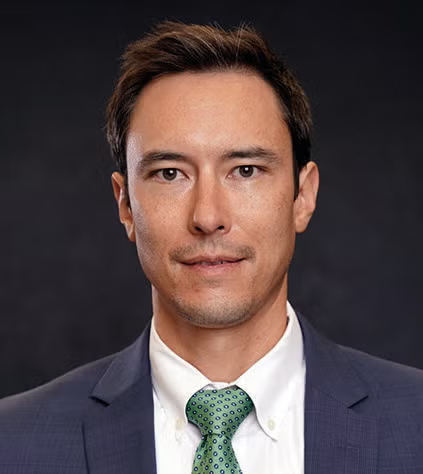
The American Academy of Otolaryngology-Head and Neck Surgery (AAO-HNS) has acknowledged the workforce challenges, with its workforce task force chair, Dr. Tompkins, highlighting the disparities. Initiatives aimed at addressing the rural otolaryngologist shortage must consider all facets of the pipeline, from medical school recruitment to residency selection and beyond.
Broader Implications and Future Directions
The issue of rural healthcare disparities is not unique to otolaryngology; it is a pervasive challenge across numerous medical specialties. However, the specific mechanisms within specialty training programs, such as the SLOR, offer tangible points for reform. By critically examining and potentially revising selection tools, the medical community can proactively work towards a more equitable distribution of healthcare professionals.
The long-term implications of failing to address the rural otolaryngologist shortage are substantial. Without a sufficient number of trained specialists in these areas, rural patients will continue to face delayed diagnoses, suboptimal treatment outcomes, and increased morbidity and mortality. This not only impacts individual health but also places a greater burden on primary care physicians and emergency services in rural areas.
Moving forward, a multi-pronged approach is necessary. This includes:
- Residency Program Initiatives: Actively recruiting and supporting residents interested in rural practice through targeted mentorship, rural rotation opportunities, and potentially financial incentives.
- Curriculum Development: Ensuring that residency curricula adequately prepare physicians for the broad scope of practice required in rural settings, including comprehensive surgical skills and management of complex cases.
- Policy and Advocacy: Engaging with policymakers to support legislation and funding initiatives that incentivize practice in underserved areas and address the underlying socioeconomic factors contributing to rural health disparities.
- Continued Research: Further investigation into the SLOR’s impact, as well as other factors influencing rural physician distribution, is crucial for evidence-based reform.
Ultimately, the goal is to cultivate an otolaryngology workforce that is not only academically proficient but also deeply committed to serving all communities, ensuring that geographic location does not dictate access to quality healthcare. The SLOR, as a tool within the residency selection process, holds the potential to either perpetuate or help alleviate these critical disparities, making its careful consideration and potential revision a vital step towards a more equitable future for otolaryngology patient care across the nation.