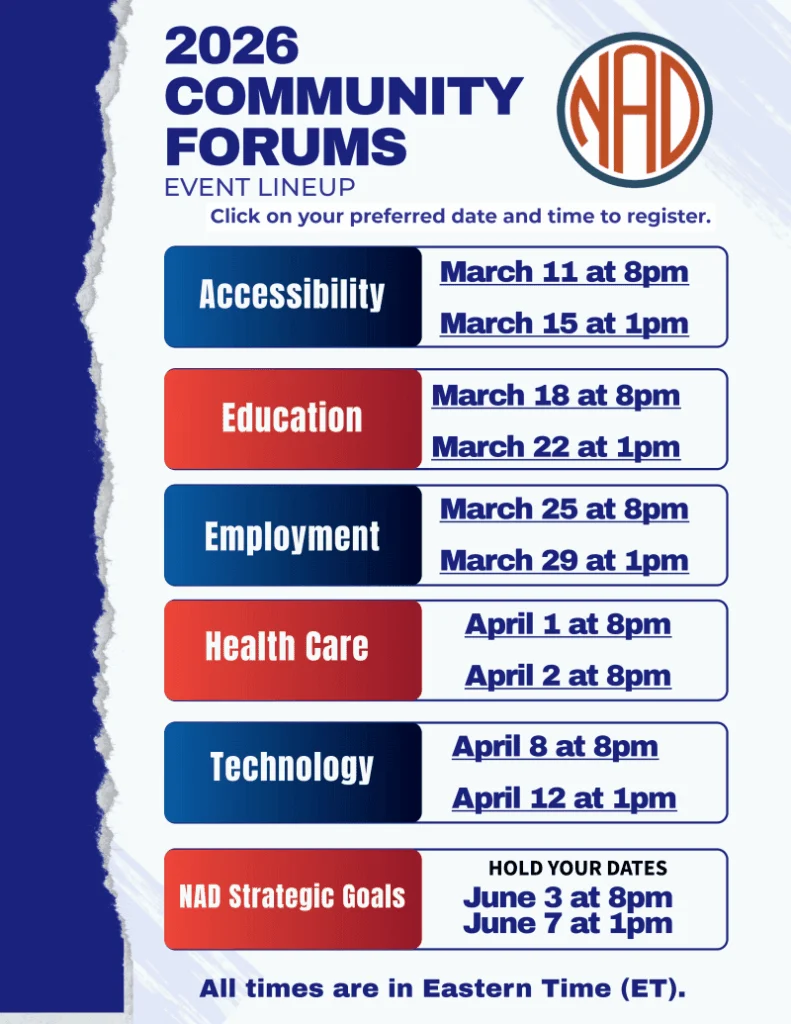
The Strategic Objective of the Forums
The NAD serves as the nation’s premier civil rights organization of, by, and for deaf and hard-of-hearing individuals. As the organization prepares for its biennial national conference, the board of directors has identified a need to bridge the gap between national-level policy goals and the day-to-day realities of its members. NAD Board Secretary Milmaglyn Morales emphasized that these forums are not merely listening sessions but are intentional platforms for identifying the most pressing issues facing the community.
The forums are structured around five core pillars: Accessibility, Technology, Education, Employment, and Healthcare. Each of these pillars represents an area where systematic barriers continue to impact the quality of life for the Deaf community. The goal of these sessions is to gather qualitative data that will inform the resolutions, policy priorities, and advocacy strategies adopted by the NAD Board and delegates at the 2026 conference.
Historical Context and Evolution of NAD Advocacy
The NAD has historically functioned as a catalyst for legislative change and a guardian of the Americans with Disabilities Act (ADA). Since its founding in 1880, the organization has navigated shifting social landscapes, from the integration of deaf students in mainstream education to the modern challenges posed by the rapid digitization of society.
In recent decades, the NAD has faced a rapidly changing technological landscape. While advancements in Video Relay Service (VRS) and closed captioning have improved connectivity, the digital divide remains a significant concern. The shift to remote work and tele-education, accelerated by the global pandemic, highlighted both the promise and the peril of modern digital tools. By holding these virtual forums, the NAD is leveraging the very technology it advocates for, ensuring that geography is not a barrier to participation in national governance. This reflects a maturation in the organization’s approach: shifting from purely top-down policy setting to a more decentralized, grassroots-informed strategy.
Breakdown of Key Focus Areas
The five focus areas selected for the 2026 strategic planning sessions represent the most critical sectors of public life.

Accessibility: This pillar encompasses the physical and digital infrastructure of the nation. It involves ongoing efforts to ensure that public spaces, government communications, and entertainment media are fully accessible through sign language interpretation and real-time captioning.
Technology: As artificial intelligence and machine learning become embedded in daily life, the NAD is increasingly concerned with the development of sign-language-aware software and the mitigation of bias in automated captioning tools. Ensuring that emerging technologies are accessible to the Deaf community from the design phase is a primary concern.
Education: The educational landscape for deaf children remains a perennial challenge. The NAD has consistently advocated for early language acquisition, the provision of qualified sign language interpreters in classrooms, and the preservation of residential schools for the deaf as vital cultural and educational hubs.
Employment: Despite federal protections, the unemployment and underemployment rates for the Deaf community remain significantly higher than those of the general population. The forums will explore systemic barriers to workplace inclusion, including the lack of reasonable accommodations and pervasive misconceptions about the capabilities of deaf employees.
Healthcare: Health equity is a major priority. The NAD has documented numerous instances of systemic failure in healthcare settings, where patients are denied qualified medical interpreters, leading to misdiagnoses and inadequate care. The forums will seek to gather testimonies to bolster ongoing litigation and policy advocacy in this sector.
Data-Driven Advocacy and Community Impact
While the NAD is currently collecting qualitative data through these forums, the organization’s advocacy is backed by a body of demographic and economic data. According to the National Institute on Deafness and Other Communication Disorders (NIDCD), approximately 15 percent of American adults (37.5 million) aged 18 and over report some trouble hearing. When considering the specific population that utilizes American Sign Language (ASL), the numbers represent a significant linguistic and cultural minority that requires tailored public services.
The economic implications of these forums are substantial. By aligning the organization’s strategic goals with the actual needs of the community, the NAD can more effectively target its resources toward high-impact advocacy. For instance, if the forums reveal a consistent pattern of failure in telehealth accessibility, the NAD can allocate its legal and lobbying budget to address digital health regulations. This approach allows the organization to maximize its impact, ensuring that donor funds and membership dues are utilized where they are most urgently needed.

The Role of Delegates and the 2026 Conference
The feedback gathered from these sessions will be synthesized into a report for the NAD delegates. These delegates, representing various state associations and affiliate organizations, are the voting members who determine the official position of the NAD. The 2026 conference in San Francisco will serve as the venue where these positions are codified.
The strategic planning cycle initiated by these forums is essential for democratic accountability. By providing a clear timeline—moving from individual engagement to organizational strategy—the NAD ensures that the leadership remains responsive to the constituency. This structure also helps in identifying emerging leaders within the community who may go on to represent their states as delegates, thereby fostering the next generation of advocacy.
Official Stance and Community Participation
The NAD has encouraged all members, regardless of their level of prior involvement, to register for these sessions. The organization has emphasized that the diversity of the community—including intersectional experiences related to race, gender, and socio-economic status—is vital to a comprehensive strategy.
"Your voice matters," the organization noted in its official call to action. By facilitating these conversations, the NAD is attempting to preempt the challenges of the next decade rather than merely reacting to them. Experts in disability law and civil rights advocacy have noted that such initiatives are essential for maintaining the relevancy of national advocacy groups. As the population ages and the prevalence of hearing loss increases, the influence of the Deaf community in national discourse is expected to grow, provided that the community remains organized and focused on shared objectives.
Implications for Future Legislation
The insights gained from these forums are likely to influence future lobbying efforts on Capitol Hill. The NAD has a long history of influencing federal policy, including the passage of the 21st Century Communications and Video Accessibility Act. Future legislative priorities may include strengthening protections for tele-health access, ensuring the inclusion of Deaf individuals in emergency management planning, and mandates for more robust captioning standards in streaming media.
By grounding its advocacy in the lived experience of its members, the NAD strengthens its legal standing in federal court cases. Courts often look to the expressed needs and priorities of a protected class when evaluating the reasonableness of accommodations or the impact of discriminatory practices. Consequently, the data collected during these forums could serve as critical evidence in future civil rights litigation.
Conclusion
The launch of the NAD 2026 Community Forums represents a significant milestone in the organization’s long-standing mission. By prioritizing direct engagement and structural transparency, the NAD is positioning itself to navigate the complex social and technological challenges of the coming years. As members prepare to register and participate in these sessions, they are contributing to a legacy of advocacy that has shaped the civil rights landscape for over a century. The success of these forums will ultimately be measured by the ability of the NAD to translate the concerns of its members into actionable, legislative, and social change at the 2026 conference and beyond. Stakeholders are encouraged to monitor the official NAD channels for specific scheduling updates and registration protocols as the organization moves toward its next major strategic summit.