

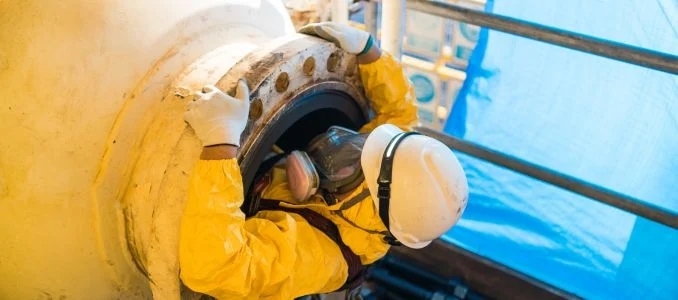
Federal investigators have issued 12 serious citations against PCE Petroleum Contractors Enterprises Inc., a Florida-based firm, following a fatal workplace accident that claimed the life of a laborer inside a fuel storage tank. The incident, which occurred in July 2025 at a jobsite in Lake Worth, Florida, has once again brought the critical issue of confined space safety to the forefront of the industrial sector. According to documents released by the Occupational Safety and Health Administration (OSHA), the worker suffered fatal exposure to toxic chemical vapors while performing maintenance duties, a tragedy that officials argue could have been prevented through rigorous adherence to federal safety protocols.

The citations, totaling $60,242 in proposed penalties, highlight a systemic failure to identify and mitigate atmospheric hazards. OSHA inspectors allege that the company neglected to establish or enforce a permit-required confined space entry program, a foundational requirement for any operation involving enclosed vessels that may contain hazardous substances or oxygen-deficient environments. As PCE Petroleum Contractors Enterprises Inc. contests these findings before the Occupational Safety and Health Review Commission, the case serves as a somber reminder of the lethal risks inherent in the petrochemical maintenance industry.
The Chronology of the Lake Worth Incident
The events leading up to the fatality began in the summer of 2025, a period characterized by high demand for petroleum infrastructure maintenance in the Florida region. While the specific day of the accident has been marked by investigators as a routine maintenance operation, the internal environment of the fuel storage tank was anything but routine.

According to preliminary reports, the worker entered the tank to facilitate cleaning or repair work. In such environments, even trace amounts of residual hydrocarbons can rapidly vaporize, displacing oxygen and creating toxic concentrations of gases. The investigation indicates that the atmospheric monitoring equipment—intended to be the primary defense against such hazards—was either not utilized correctly or not utilized at all. Within minutes of entry, the victim was overcome by the toxic atmosphere. Emergency responders were called to the Lake Worth site, but despite their efforts, the worker succumbed to the exposure.
The ensuing OSHA investigation was comprehensive, involving on-site inspections, interviews with surviving crew members, and an analysis of the company’s internal safety documentation. The investigation concluded that the absence of a formal permit system meant there was no mechanism to verify that the tank had been properly purged, ventilated, or tested before the worker crossed the threshold.

Analysis of OSHA Citations and Safety Failures
OSHA’s classification of the 12 violations as "serious" is significant. Under the Occupational Safety and Health Act, a serious violation exists when there is a substantial probability that death or serious physical harm could result from a condition which exists, or from one or more practices, means, methods, operations, or processes which have been adopted or are in use.
The core of the agency’s case against PCE Petroleum Contractors Enterprises Inc. revolves around three primary lapses:

- Failure to Implement a Permit-Required Confined Space Program: OSHA standards (29 CFR 1910.146) require employers to identify all confined spaces in which their employees may work. If a space contains potential hazards, the employer must establish a written permit system to authorize entry, ensuring that safety precautions are verified and documented before any person enters.
- Failure to Evaluate Atmospheric Hazards: Before entry, an employer is mandated to test the internal atmosphere for oxygen content, flammable gases, and toxic contaminants. The investigation found that the contractor failed to ensure these tests were performed or documented.
- Lack of Adequate Training and Emergency Rescue Procedures: OSHA regulations dictate that employees must be trained to recognize the hazards of confined spaces and that a rescue team must be readily available. The citations suggest that the company’s training programs were insufficient to prepare the workforce for the specific dangers of the Lake Worth site.
The Broader Context of Confined Space Hazards
Confined space incidents remain a persistent challenge for the industrial sector. According to data from the Bureau of Labor Statistics (BLS), hundreds of workers are injured or killed annually in the United States due to accidents within confined spaces. These accidents frequently share a common profile: they involve small, specialized crews operating under tight project deadlines, often with limited oversight.
In the petrochemical sector, these risks are compounded by the volatile nature of the products handled. Fuel storage tanks, in particular, are "high-hazard" environments. Even when a tank is emptied, "sludge" at the bottom can continue to release hazardous gases, such as benzene or hydrogen sulfide, at levels that can incapacitate a worker within seconds.

"The tragedy in Lake Worth is not an isolated event but rather part of a pattern of negligence that we see across the industry," noted a safety consultant familiar with the case who requested anonymity. "When companies treat safety permits as mere ‘paperwork’ rather than essential life-saving tools, the margin for error disappears. In a fuel tank, there is no room for error."
Official Responses and the Legal Process
PCE Petroleum Contractors Enterprises Inc. has formally contested the citations issued by OSHA. This legal maneuver is common in high-stakes workplace safety cases, as it triggers a review by the Occupational Safety and Health Review Commission, an independent federal agency. The commission will now evaluate whether the evidence gathered by OSHA meets the legal threshold for the penalties proposed.

While the company has not issued a public statement regarding the specifics of the case, their contestation suggests a dispute over the interpretation of the regulatory requirements or the scope of the company’s responsibilities at the time of the incident. For the family of the deceased worker, the legal proceedings represent a search for accountability. For the safety community, the outcome will be closely watched, as it may set a precedent for how similar cases of non-compliance are adjudicated in the future.
Implications for the Petroleum Maintenance Industry
The implications of the Lake Worth incident extend far beyond the legal outcome for PCE Petroleum Contractors Enterprises Inc. Industry experts suggest that this case should trigger a widespread reassessment of safety culture among contractors operating in the petroleum space.

- Heightened Regulatory Scrutiny: OSHA has signaled that enforcement in the area of confined space safety will be a priority. Contractors can expect more frequent, unannounced inspections of sites where tank maintenance is occurring.
- Safety Technology Integration: The incident has renewed calls for the adoption of automated, real-time atmospheric monitoring systems. Modern devices can now alert both the worker and a remote supervisor to dangerous conditions, providing an extra layer of protection that goes beyond traditional handheld monitors.
- Cultural Shift: Many organizations are now moving toward a "stop-work authority" culture, where any worker—regardless of their position—has the unconditional power to halt a job if they perceive a safety risk. Implementing such a policy requires a fundamental shift from production-first to safety-first management.
Conclusion
The death of a worker in Lake Worth in July 2025 remains a stark reminder of the extreme dangers associated with confined space entry. As the Occupational Safety and Health Review Commission prepares to deliberate on the citations issued to PCE Petroleum Contractors Enterprises Inc., the broader industrial sector must confront the reality that regulatory compliance is not merely a bureaucratic obligation, but a moral imperative.
Whether through enhanced training, more rigorous oversight, or the integration of advanced safety technology, the goal remains singular: to ensure that no worker enters a tank and fails to return home. The $60,242 in penalties, while a significant financial assessment, pales in comparison to the human cost of the incident. As investigations conclude and legal arguments are presented, the industry must ensure that the lessons from this tragedy are not forgotten, and that safety becomes the standard, not the exception, in the maintenance of our nation’s critical petroleum infrastructure.