The Search Process and Institutional Context
The search for a new CEO was initiated to ensure the NAD remains robust, responsive, and effective in its advocacy efforts, which span legislative lobbying, legal challenges, and community outreach. The process was designed to be exhaustive, involving an executive search firm, a dedicated committee, and multiple rounds of interviews that focused on leadership experience, advocacy acumen, and institutional stability.
The NAD, established in 1880, has historically navigated complex sociopolitical landscapes to protect the rights of the deaf community. As the organization faces new challenges in the digital age—ranging from the accessibility of artificial intelligence to the evolving landscape of education and employment—the incoming CEO will be tasked with steering the association through a period of significant technological and cultural shifts. The Board’s selection of two finalists was predicated on the need for a leader who possesses both the institutional memory of the deaf community and the forward-thinking approach required to expand the organization’s influence.
Chronology of the Leadership Transition
The roadmap to this final stage of the CEO search was carefully structured to allow for both internal administrative review and public consultation. The chronology of events leading to the April 2026 announcement is as follows:
- Late 2025: The NAD Board of Directors formalizes the search committee and engages professional recruitment services specializing in non-profit executive leadership.
- January 2026: The job posting goes live, inviting applications from across the country. The criteria emphasized deep involvement in deaf advocacy, non-profit management, and a commitment to intersectional inclusion.
- February 2026: Initial interviews are conducted by the search committee. A long list of candidates is reduced to a semi-finalist pool.
- March 2026: Finalist candidates undergo rigorous in-person and virtual assessments, including meetings with existing staff, board members, and key stakeholders.
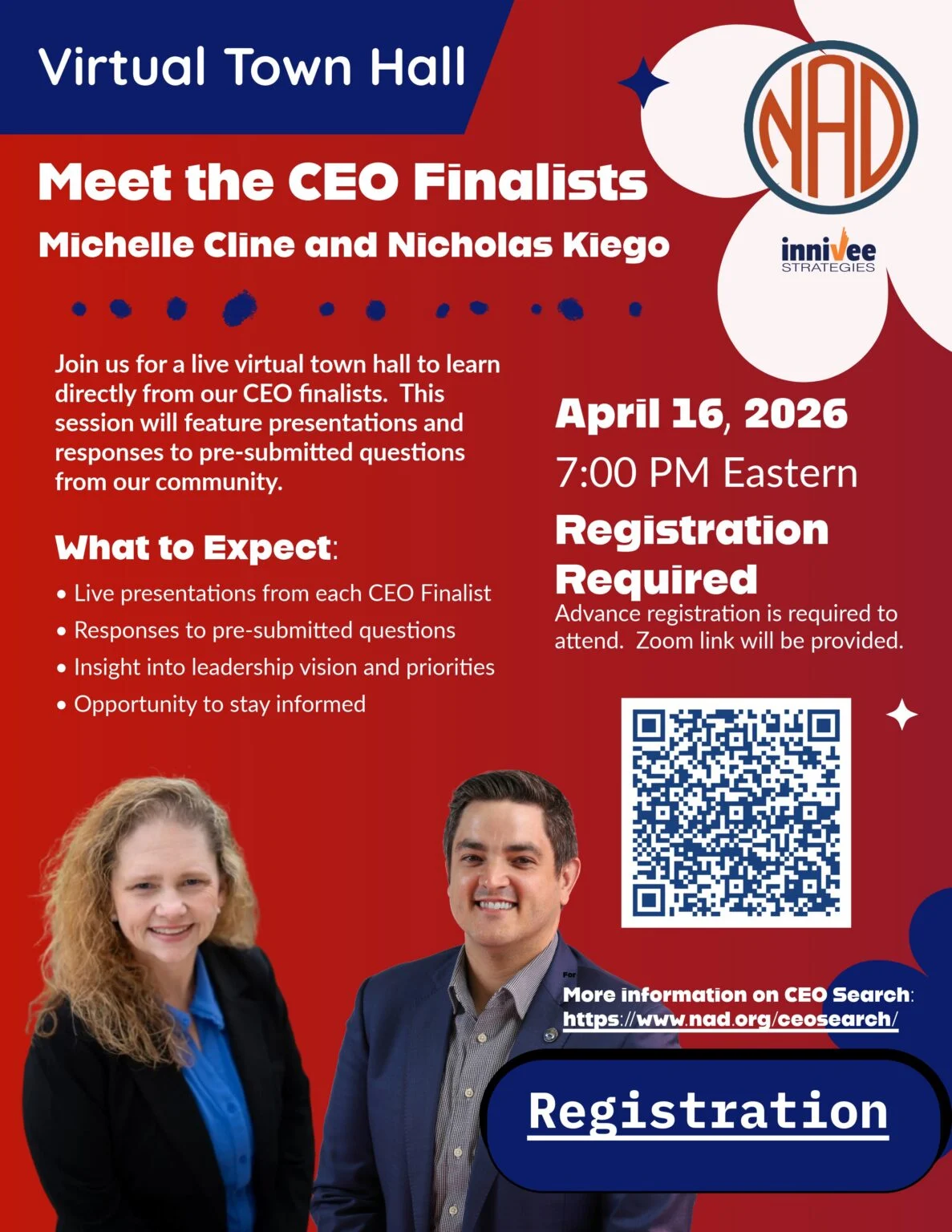
- April 10, 2026: The NAD Board announces the two finalists, Michelle Cline and Nicholas Kegio, and schedules a virtual town hall for community input.
- April 16, 2026: The virtual town hall takes place, featuring presentations from the candidates and a Q&A session addressing pre-submitted inquiries from members.
Profiles of the Finalists
The two candidates, Michelle Cline and Nicholas Kegio, represent distinct professional backgrounds that offer different potential paths for the organization.
Michelle Cline brings a wealth of experience in non-profit management and advocacy, with a track record of implementing systemic policy changes. Supporters have highlighted her ability to manage complex organizational budgets while simultaneously scaling grassroots initiatives. Her vision, as presented during the selection process, centers on strengthening the financial health of the NAD while ensuring that the organization’s advocacy reaches historically marginalized sectors of the deaf community.
Nicholas Kegio offers a profile characterized by deep integration within the community and a history of high-level project management. Kegio’s expertise in navigating the complexities of public policy and his background in educational and civil rights advocacy have made him a formidable candidate. His stated priorities focus on technological integration within the advocacy space, particularly in how the NAD utilizes digital platforms to engage with younger generations of deaf and hard-of-hearing citizens.
The Role of Community Engagement
The April 16 virtual town hall served as more than just a formal introduction; it acted as a litmus test for the candidates’ ability to connect with the organization’s base. By soliciting pre-submitted questions, the Board ensured that the discourse remained focused on high-priority issues such as the American with Disabilities Act (ADA) compliance, educational equity, and the sustainability of advocacy programming.
During the session, the candidates addressed the necessity of balancing tradition with modernization. The feedback from the community—which is being processed by the Board as part of the final decision-making criteria—reflects a broad interest in how the new CEO will manage the organization’s internal culture. The NAD has historically operated as a member-driven entity, and the inclusion of this town hall format signals a commitment to maintaining that grassroots legitimacy during a time of top-level administrative change.
Analysis of Implications for the NAD
The selection of a new CEO carries significant weight for the broader disability advocacy movement. The NAD is frequently at the forefront of litigation that establishes legal precedents for all people with disabilities. Therefore, the strategic direction of the new CEO will influence federal litigation strategies and national public policy for years to come.
Analysts note that the incoming leader must be prepared to tackle several urgent challenges:
- Digital Accessibility: Ensuring that the rapid expansion of AI and automated communication tools does not leave the deaf community behind.
- Educational Disparities: Addressing the ongoing struggles regarding language acquisition for deaf children and the quality of special education services.
- Financial Diversification: Expanding the organization’s funding base to reduce reliance on traditional donor channels and ensure long-term solvency.
The Board’s insistence on a transparent, public-facing search process is an attempt to mitigate potential friction during the transition. By allowing members to hear directly from the finalists, the NAD aims to ensure that the eventual appointment is viewed as a democratic mandate rather than an internal, opaque corporate hire.
Official Stance and Next Steps
The Board of Directors has maintained a posture of careful deliberation throughout this period. In their official communications, they have emphasized that the criteria for selection are not limited to professional pedigree but extend to an "alignment of values" with the NAD’s mission. The Board is expected to finalize their decision following the comprehensive review of the community feedback gathered during the town hall.
For members and stakeholders, the period following the announcement remains one of anticipation. The NAD has provided ongoing updates via their dedicated search portal, which serves as a repository for documentation, candidate bios, and meeting summaries. This commitment to information-sharing is designed to prevent misinformation and keep the membership informed about the trajectory of the organization.
As the Board moves toward the final selection, the broader deaf community continues to observe the proceedings with high expectations. The appointment will mark the end of a transitional phase and the beginning of a new chapter in the association’s 146-year history. Whether the Board selects a candidate with a primary focus on internal administrative reform or one with a mandate for aggressive external advocacy remains to be seen, but the process itself has underscored the vitality and active participation of the NAD’s membership.
Looking Ahead
As the organization moves toward the formal announcement of the new CEO, the focus will likely shift from the mechanics of the search to the implementation of the new leader’s strategic vision. The challenges ahead are substantial, yet the NAD’s commitment to an inclusive selection process suggests a desire for unity and a unified front in the face of future advocacy battles.
The successful candidate will be stepping into a role that demands the agility of a lobbyist, the wisdom of an educator, and the administrative discipline of a corporate executive. The community’s active participation in the April 2026 town hall has provided the Board with the necessary pulse of the organization, ensuring that the final selection is not merely a bureaucratic task but a reflection of the collective will of those the NAD represents. As the organization stands on the precipice of this leadership transition, the focus remains on ensuring that the legacy of the NAD is carried forward by an individual capable of navigating the complex, rapidly evolving landscape of modern civil rights advocacy.