

Airway foreign body aspiration in pediatric patients remains a significant clinical concern, demanding swift and effective intervention. While organic materials constitute the majority of such incidents, the aspiration of magnetic objects, particularly multiple small magnets, presents a unique and potentially severe threat due to their adhesive properties and the risk of internal damage. This challenge is amplified when these foreign bodies lodge in distal airways, such as the tertiary bronchi, beyond the reach of conventional retrieval tools. In response to the escalating incidence of pediatric magnetic foreign body ingestions and aspirations, a recent medical report details a novel and successful approach utilizing a flexible, ferromagnetic grasping instrument for the retrieval of a magnet lodged in a distal tertiary bronchus of an older pediatric patient. This case highlights an innovative solution to a growing problem, underscoring the importance of adapting medical technology to emerging pediatric health risks.
The Growing Threat of Magnetic Foreign Bodies in Children
The proliferation of magnetic toys, jewelry, and even educational materials has unfortunately led to a parallel rise in pediatric ingestions and aspirations of these small, powerful objects. According to data from the U.S. Consumer Product Safety Commission (CPSC), there has been a notable increase in emergency room visits related to swallowed magnets, with children under the age of six accounting for the majority of cases. These incidents can range from minor gastrointestinal issues to life-threatening complications, especially when multiple magnets are involved, as they can attract each other through intestinal walls, causing perforation, obstruction, and severe tissue damage. While ingestion is more common, aspiration into the airway presents a more immediate and acute danger, potentially leading to airway obstruction, pneumonia, and even respiratory failure. The unique magnetic properties of these objects complicate their removal, particularly when they migrate deep into the bronchial tree.
A Case of Distal Bronchial Intrusion
The case that prompted this innovative intervention involved a 13-year-old female who presented to the emergency department with a reported accidental inhalation of the backing from her magnetic nose ring. The patient reported experiencing chest discomfort but denied any difficulty breathing or stridor. Initial vital signs and oxygen saturation upon arrival were within normal limits, suggesting that at that precise moment, her airway was not critically compromised.
A standard chest X-ray, including both anteroposterior and lateral views, was performed. This imaging revealed a metallic foreign body measuring approximately 3mm by 4mm located in the right lower lobe of her lung. Crucially, on an expiratory film, the object was noted to be situated just 0.5cm from the diaphragm, indicating its deep penetration into the lung parenchyma. Given the precise location of the foreign body deep within the bronchial tree, a decision was made to proceed with operative intervention to prevent potential complications and ensure its safe removal.
The Chronology of Intervention
Following the diagnostic imaging, the patient was prepared for surgical intervention under general anesthesia. The procedure commenced with a direct laryngoscopy, a standard examination to visualize the upper airway and confirm the absence of any foreign body in the oropharynx or hypopharynx. This initial step confirmed that the aspirated object had indeed bypassed the upper airway structures.
The surgical team then proceeded with a rigid bronchoscopy, a procedure that involves inserting a hollow metal tube into the trachea and bronchi to visualize the airways directly and facilitate the removal of foreign objects. A 6.0 rigid bronchoscope was carefully introduced and advanced. The bronchoscope was navigated through the trachea and into the segmental bronchi on both sides.
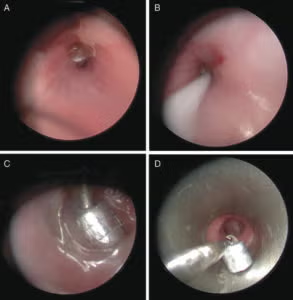
Upon reaching the right lung, the metallic foreign body was visualized. It was lodged in a distal tertiary bronchus, a small airway branching off from the segmental bronchi. This location presented a significant challenge, as it was beyond the effective reach of traditional optical instruments typically employed during rigid bronchoscopy. Standard endoscopic graspers, designed for grasping larger objects in more accessible locations, proved ineffective due to the foreign body’s deep and narrow placement.
The medical team then attempted alternative retrieval methods. They tried to engage the foreign body using a salivary wire basket and a ureteral stone retrieval basket, both designed for capturing small objects. However, the size and configuration of the foreign body, combined with the confined space of the tertiary bronchus, rendered these attempts unsuccessful. A further attempt involved passing a 2 French Fogarty embolectomy catheter distally. This catheter, usually used to dislodge blood clots, was deemed too large to navigate past the foreign body within the narrow confines of the tertiary bronchus, highlighting the anatomical limitations of conventional tools.
A Novel Solution: Ferromagnetic Grasping
Facing the persistent challenge of retrieving the deeply embedded foreign body, the medical team explored other available instruments. Their inspection of pulmonary flexible bronchoscopy equipment led them to identify ferromagnetic flexible rat tooth biopsy forceps. These specialized forceps are designed to be atraumatic and are often used for delicate tissue sampling. The critical feature in this scenario was their ferromagnetic composition.

The ferromagnetic biopsy forceps were carefully advanced through the rigid bronchoscope and guided into the tertiary bronchus, aiming towards the magnetic foreign body. The inherent magnetic properties of the nose ring backing were then leveraged. The small but potent magnetic field generated by the foreign body was sufficient to attract and adhere to the ferromagnetic instrument. This magnetic attraction allowed the forceps to firmly grasp the foreign body.
With the foreign body securely adhered to the instrument, the entire assembly – the rigid bronchoscope with the attached forceps and the retrieved object – was carefully withdrawn from the airway. This maneuver successfully extracted the foreign body without causing further injury to the delicate bronchial tissues.
Examination and Recovery
Upon successful retrieval, the foreign body was identified as three small, interconnected magnetic nose ring backings. The successful engagement and removal of these multiple magnetic components in a single maneuver was a testament to the effectiveness of the ferromagnetic instrument.
Following the removal, a repeat bronchoscopy was performed to meticulously examine the airways. This thorough inspection confirmed the absence of any remaining foreign bodies and ensured that no significant airway injuries had occurred during the retrieval process. The patient tolerated the procedure well. Postoperatively, she recovered uneventfully and was discharged from the hospital without any complications, marking a successful resolution to a potentially perilous situation.
Implications and Future Directions
This case report, published in ENTtoday, offers a valuable insight into managing a growing pediatric health concern. The successful retrieval of multiple, small magnetic foreign bodies from a distal tertiary bronchus using ferromagnetic flexible biopsy forceps represents a significant advancement. It demonstrates the adaptability of existing medical instruments and the potential for innovative applications in challenging clinical scenarios.
The implications of this case extend beyond the immediate patient. As the incidence of magnetic foreign body aspirations continues to rise, medical professionals in otolaryngology, pulmonology, and emergency medicine need to be aware of these novel retrieval techniques. The availability and accessibility of ferromagnetic instruments, particularly those designed for flexible bronchoscopy, may become increasingly important in pediatric emergency departments and specialized centers.
Furthermore, this case underscores the importance of parental education and product safety. While the exact circumstances of the aspiration remain anecdotal, it highlights the inherent risks associated with small, powerful magnets, especially in households with young children. Public health campaigns and clearer product labeling regarding the dangers of magnetic foreign bodies could play a crucial role in preventing such incidents.
The authors of the report conclude that ferromagnetic flexible bronchoscopic instruments offer a safe and effective method for retrieving small magnetic foreign bodies from distal airways in older pediatric patients, a scenario that often proves intractable with traditional tools. This pioneering approach not only resolved an immediate medical crisis but also provides a blueprint for managing similar complex cases in the future, reinforcing the ongoing evolution of pediatric airway management.