

Airway foreign body aspiration, particularly in pediatric populations, remains a critical medical concern, often necessitating urgent intervention. While organic materials constitute the majority of inhaled foreign bodies, the increasing prevalence of magnetic objects, especially those comprising multiple small magnets, presents a unique and potentially severe morbidity. These magnetic foreign bodies can adhere to each other and to the airway lining, leading to significant tissue damage and complex removal challenges. This report details a compelling case of a 13-year-old female who successfully had a distal tertiary bronchi magnetic foreign body retrieved using a novel approach involving a flexible, ferromagnetic grasping instrument, highlighting an innovative solution to a growing pediatric health issue.
The Growing Threat of Pediatric Magnetic Ingestion
The advent of magnetic toys, jewelry, and even educational tools has unfortunately coincided with a concerning rise in incidents of children ingesting or aspirating these small, powerful magnets. Medical literature and public health advisories have increasingly warned about the dangers associated with these objects. Unlike inert foreign bodies, magnets can attract each other through the gastrointestinal tract or respiratory system. If multiple magnets are ingested or aspirated, they can create a "sandwich effect," pinching and potentially perforating intestinal walls or airway tissues. The force of attraction can be substantial, leading to necrosis, fistulas, and severe inflammatory responses.
According to data from the U.S. Consumer Product Safety Commission (CPSC), there has been a significant increase in emergency room visits related to magnet ingestions over the past decade. While precise figures for aspirational incidents are less readily available, the underlying physics and potential for harm are equally, if not more, immediate when the airway is involved. The case of this adolescent patient underscores the fact that these risks are not confined to younger children, with older pediatric patients also susceptible.
A Case of Accidental Aspiration: The Initial Presentation
The incident unfolded when a 13-year-old female presented to the emergency department reporting the accidental inhalation of the backing of her magnetic nose ring. She described experiencing chest discomfort but denied any overt difficulty or noisy breathing. Upon initial assessment, her vital signs were within normal limits, and her oxygen saturation was stable, indicating no immediate signs of severe respiratory compromise.
A standard chest X-ray, including both lateral and anteroposterior views, was performed. The imaging revealed a small metallic foreign body, measuring approximately 3mm by 4mm, located in the right lower lobe of her lung. Crucially, a film taken during exhalation showed the foreign body to be situated just 0.5cm from the diaphragm. This precise localization was a critical factor in the medical team’s decision-making process. Given the foreign body’s position within the delicate tertiary bronchi, far down in the lung’s lower lobe, operative intervention was deemed necessary to prevent potential complications and ensure its safe removal.
The Challenge of Distal Retrieval: A Surgical Chronicle
Following the decision for surgical intervention, the patient was taken for a procedure under general anesthesia. A thorough direct laryngoscopy was conducted to rule out any foreign bodies lodged in the upper airway, such as the oropharynx or hypopharynx. Fortunately, no such obstructions were found.
The surgical team then proceeded with a rigid bronchoscopy, a procedure that involves inserting a rigid tube with a light and camera into the airway. A 6.0 rigid bronchoscope was carefully introduced into the trachea and advanced progressively. The bronchoscope navigated through the distal trachea and into the segmental bronchi on both the left and right sides.
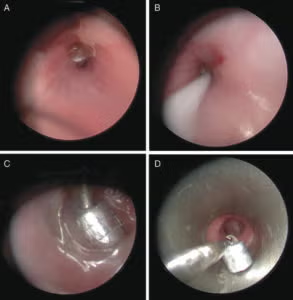
It was on the right side, within the distal tertiary bronchus, that the small metallic foreign body was visualized. The challenge immediately became apparent: the foreign body’s distal location rendered it beyond the reach of traditional optical instruments and standard endoscopic graspers. These instruments, designed for more accessible obstructions, were insufficient for this precise and delicate maneuver.
The medical team explored alternative methods. Attempts were made to use a salivary wire basket and a ureteral stone retrieval basket, tools often employed for dislodging or capturing foreign objects. However, these too proved unsuccessful, unable to effectively engage the small, firmly lodged foreign body. Further efforts involved attempting to pass a 2 French Fogarty embolectomy catheter, a flexible balloon catheter used for clearing blood clots. This attempt failed because the catheter’s diameter, even at its smallest, was too large to navigate past the foreign body and into the tertiary bronchus. The obstruction prevented its passage, highlighting the limitations of conventional retrieval techniques in such a confined space.

Innovation in the Bronchus: The Ferromagnetic Solution
Faced with these persistent challenges, the surgical team turned to innovation. A careful inspection of available flexible bronchoscopy instruments revealed a promising tool: ferromagnetic flexible rat tooth biopsy forceps. These instruments are designed to grasp tissue and are made of materials susceptible to magnetic fields.
The strategy involved advancing these specialized forceps through the rigid bronchoscope and into the distal tertiary bronchus, positioning them near the magnetic foreign body. The inherent magnetic field of the nose ring backing was then leveraged. The small magnets within the foreign body exerted an attractive force on the ferromagnetic forceps, causing them to adhere to each other. This magnetic attraction provided the necessary grip.
With the forceps securely attached to the foreign body, they were carefully withdrawn through the rigid bronchoscope. This maneuver successfully extracted the foreign body from the delicate airway. Upon further examination, it was revealed that the aspirated object consisted of three small, interconnected magnetic nose ring backings.
Following the successful retrieval, a repeat bronchoscopy was performed to ensure no residual foreign bodies remained and to assess for any injuries to the airway. The examination confirmed a clean airway and no signs of trauma. The patient recovered uneventfully from the procedure and was discharged from the hospital postoperatively without any complications.
Analysis of Implications and Broader Impact
This case report offers significant insights into the evolving landscape of pediatric foreign body aspiration. The increasing popularity of magnetic jewelry and toys, particularly among adolescents, necessitates heightened awareness among parents, educators, and healthcare providers regarding the potential risks.
Key implications of this case include:
- The limitations of traditional methods: The failure of standard retrieval tools underscores the need for a broader armamentarium of specialized instruments for managing complex airway foreign bodies, especially those with unique properties like magnetism.
- The power of innovation: The successful deployment of ferromagnetic biopsy forceps demonstrates how adapting existing technologies and instruments can provide elegant solutions to previously intractable problems. This highlights the importance of clinician ingenuity and resourcefulness in challenging medical scenarios.
- The need for targeted prevention: While this case highlights a successful retrieval, it also serves as a stark reminder of the importance of preventative measures. Clearer labeling of magnetic products, public awareness campaigns about the dangers of magnet ingestion and aspiration, and age-appropriate toy design are crucial.
- The role of advanced imaging: The use of expiratory films in chest X-rays proved valuable in pinpointing the foreign body’s exact location and its proximity to the diaphragm, aiding in surgical planning.
The medical team’s proactive approach in identifying and utilizing a less conventional instrument underscores a growing trend in interventional pulmonology and pediatric otolaryngology: the application of specialized tools for complex cases. The "Lord of the Rings" moniker, playfully suggested by the original publication, aptly captures the challenging yet ultimately triumphant retrieval of this magnetic intruder from the bronchi.
Future Directions and Recommendations
This unique case prompts consideration for several future directions:
- Development of dedicated magnetic foreign body retrieval tools: While ferromagnetic forceps proved effective, the development of instruments specifically designed for magnetic foreign bodies, perhaps with adjustable magnetic strength or specialized grasping mechanisms, could further enhance safety and efficacy.
- Enhanced training and simulation: Training programs for pediatricians and emergency medicine physicians should incorporate scenarios involving magnetic foreign bodies, including simulations of retrieval techniques that go beyond conventional methods.
- Data collection and registry: Establishing a registry for pediatric foreign body aspirations, with specific data points on the type of foreign body (including material and number of components for magnets), location, and retrieval method, would provide valuable epidemiological data and inform clinical guidelines.
- Collaboration between manufacturers and medical professionals: Closer collaboration between manufacturers of magnetic products and medical experts could lead to the design of inherently safer products and the development of effective countermeasures or emergency response protocols.
The successful management of this 13-year-old patient underscores the critical importance of a multidisciplinary approach, embracing technological advancements, and maintaining a high index of suspicion for less common but potentially dangerous foreign body aspirations. As magnetic products continue to permeate our daily lives, medical professionals must remain vigilant and innovative in their efforts to protect the youngest and most vulnerable members of society from their potential hazards. The case serves as a beacon of successful intervention, demonstrating that even the most challenging distal airway obstructions can be overcome with ingenuity and the right tools.