

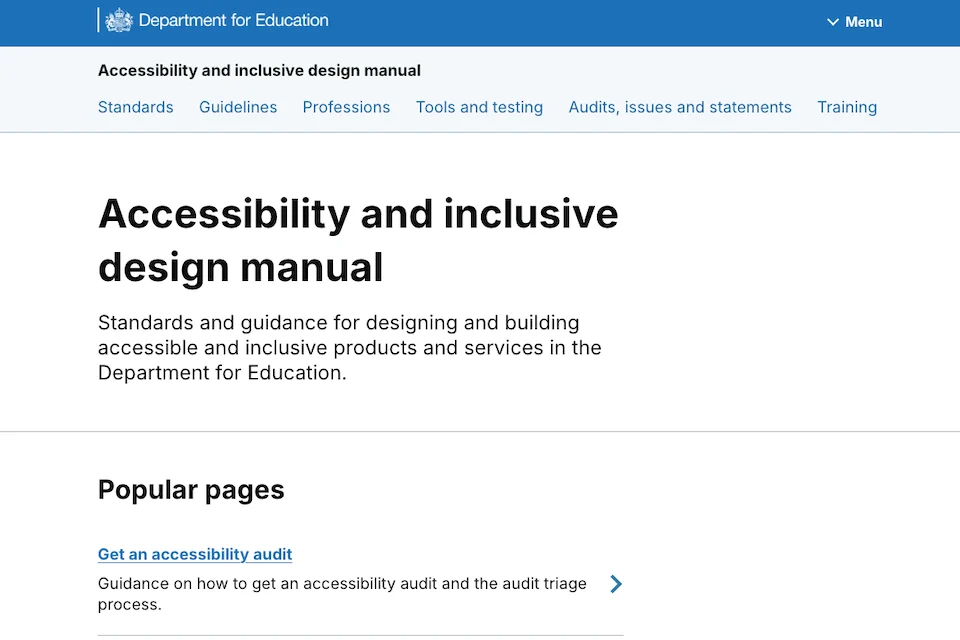
The Department for Education (DfE) has officially released a comprehensive update to its Accessibility and Inclusive Design Manual, marking a significant milestone in the UK government’s ongoing commitment to digital inclusivity. Launched on July 21, 2025, the revised manual represents the culmination of nearly a year of iterative development, user testing, and strategic restructuring aimed at streamlining how public sector professionals build and maintain accessible digital services. While originally developed for internal DfE teams, the manual remains an open-resource platform, providing a blueprint for designers, developers, and product managers across the global digital landscape.
The initiative follows the initial publication of the manual in September 2024. While early adoption rates were high and feedback was generally positive, internal data and user analytics suggested that certain sections of the repository were difficult to navigate. To address these friction points, the DfE’s digital team embarked on a rigorous research phase, engaging directly with professionals in design, product management, and delivery roles to identify barriers to efficiency and comprehension.
The Evolution of Digital Accessibility Standards in the UK
The DfE’s focus on inclusive design is situated within a broader legal and ethical framework established by the UK government over the last decade. Under the Public Sector Bodies (Websites and Mobile Applications) (No. 2) Accessibility Regulations 2018, all public sector digital services are legally required to meet the Web Content Accessibility Guidelines (WCAG) 2.2 at the AA standard. These regulations ensure that services are perceivable, operable, understandable, and robust for all users, including those with visual, auditory, motor, or cognitive impairments.
Within the Department for Education, the stakes for accessibility are particularly high. The department oversees a vast digital ecosystem that serves students, parents, teachers, and educational administrators. Statistics from the Department for Work and Pensions (DWP) indicate that approximately 24% of the UK population reports having a disability, a figure that includes a significant portion of the student body and the educational workforce. Furthermore, data from the 2023/24 academic year shows that over 1.6 million pupils in England have special educational needs (SEN). For these individuals, the accessibility of DfE digital platforms is not merely a convenience but a fundamental requirement for accessing education and support services.
Chronology of the Manual’s Development
The development of the DfE Accessibility and Inclusive Design Manual followed a structured timeline characterized by evidence-based refinements:
- September 2024: The initial version of the DfE Accessibility and Inclusive Design Manual is launched. It serves as a centralized repository for accessibility standards, tools, and best practices.
- Late 2024 – Early 2025: The DfE Digital team monitors usage data and gathers qualitative feedback. While the "Knowledge Hub" is noted for its high-quality content, users report difficulty in locating specific information quickly.
- Spring 2025: A dedicated research phase begins. The team focuses on three primary objectives: understanding how users search for information, evaluating the effectiveness of the existing navigation, and identifying gaps in the "Tools" guidance.
- May – June 2025: Content designers and UX researchers reorganize the manual’s information architecture. The "Knowledge Hub" is decommissioned in favor of a journey-based structure.
- July 21, 2025: The updated manual is officially deployed, featuring a simplified homepage and enhanced guidance on accessibility testing tools.
Strategic Restructuring: Moving Beyond the Knowledge Hub
One of the most significant changes in the 2025 update was the removal of the "Knowledge Hub" section. During the research phase, users described this section as a "dumping ground" for information. Although the content was perceived as valuable, its organization did not align with the practical workflows of digital teams. Designers and developers often found themselves overwhelmed by a high volume of unsorted articles, which hindered their ability to find specific solutions during active project phases.
In response, the DfE transitioned to a "user journey" model of information architecture. Content was redistributed into thematic sections that mirror the lifecycle of a digital product. For example, information regarding specific design patterns was moved to sections dedicated to the design phase, while technical documentation for screen reader compatibility was integrated into the development and testing guidance. This change ensures that information is surfaced at the exact moment a user requires it, reducing cognitive load and increasing the manual’s utility as a real-time reference tool.
Reimagining Tools Guidance for Human Needs
The 2025 update also addressed a critical gap in the manual’s guidance on accessibility tools. In the 2024 version, the tools section functioned primarily as a directory—a list of software and browser extensions with instructions on how to install them. However, user research revealed that professionals were less concerned with installation and more concerned with application.
Research participants indicated they needed answers to specific operational questions:
- Which tool is most appropriate for a specific task (e.g., contrast checking vs. code linting)?
- When in the development cycle should a particular tool be used?
- What are the limitations of automated testing tools compared to manual testing?
To meet these needs, the DfE revamped the guidance to focus on the human element of testing. The new content clarifies the distinction between automated tools, which can typically identify only 30% to 40% of accessibility issues, and manual testing techniques involving assistive technologies like JAWS, NVDA, and VoiceOver. By providing context-sensitive recommendations, the manual empowers teams to select the right tool for the right stage of the project, ultimately leading to more robust and compliant digital services.
User Interface and Homepage Optimization
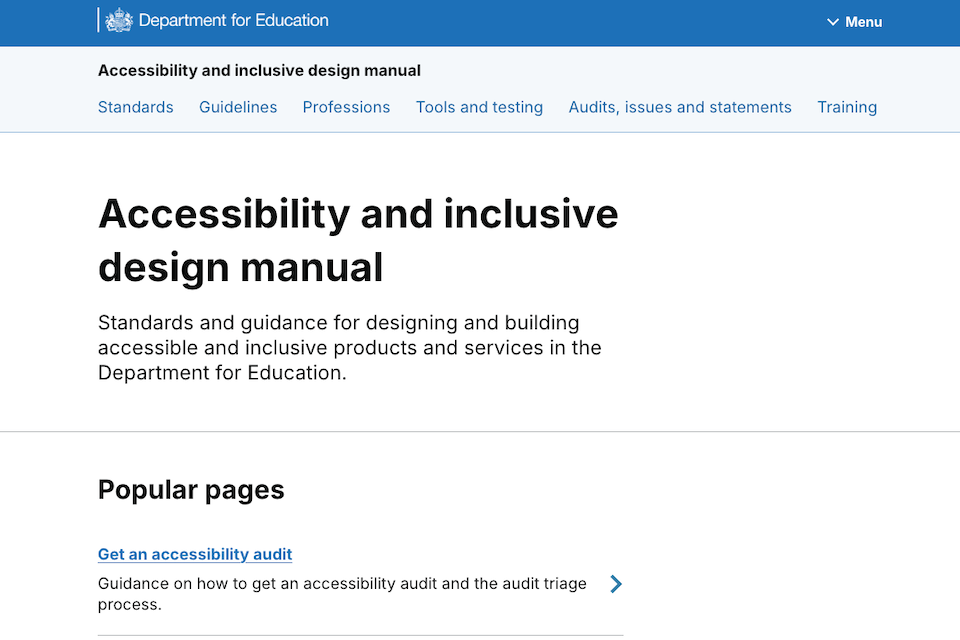
The visual and structural overhaul of the manual’s homepage was driven by the principle of "less is more." The original homepage featured an array of icons, decorative images, and a long-scroll format that users found distracting. Furthermore, the top navigation bar was criticized for being ambiguous, often leading users to dead ends or irrelevant pages.
The July 2025 update introduced several UI improvements:
- Reduced Visual Noise: Icons and non-essential images were removed to allow users to focus on text-based navigation and search functionality.
- Streamlined Navigation: The top navigation menu was simplified to highlight the most frequently accessed sections, such as "Design," "Development," and "Testing."
- Optimized Searchability: By improving metadata and header structures, the team ensured that the manual’s internal search engine delivers more accurate results.
These changes align with the Government Digital Service (GDS) design principles, which emphasize the importance of making services so simple that users can succeed at the first attempt.
Supporting Data and Technical Implications
The DfE’s commitment to data-driven design is evident in the manual’s emphasis on measurable accessibility. Recent audits of public sector websites have shown that the most common accessibility failures involve low color contrast, missing alternative text for images, and poor keyboard navigation. By providing specific, actionable guidance on these issues, the DfE manual aims to lower the failure rate of digital audits across the department.
Industry data suggests that inclusive design is also a cost-saving measure. According to studies by the Design Council, every £1 spent on design can return up to £20 in increased revenue or reduced operational costs. In the context of the public sector, inclusive design reduces the need for "alternative formats" and manual interventions, as users are able to complete journeys independently through digital channels. By making the manual easier to use, the DfE is effectively lowering the barrier to entry for inclusive design, ensuring that accessibility is "baked in" rather than "bolted on."
Official Responses and Broader Impact
While official statements from the DfE emphasize the internal benefits of the manual, the broader digital community has welcomed the update as a vital contribution to the "Open Government" movement. Accessibility advocates note that by publishing their internal standards, the DfE provides a high-quality resource for smaller organizations and local authorities that may lack the budget for extensive accessibility research.
"The update to the DfE Accessibility and Inclusive Design Manual reflects a maturing understanding of digital inclusion," noted one senior accessibility consultant familiar with the project. "It moves the conversation from ‘what is accessibility’ to ‘how do we practically implement it within a fast-paced delivery environment.’ The shift toward a user-journey-based architecture is a model that other departments should look to emulate."
The impact of the manual extends beyond the UK. As global digital standards converge around WCAG, resources like the DfE manual serve as international benchmarks. The manual’s emphasis on inclusive design—designing for the widest possible audience rather than just those with permanent disabilities—aligns with modern UX trends that recognize how situational and temporary impairments (such as using a screen in bright sunlight or browsing with a broken arm) affect all users.
Conclusion and Future Outlook
The July 21, 2025, update to the DfE Accessibility and Inclusive Design Manual is not a final destination but a part of a continuous cycle of improvement. The DfE Digital team has indicated that they will continue to monitor user feedback and update the manual as new technologies and accessibility standards emerge.
As the Department for Education continues to modernize its digital infrastructure—including the use of artificial intelligence and machine learning in educational tools—the manual will play a crucial role in ensuring these innovations do not leave anyone behind. By prioritizing clarity, usability, and human-centric guidance, the DfE is setting a high standard for how government departments can foster an inclusive digital future. The manual stands as a testament to the idea that in the digital age, accessibility is a fundamental right, and inclusive design is simply good design.